
You are currently browsing the monthly archive for December 2011.
The things she knew, let her forget again —
The voices in the sky, the fear, the cold,
The gaping shepherds, and the queer old men
Piling their clumsy gifts of foreign gold.
Let her have laughter with her little one;
Teach her the needless, tuneless songs to sing;
Grant her her right to whisper to her son
The foolish names one dare not call a king.
Keep from her dreams the rumble of a crowd,
The smell of rough-cut wood, the trail of red,
The thick and chilly whiteness of the shroud
That wraps the strange new body of the dead.
Ah, let her go, kind Lord, where mothers go
And boast his pretty words and ways, and plan
The proud and happy years that they shall know
Together, when her son is grown a man.
–Dorothy Parker, 1928
Twitter has been blowing up today with reports that a Washington DC teen named Tyreek Amir Jacobs was killed in last night’s shopping frenzy over Nike’s new Air Jordan Concords. But as the Baltimore Sun has reported, no such murder is known to capital region police — and the image of “Jacobs” that’s been circulating is a stock photo. (Google searches on his name with keywords relating to this hoax don’t produce any hits either.)
Some tweets are now taking the story a step further, claiming multiple murders over the shoes, but those claims don’t seem to have any truth to them either. The Washington Post reports a police pepper-spray incident in Seattle in connection with the shoes’ launch, and arrests after scuffles in Michigan and Georgia, but that’s it.
I recently read A Rap on Race, the book-length transcript of a conversation between James Baldwin and Margaret Mead, recorded in
the summer of 1970. As I said two weeks ago, it’s a fascinating book, and I’m going to be posting excerpts each Wednesday for the next while. I put up the first last week — here’s the second, somewhat condensed from the original:
MEAD: This was, I suppose, twenty-five years ago. I was speaking in those days about three things we had to do: appreciate cultural differences, respect political and religious differences, and ignore race. Absolutely ignore race.
BALDWIN: Ignore race. That certainly seemed perfectly sound and true.
MEAD: Yes, but it isn’t anymore. You see, it really isn’t true. This was wrong, because —
BALDWIN: Because race cannot be ignored.
MEAD: Skin color can’t be ignored. It is real.
BALDWIN: It was a great revelation for me when I found myself finally in France among all kinds of very different people — I mean, at least different from anybody I had met in America. And I realized one day that somebody asked me about a friend of mine who, in fact, when I thought about it, is probably North African, but I really did not remember whether he was white or black. It simply had never occurred to me.
Three things jump out at me about this passage.
First, there’s the obvious fact that Baldwin and Mead, speaking forty years ago, regard the idea of racial “colorblindness” as a quaint relic of Jim Crow-era liberalism. It was something that seemed to make sense back in the fifties, they agree, but not anymore. Not in 1970. The fact that we’re still, as a culture, debating this in 2011 is striking.
There’s also Mead’s troubling use of the phrase “skin color” as a synonym for “race.” I know it’s a traditional synecdoche, but it’s weird and unfortunate in this context, because although race is real, it’s not “real” in the sense that skin color is.
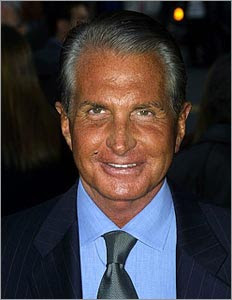
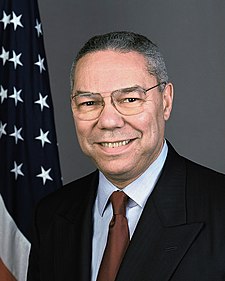
Skin color doesn’t determine race — George Hamilton is darker than Colin Powell, after all. What makes race “real” isn’t its physicality, because race is a cultural, rather than a biological, fact. As I noted last week, the one-drop rule was created for social and economic reasons. Genetics didn’t, and don’t, enter into it.
Skin color, in other words, can be ignored. We ignore it all the time. I had to Google photos of George Hamilton and Colin Powell to make sure I was right about who was darker — I don’t carry that information around in my head. But I do carry around the knowledge that Hamilton is white and Powell is black. And it’s that knowledge which can’t be suppressed or wished away.
Which brings us to Baldwin’s comment about his own race-blindness in Paris. Earlier in the book, Mead had paraphrased his insight that “there are no ‘Negroes’ outside of America,” and it seems that this is what’s operating here. The racial categories carries with him are American racial categories, and French racial structures, differing as they do from the American, don’t resonate for him in the same way. And so although it may seem like a contradiction for Baldwin to say in one breath that “race cannot be ignored” and in the next that it had “never occurred to” him whether a friend was French or French North African, it’s actually completely consistent.
Skin color can be ignored. Race cannot.
Looking for evidence of young voters’ dissatisfaction with Obama? Look no further than MTV.
For decades the network’s election coverage has been titled “Choose or Lose.” Launched at the time of Bill Clinton’s 1992 run, the slogan reflected youth excitement around that candidacy, and encouraged the sense that young people had a personal stake in the outcome of the race.
MTV stuck with the slogan for five election cycles — through Gore and Kerry and their lackluster campaigns. It resonated particularly strongly in 2008, when a young, charismatic Barack Obama succeeded in building youth loyalty like no candidate since Bobby Kennedy in 1968.
But now it’s done. MTV is finished with “Choose or Lose,” and will introduce a new slogan for its election programming in 2012.
Here’s why, according to the New York Times: “While young people turned out in unusually high numbers to support Barack Obama in 2008, MTV’s research into ‘Choose or Lose’ found that many felt they had lost anyway.”
Youth voters haven’t abandoned Obama, not by a long shot. His approval ratings with young people are still consistently higher than any other age group, and a recent poll found them supporting the president over Mitt Romney by 26 points. But the enthusiasm of 2008 has been muted, and disappointment with Obama’s presidency is the primary cause.
When asked which president in their lifetime had “done the best job,” voters under 30 choose Democrats over Republicans by a 62-19 margin. But Bill Clinton is the choice of nearly half, with Obama getting the nod from just 14%. In fact, a higher percentage of young people now rank Bill Clinton as the greatest president of their lifetime than voted for him in 1992.
Obama has disappointed young voters again and again. Where the percentage of Americans who say they care strongly who is elected president next year has remained essentially stable since the last cycle, among young voters it’s dropped from 81% to 69%. And though, as noted above, Obama still retains relatively high approval ratings among young voters, his “very strongly approve” numbers among youth now match national averages exactly.
In the electorate as a whole, the percentage of voters saying they’re angry with Obama has risen by 21 points since the election. Among young voters, it’s risen by just 10 points. But where more than 80% of youth said Obama feel hopeful and proud in 2008, today fewer than half do, a far steeper decline than among other voters.
President Obama is going to sweep the youth vote in 2012, and that strength is going to be essential to his re-election victory if he wins. The values of the Republican establishment are simply alien to most young people, and that divergence is a serious and growing problem for the GOP.
But while young voters are still looking for dramatic change in how the country operates, their belief that an Obama presidency could be the vehicle for such change has evaporated. They’ll vote for him again, but they’re looking elsewhere for solutions.
I recently read A Rap on Race, the book-length transcript of a conversation between James Baldwin and Margaret Mead, recorded in
the summer of 1970. As I noted last week it’s a fascinating book, and I’m going to be posting excerpts every Wednesday for the next while.
Here’s the first, from the third page of the book:
MEAD: I recall a boy whose father married again, married a woman who had a son about the same age. They weren’t related, of course, they were stepbrothers. And then that father and mother, the father of the first boy and the mother of the second, had a child. And the first boy said, “Now I feel differently about it. We have a brother in common.”
BALDWIN: Ah, that makes a great deal of difference.
MEAD: You see, this is true in a sense. Because as far as I know — and this is all any white person in the United States can ever say — as far as I know, I haven’t any black ancestry. But you’ve got some white ancestry.
BALDWIN: Yes, yes.
MEAD: So we’ve got a brother in common.
BALDWIN: So we’ve got a brother in common. But isn’t the tragedy partly related to the fact that most white people deny their brother?
One of the crucial ideas that I try to get across to my students, when we’re talking about how race was constructed in the United States, is that it was designed to be a one-way valve. Whoever you were, whatever your race, you could produce black kids by having them with a black partner, but if you were black you couldn’t produce white kids by having them with a white partner. Race flowed in the direction of blackness, never the other way.
And this was, of course, a matter of politics and economics, not of biology or genetics. If the child of a white slaveholder and his black slave was white, that child would be free, and have a claim on the slaveholder’s estate — an estate which would include that child’s own mother. For this and a hundred other reasons, American racism could not operate in the absence of the one-drop rule and its many variants, and so that rule had to be invented.
Racism depends on white people denying their brothers (and their sisters). So much of American history flows directly from that fact.

 studentactivism.net
Recent Comments