
You are currently browsing the monthly archive for November 2011.
Ten days ago a group of students from campuses across New York City occupied a suite of rooms at the New School at 90 Fifth Avenue. They set up a blog, released a statement, and settled in to work.
The space the group was occupying, however, wasn’t owned by the New School itself but was leased (or rather borrowed, as it was “leased” rent-free), and before too long the owners started making noises about evicting the occupation. Fire Marshals were called. The New School offered to relocate the group to the Kellen gallery, another NS space a few blocks away, with a commitment to let them stay until the fall semester ends in late December.
The occupation voted to accept the offer at a mass meeting on Tuesday night, but the vote wasn’t close to unanimous and some charged that non-occupiers had been sent in to tip the vote. As a result, one group moved to the new space, while another stayed at the old, and set up their own blog.
In the early morning hours of Friday, November 25, the group that stayed behind at 90 Fifth Avenue released a statement saying that they had received word of a planned police raid, and that they had “chosen to barricade all entrances to this space and will defend it by all means available to us.”
Then they left.
What exactly happened at that point isn’t completely clear, but New School officials say that the group abandoned the occupation during the night, and that some of the occupiers then vandalized the Kellen Gallery with messages that included “Spoiled New School Anarchists,” “Free Education,” “Pussies,” and “Cops Out Of CUNY.”
By morning, there were just five people left in Kellen, and the New School president asked them to leave so that the space could be cleaned and painted. They did.
The New School says that they hope to have both previously occupied spaces reopened by Monday morning. They intend to return the space at 90 Fifth Avenue to its previous use as a study area, and have not yet announced whether they plan to offer the Kellen Gallery to the occupation again.
Some links:
- The New School Free Press, which has been covering this story since the beginning. (Twitter here.)
- The original blog (and Twitter account) of the occupiers.
- An early critique of the political and interpersonal dynamics of the occupation.
- The blog of the group that stayed in 90 5th Avenue.
- Another blog that may or may not have been put together by the 90 Fifth group after they left.
- Messages to the New School community from its president, including several relating to the occupation.
- A New School student’s criticism of the Kellen vandalism.
Update | Here’s a Flickr photoset from a NS person. The first six shots are of preparations for the Kellen occupation, and the rest are of graffiti left behind by the 90 Fifth Avenue occupation.
Lili Loofbourow put up an amazing post yesterday about the way administrators in the University of California system have presented themselves in public statements about campus activism. It’s great and long and filled with important insights, and you should go read the whole thing. Here’s a taste, from somewhere in the middle:
Word choice seems trivial much of the time. “We” or “I,” “distress” or “regret.” But this use of “we” is not to be taken lightly. It is not a mistake to be cosmetically airbrushed out of the record. It is a persistent, unapologetic use of that pronoun “we” to drive home that he was in full control of what had gone on, and that he approved of it. It’s a rhetorical choice, the utter baselessness of which is revealed, in that second letter, through the admission that he had exactly none of the information he claimed to have carefully considered when making his first assessment of campus events.
This is a dead horse worth beating: the Chancellor of UC Berkeley unapologetically authorized the police action against faculty and students and unapologetically supported that decision, claiming both responsibility for the action and knowledge of the circumstances: he represents himself as part of the “we” that “encountered” a situation that forced police to use inexcusable violence.
You don’t get to walk away from that particular kind of mendacity, no matter how many letters you issue. Here’s why: it’s symptomatic of an institution whose checks and balances are sick, whose appeals processes are broken, and whose administrators appear to speak only in terms of what makes good or bad press.
It’s likely that the Chancellor wrote that letter, not maliciously, but carelessly. That does not make it better; it makes it worse. It reveals that this is a practice that isn’t limited to one Chancellor or to one day—it’s a pattern, a habit, a system.
Not long after that post went up, Loofbourow came across some more information about exactly how these statements are composed — a paper trail showing that a long, detailed statement about one 2009 UC Berkeley mass arrest was composed some twelve hours before those arrests took place. Berkeley’s chancellor even directed that a quote from him be added “expressing my admiration for the very professional way in which the police managed to apprehend and remove the illegal occupiers” — again, before those arrests took place. Check it out.
The chancellors of UC Davis and UC Berkeley have in recent days been forced to distance themselves from episodes of police violence that they embraced with warm enthusiasm (tempered by hand-clasping “sadness”) in their immediate aftermath. Now we know why.
Physical violence against, and improper arrest of, student activists in the University of California system has become so routinized that administrators write their defenses of those actions before they even occur.
At this week’s huge General Assembly on the UC Davis campus, students voted by a margin of 1720 to 3 to hold a general strike next Monday. That call has been taken up by student activists across the country, including the folks at Occupy Colleges.
It’s not clear yet how widespread next Monday’s actions will be. On the one hand, the strike has been called for the first day back from the Thanksgiving break, leaving organizers little time to plan and get the word out to students on campuses. On the other hand, last week’s pepper spray incident at Davis has galvanized American student activists like no other event in recent memory.
I’ll be tracking planning for the Monday strike over the weekend and reporting back what I find. I’ll also be covering events on Monday as they occur.
Stay tuned.
Saturday Update | More info here.
In the aftermath of last Friday’s pepper-spraying on the UC Davis campus, and the subsequent benching of two campus police officers and the chief of the UC Davis PD, Davis activists have set up a number of tents on the quad.
And one gigantic geodesic dome.
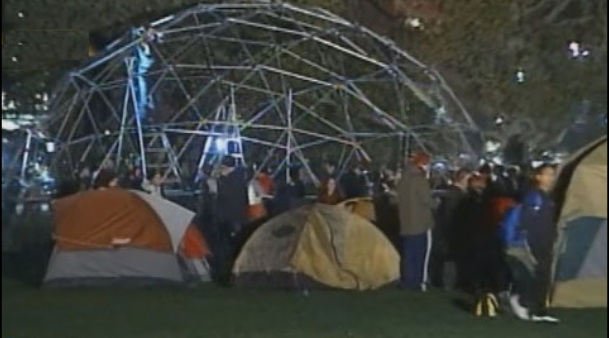
That’s a big dome.
The panel discussion I participated in yesterday at the Center for American Progress in Washington DC is now online. It was a good discussion, I think, and particularly timely given the events of the last week in California.
http://www.americanprogress.org/images/rd2/flash/flowplayer.commercial-3.0.5.swf
Along with myself, the panel included Tiffany Loftin, vice president of the United States Student Association, and PIRG campus organizer Dan Herb. Louis Soares of CAP and White House education policy advisor Zakiya Smith gave opening remarks, and the panel was moderated by CAP Policy Analyst Julie Morgan, lead author of a new report on student involvement in higher education governance.
C-SPAN broadcast the panel live, and they’ve got a copy of it up as well. (Not sure why they chose to title the event “Students Discuss Higher Education,” by the way. Though two of the three of us on the panel were young activists, none were actual students.)

 studentactivism.net
Recent Comments