
You are currently browsing the daily archive for December 14, 2009.
The Student Advocate’s Office, an independent office within the UC Berkeley student government, has prepared a blistering report on last Friday’s Wheeler Hall arrests, accusing the university of “egregious” misbehavior in its response to the Wheeler Hall occupation.
The report contends that the mass arrests at Wheeler Hall were planned from the start of the occupation, and that those plans were kept secret from the occupiers and the university community. It accuses the Berkeley administration of “misleading” the public, of negotiating in “bad faith” with the students at Wheeler, and of ignoring the “potentially dire consequences” of their actions.
I spoke on the phone with a representative of the SAO who confirmed the authenticity of the report, which was posted this afternoon at liveweek.net, the website of the Wheeler occupation. A short while ago I published a lengthy analysis of the report on the basis of that confirmation. A new note appended to the transcript at liveweek.net, however, now describes the report as a “leaked draft” and says that “the language in this document does not represent the views of the SAO.”
In light of this information I have pulled the long version of this post. I will repost with any necessary revisions when the final report becomes available.
Tuesday update: I’ve spoken with a second representative of the SAO, who confirms that the final report has not been completed. I’ll bring it to you as soon as it’s released.
Wednesday update: The report has been released, and I’ve posted a copy of it here. Full analysis soon.
Thursday update: Here are my thoughts on the implications of the SAO report.
This is a great story from so many perspectives…
Last Tuesday, Iranian state-affiliated Fars News Agency reported that student activist leader Majid Tavakoli, who had been arrested after speaking at a campus demonstration the previous day, had been wearing women’s clothing when taken into custody. Fars published photographs of Tavakoli in a light blue headscarf and black chador, saying he had put them on in an effort to avoid arrest.
 Movement figures condemned the story and photos immediately. They said that eyewitnesses agreed that Tavakoli had been dressed in his usual jacket and slacks when arrested, and charged that the government had forced him to put on women’s clothes in an effort to humiliate him. The photos themselves, which showed a sullen and heavily stubbled Tavakoli (left), seemed to support their account.
Here’s where the story gets really interesting.
Opponents of the regime assailed the photos as not just an attack on Tavakoli, not just an attempt to divide the movement, but also an insult to Iranian women. In light of this, one activist put out a call on Facebook:
“To prove that we are behind Majid Tavakoli, to prove that there is nothing wrong with female clothing and the only thing that’s wrong is the compulsory wearing of hijab whether it is forced on the women of this country or upon Majid Tavakoli, to show that we are all together, post your picture in hijab!”
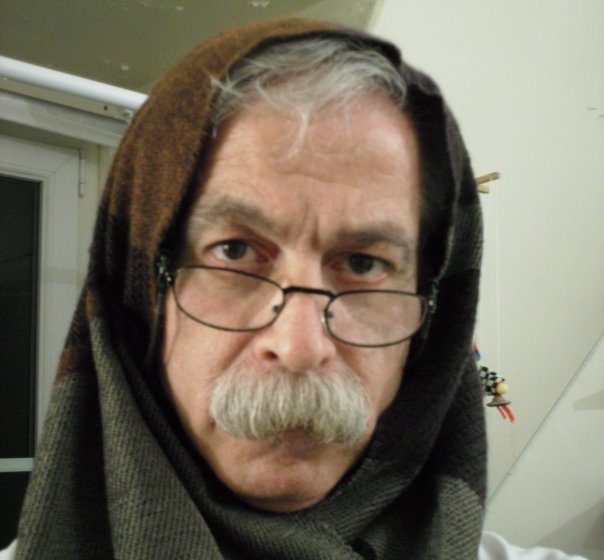 And they did.
Hundreds of Iranian men took up the challenge. The Free Majid Tavakoli event page on Facebook now has more than 500 photos in its album. There are funny photos, serious photos, touching photos — and not a few sexy photos — of men and boys (and some mustachioed women) wearing headscarves and/or the chador.
As one Iranian activist put it, “the story of Majid Tavakoli is the story of centuries of women’s oppression in Iran … of those who view women and all things associated with women in a humiliating manner.”
Today’s Iranian activists are rewriting that story in a thrilling way.
Update: Over on Twitter, @redjives pointed me toward this amazing piece, which situates the headscarf protest in the context of Iranian history, the history of revolution, and the history of gender and feminism. Seriously, go read it.
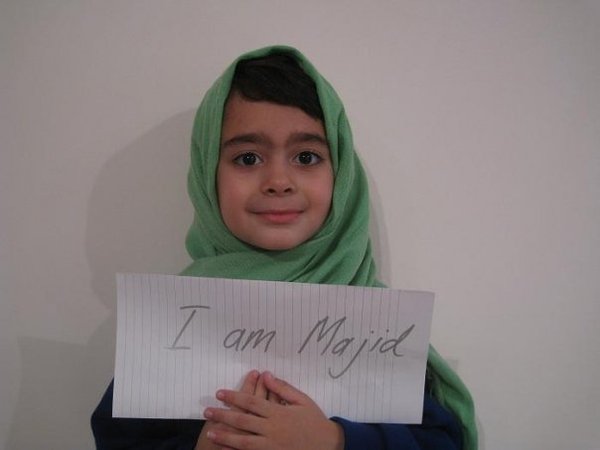 That piece also features this great photo and quote from Hamad Dabashi, a Columbia professor of Iranian Studies and Comparative Literature whom the post describes as holding “the oldest and most prestigious Chair in his field:”
“Proud to wear my late mother’s rusari, the very rusari that was forced on my wife in Iran, the very rusari for which my sisters are humiliated if they choose to wear it in Europe, and the very rusari that the backward banality that now rules Iran thinks will humiliate Majid Tavakoli if it is put on him — He is dearer and nobler to us today than he ever was.”
This semester has seen students at three large Texas universities publicly grapple with questions of lesbian, gay, bisexual, and transgender (LGBT) rights.
First the University of North Texas student government shot down a proposal to allow same-sex couples to run for the school’s homecoming court. The vote made headlines and sparked student protest at a subsequent student government meeting, prompting the student senate to put the question to a referendum vote. More than two thousand UNT students voted in favor of the change, but the referendum failed by a 58-42 margin in heavy turnout.
In early December, the student government at Southern Methodist University divided over a plan to add a special interest seat for “Sexual Orientation and Gender Equity” to its student senate. (The 47-member senate currently includes seats for African American, Latino, Asian, and international students.) A proposal to send that question to a referendum failed in a 19-19 vote of the senate, needing a three-quarters majority for passage. The question appears likely to go to a referendum anyway, as supporters have vowed to gather the 1100 signatures needed to authorize a vote without senate approval.
At about the same time, the UT Austin student government passed a resolution in support of extending partnership benefits to UT employees in same-sex relationships. The vote there was overwhelming — twenty-four in favor and one opposed, with one abstention. Supporters argued that the measure was not only a matter of decency but also of university competitiveness: “The University of Texas wants to be the best public university in the country,” one said, “but it’s working with one hand tied behind its back in terms of recruiting.”
None of these campaigns won concrete victories for LGBT rights. Two of the reform efforts came up short, and the question of partnership benefits for employees will be decided by UT’s regents, not its students. But the fact that supporters of equality have been able to build such substantial support on each of the three campuses indicates — like last week’s election of an openly lesbian mayor in Houston, Texas’s largest city — that some outsiders’ views of the Lone Star State may be in need of an update.

 studentactivism.net

Recent Comments