
You are currently browsing the category archive for the ‘Students’ category.
I don’t have a Substack and I haven’t figured out Mastodon and I haven’t yet quite been browbeaten into posting on TikTok, so for now if Twitter goes down here’s where I’ll be—where I’ll be posting anything I feel desperately compelled to post, where I’ll be giving updates on upcoming projects (including the one I impulsively tweeted about in a moment of near-death serenity last night), and where I’ll be letting folks know about my social media accounts as they evolve.
I’ll likely be dusting off this site a bit in the coming days, but for now you can just plug in your email below, and you’ll get an email notification when I post something new.
And if you want to let me know where you’re gonna be, leave a comment!
Join 509 other subscribers
I’ve let the blog go pretty much dormant, but I’ve been thinking I should at least start archiving my big Twitter threads here for future use. So here’s today’s.
Three weeks to election day. Let’s talk about volunteering.
Giving money is good and important, but the closer we get to election day, the less useful donating is, for a whole bunch of reasons. What campaigns need most in these final days is your time.
There’s lots of stuff you can do remotely if you’re not near a swing district—writing postcards, phonebanking, texting—and that stuff all helps. But if you can get out and knock on doors, that’s even better.
(Campaigns have different needs at different times, by the way. The best-best thing you can do is let them know you’re available for whatever they need. But even if you have restrictions on what you can do, they’ll likely find work for you. Hit ’em up.)
What I really want to talk about today, though, is door-knocking—what it’s for, how it works, what you can expect.
The first thing you may be worrying about is confrontation, but that’s actually really rare—by design. Campaigns don’t send you out to random houses. They’re going to be targeting specific people who they have reason to believe will be supportive.
When I went out this weekend, the list of voters we were trying to contact was all registered Democrats with a history of voting in midterm elections about half the time. We weren’t trying to convince them, we were trying to get them to turn out.
Most of the doors I knocked on, nobody was home. Most of the people I talked to were actively happy to see me. Nobody was hostile or angry or obnoxious. Not one person.
The best way to door-knock is with a partner, both for comfort and for safety. If you have someone to go with, that’s ideal, and if you don’t they can pair you up with someone as they’re sending you out. But really, the experience is overwhelmingly positive.
I’ve done door-knocking for nearly a dozen campaigns over the years at this point. I’ve talked to hundreds of people. A few were uninterested, a few were a little snotty. But I don’t remember a single really negative encounter.
(I did get chased by chickens on Saturday, and that was a little weird. But they just thought I had food. Sadly, I didn’t.)
Different campaigns use different screens when deciding which houses to send you to, but the voter data they’re using will be on the form they give you (along with name, gender, and age). If you’re worried about a specific scenario, ask.
So if you’re not trying to persuade people, what are you knocking on doors for? A few things.
First, you want to make sure people know about the election—when it is, where there polling place is, who’s running. This is a particularly big deal for down-ballot races, which are a huge deal that a lot of people don’t pay attention to.
When I was out this weekend, I’d volunteered for a congressional campaign, but the canvass turned out to be a joint one with a state senate candidate. I was giving out lit for both candidates, and making sure people knew about both races.
Another crucial thing you’ll be doing if you go out in the next couple of weeks is cleaning up the canvass lists. People move, or die, or whatever. Some houses are inaccessible. Some people don’t want to be contacted. You’ll note all that down.
And when you do that weeding, the campaign will update their data, which means that when they send people out to do Get Out The Vote work in the immediate run-up to election day, they’ll be able to work much more efficiently.
Every door you knock on this weekend and find out that someone moved is a door that someone else won’t be wasting time on later—and a different door that they will be able to knock on when the crunch happens. It’s hugely helpful.
Another thing you’ll be doing is helping out folks who may have issues. Someone may not have transportation to the polls, for instance, and if you let the campaign know that, they may be able to send someone out to drive them.
And yes, you may wind up talking about the specifics of the races, too. I had one contactee this weekend who was really pissed off about a local environmental issue. I took notes on that and added it to their entry on the list, to let the candidate know this was a concern.
Often, though, even in those cases, you’re just letting them know what’s up. And you won’t be on your own on that—the campaign will give you a script, and answers to likely questions, and you’ll have the lit as well. You’re not flying blind.
If you’re shy, they’ll likely be able to pair you with someone more outgoing. If you’re a newb, they’ll try to put you with someone experienced. And it doesn’t take long to get the hang of it. The typical interaction is very brief and not at all stressful.
So how does it work, exactly? Well, there’ll be a staging area where they’ll send you out from, and they’ll give you lists and maps and lit. You’ll have let them know in advance whether you have a car—sometimes you need it, sometimes not, sometimes you can ride share.
Something they had this weekend that I hadn’t seen before was a canvassing app—you plugged in all the data on your phone, and it had the script and the canvass map and everything right there. But usually it’s all done with paper and pen.
I did two shifts this weekend—one with my kid and my dad, one with just my kid. Each one was about 25 houses, and each one took about 3 hours—more than is typical, because this was a pretty rural route in an area I didn’t know, so there was a fair amount of wandering around.
Again, you’re asking for specific people, sometimes more than one in a house. This weekend, most were older, but my 15-year-old got to canvass some first-time voters, which was pretty fun for both canvasser and canvassee.
(And of course the old Dems in their seventies were generally thrilled to bits to see a fifteen-year-old out knocking doors. Kids are AMAZING at this work, and everyone is always so happy to see them out.)
If you hit a dead end, you note it down. If there’s nobody home, you leave the lit tucked into their door and feel virtuous and useful anyway.
And there’s a lot of people out there right now who are really eager to win this election, so you may even wind up convincing some people to volunteer. What’s the opposite of a pyramid scheme?
Oh, and there are often snacks. Not always, and more frequently at the GOTV stage than earlier, but yeah. Snacks.
At the end of the route, you’ll turn in your info and extra lit (if you’re using an app, you may not even need to do that), and that’s it. If you somehow can’t finish, it’s not a big deal, and if you want more names they’ll be happy to give them to you.
Let’s see, what else? Volunteering for a campaign gives you an excuse to go to their election-night party, which can be incredibly fun. I’ll never forget watching Obama’s victory speech in 2008 in a bar in Cincinnati with hundreds of cheering people and my kid in my arms.
So. If you know which campaign you want to work for, contact them directly and tell them you want to help out, and how. They’ll hook you up. If you’re not sure, you can find someone via Indivisible or Swing Left.
And if you have any questions, or fears, or need help navigating the process or finding a campaign, just tweet at me or DM me and I’ll give you a hand.
• • •
Just a quick postscript: I’m getting a little pushback from some folks on the sunniness of my description of the experience, so let me talk about that a little.
You’ll definitely meet plenty of people who aren’t happy to have their door knocked, and some of them will say so pretty curtly, but they’ll mostly want to get rid of you as quickly as you want to leave, so it’ll often be a sharp “not interested” and a closing door.
Actively aggressive behavior is, in my experience, much rarer, but it’s going to depend on a lot of factors. Knowing what the pool is is important, and the buddy system is of course a huge help.
And of course I’m a bearded six-three white guy, and my experiences are going to be reflective of that reality, as well as of the fact that the door-knocking I’ve done has all been in swing districts rather than deep-red areas.
I’ve gone out with a lot of people over the years, and our experiences have all been more positive than negative, but yes you’ll meet some cranky people, and yes I do feel more cautious going out now than I did a couple of cycles ago. We’re in a weird time.
Oh, and one thing to keep an eye out for? A house where there’s only one person listed for you to contact, and it’s a woman, and a guy of the same age answers the door. There’s a decent chance she’s a Dem and he’s … not.
I approach those guys gingerly, and if I get any negativity at all, I skeddadle with a “not home.” Occasionally I’ve included a note on the form flagging the house for that reason, just as a heads-up for future canvassers.
So yes, you’re knocking on strangers’ doors. You need to keep an eye out. But you know that already. Most of the time, in my experience, it’s going to be really really fun.
Oh, and if this thread convinced you to get out and do it, please please PLEASE let me know how it went. Tell me the race too, if you want, and I’ll keep an eye on it on election night.
2022 Update | I still have some stickers, but it’s been a long time since I sent any out. If I start the project up again—and I’m sure I will at some point—I’ll post here (and on Twitter, if it still exists) to say so.
2019 Update | After a bit of a hiatus, the project is up and running again. If you have a pending sticker request from back in the day, please fill out the form at the new link below, and I’ll be sure send them out to you.
• • •
Okay, so I bought some stickers. Specifically, I had some stickers made. More specifically, I had more than two five eleven seventeen twenty twenty-eight thousand stickers made.
Want some?
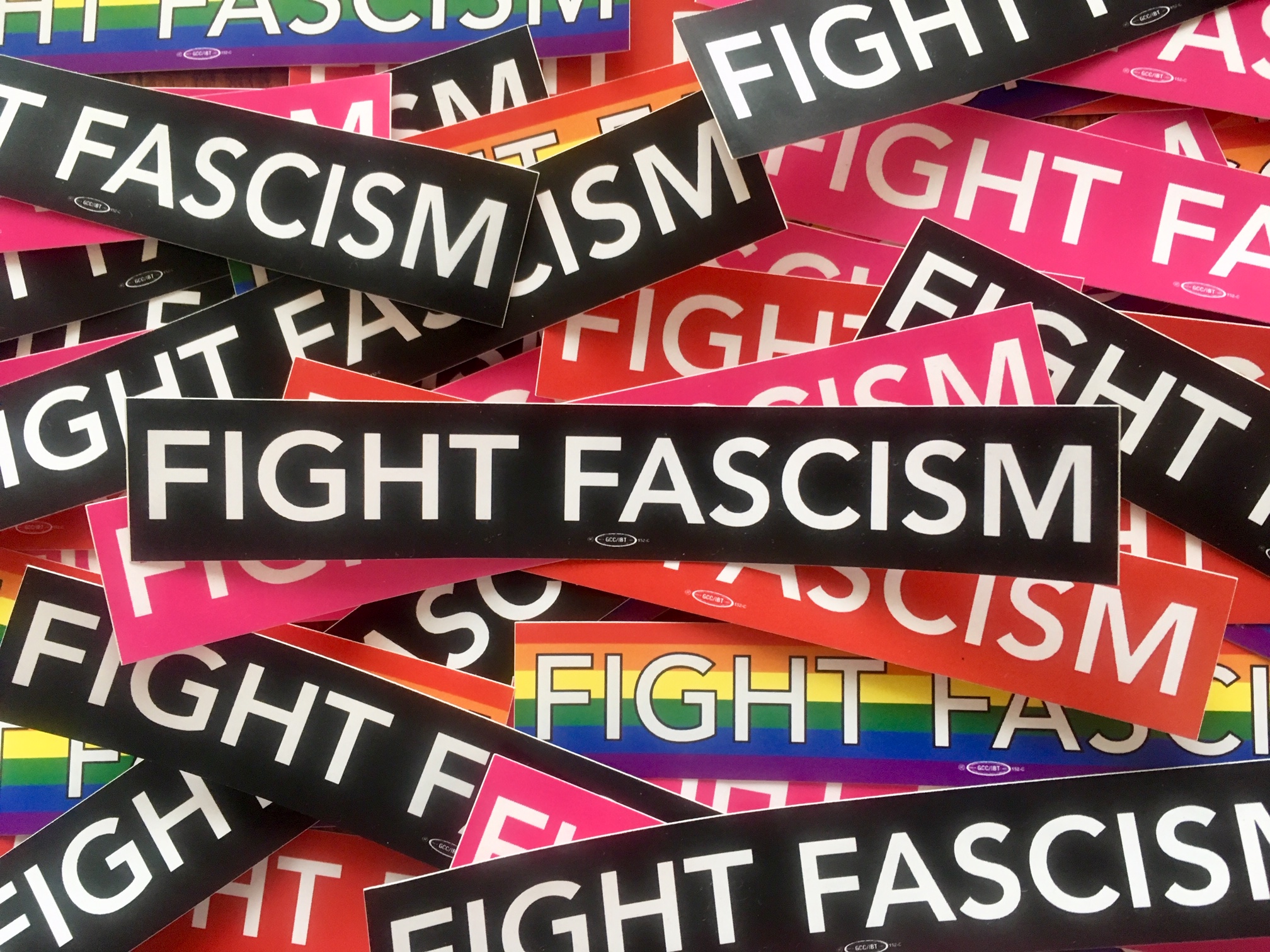
Each of the stickers is one inch tall by six inches long. (Think bookmark, not bumper sticker.) They’re made of vinyl, not paper, and they’re white print on a black background.
May 1 Update | The stickers are now available with a pink or a rainbow flag background, in addition to the black. And as of this morning, they’re available in red as well. Happy May Day!
If you’d like some, you can have some. For free. Here’s how it’s going to work.
If you’d like some stickers, fill out this Google form, giving me your name and address, and telling me how many stickers you want and what you’re going to use them for.
That’s it. If you’d like five or fewer, that’s all you have to do—just tell me you want them, and I’ll send them. I’ll stuff the envelopes, I’ll cover the postage. Everything. (The form is set up for US addresses, so if you’re overseas, you’ll need provide your full address in a comment to your request.)
If you’d like more than five stickers, or you’d like to kick in some money to help cover my costs, that’d be great. (Really great. I’m an adjunct professor, and I don’t make a lot of money. This is an extravagance on my part, not an eccentricity.) Just click here and donate via GoFundMe. (If you donate make sure you include your name so I can match it up with the one on your request form. You can send the name privately if you like.)
How much should you donate? Well, there’s no set charge per sticker, but don’t make me a chump. I’m going to put the first chunk of cash I receive directly into buying more stickers, and I’m hoping this works out well enough to be a model that I can use again in the future without draining my bank account. In other words, if you send me a dollar and ask for five hundred stickers, that’s not going to be sustainable. (If you want more than a hundred stickers, check with me by email before you fill out the form. If you’re not sure whether your donation is too small for the number of stickers you’re requesting, feel free to ask.)
If you’ve got any general questions, feel free to ask them here, but remember to use the Google form to request stickers.
If you’re concerned about giving out your address, here’s the deal: I’m going to use your info to get you the stickers, and that’s it. I won’t share it with anybody, and I won’t keep it for myself. Pinky promise.
TLDR: Request stickers here. Donate here, if you like.
January 27 Update | More than 450 requests for stickers in the first 24 hours, from forty-four states plus Canada, Britain, Austria, and the Netherlands. I’ve already put in an order for more stickers and a whole mess of envelopes and mailing labels, and I’m heading out to buy stamps today.
$1,776 in total donations (no, really) as I write this. We’ve had about one donation for every four sticker requests, which is wonderful—and which is about the rate we need for this project to continue to be self-sustaining.
So if you can donate, that’s amazing—and thank you so much. But if you can’t, please don’t be shy about putting in a request. I’ve got your back.
January 28 Update | Since so many people have asked, and since I’m beginning to get a better sense of the economics of this project, if you’re interested in receiving stickers in bulk, a donation of 50 cents or a dollar a sticker is a pretty good rule of thumb. At that rate we should be able to keep giving out stickers for free for a while.
February 23 Update | Continuing to plow my way through the requests, getting closer and closer to being caught up. Ordered 6,000 more stickers this week, which means that by about two weeks from now I should have completely cleared the backlog. If you have ordered, but haven’t received your stickers, check back here in a bit—I’ll post again when I’m completely up to date, and you can nudge me then if your order went missing. And again, thank you to everyone who’s contributed to the project—you’ve made this possible, and are making it possible to continue.
March 4 Update | New stickers are in, including one thousand PINK ones. Backlog almost cleared, new requests will be filled much more quickly.
March 18 Update | Mailed off our one-thousandth envelope yesterday. Just about caught up—printed out 150 labels today, and that’s the last of the orders to date.
2019 Update | The project has restarted after a hiatus. Links for requesting stickers and donating have been updated—if somehow a request you made in 2017 or 2018 fell through the cracks, please resubmit it and I’ll send your stickers out now. (A fair number of envelopes were returned in the initial wave because of bad or incomplete addresses, and it’s possible yours was among them.)
Okay, so I’m going to say some stuff at the start of this post that’s going to be a bit of a drag, but I want you to stick with me. It’ll be worth it, I promise, and there’s no way around what I have to say at the top without going through it. So I’m just going to jump in, and I’ll meet you on the other side. Here we go…
America’s current crisis isn’t one crisis, it’s a hundred.
We’ve got a crisis in access to medical care, and it’s about to get worse. We’re in a deep crisis in mental health care, and again, it’s about to get worse. Ditto access to reproductive healthcare. Two of the last five presidential elections have been won by candidates who lost the popular vote. That’s a crisis. Because of gerrymandering, vote suppression, and voter clustering, elections in the House and Senate and state races are growing less likely to reflect the will of the electorate. That’s a crisis. The interference of American intelligence agencies with the just-concluded presidential election is a crisis, as is the likelihood that we will never get a full accounting of that interference.
Also a crisis: Police violence against people of color, and police impunity when such violence is committed. The Republican Party’s manifest unwillingness to hold the Trump administration accountable for conforming its actions to the constitution. Rising income inequality and persistent poverty. The incompetence and malignance of so many of the administration’s appointees. Their plans to dismantle public schools and universities, undermine academic freedom, and open up the public-money spigot to predatory for-profit colleges. The weakening of international organizations and agreements. The undermining of essential diplomatic relationships. Threats to free speech and scientific research and the arts and the climate.
And of course there’s so much more I could add to the list. (I didn’t even mention the Russians.) No one person can fight all of it.
…you still with me? Excellent. Because here’s the good news:
No one person can fight all of this, but no one person needs to. Wherever you put your effort in the coming days and years, your effort is needed. Whatever work you do to fight this crisis is important work. What’s vital is not what precisely you do, but that you do something—that you pitch in and lend a hand.
It’s easy to imagine that there’s one crucial path to preventing the trainwreck we’re watching unfold, and that our obligation is to find that one thing to do—impeaching Trump, saving ACA, ending voter suppression—and do it. But that’s not how this works. We need to fight on every front at once, because all the work is necessary. That may seem overwhelming, but it shouldn’t be, because again, nobody can do it all, and nobody needs to.
The work is ongoing, on a hundred fronts. All you need to do is be a part of it, somehow, somewhere. Everything helps. Everything is vital.
And here’s some more good news: You don’t have to reinvent the wheel. If you’re someone with loads of organizing experience and lots of resources and a robust network of fellow activists and you see a gap in the existing web of work and you want to jump in and fill it, that’s great. That’s happening all over the place right now, and it’s great. But if you’re not any of those things—if you’re new to all this and want to help but don’t really know what you’re doing—that’s okay too. It’s better than okay, actually. It’s wonderful. Because it means that the struggle to fix what’s wrong with the world has one more person in it today than it did yesterday, and building that struggle is how we win. So hi, and welcome, and thank you!
So how do you get involved if you haven’t been involved before? One of the best ways is to find a group that has been involved before, and help them out. Most of these crises aren’t new, and none of these struggles are. Trump is making things worse, but he hasn’t invented anything. People have been fighting people like him, and stuff like the stuff he’s trying to do, for decades. Centuries. They know how to do this. They’ve been doing it. They’re doing it right now. And they’d love to have your help.
So start brainstorming. Is there an organization you’re a fan of but have never been involved with? Google them, and see if they’re looking for volunteers. Is there a local politician you’ve always admired, or a losing candidate for local office you wish had won? Drop them a line. Are you a union member, but inactive? Get active. Is there a rally coming up in your community? Find out who’s organizing it, and offer to lend a hand with logistics or setup. Get in touch with a local food pantry, or homeless shelter, or teen crisis hotline, or abortion clinic. If you can afford to donate money, do, but while you’re at it, see if there’s a way for you to help more directly.
I’ll have some more concrete suggestions for how and where to lend a hand later, but really, don’t stress out too much about what to do. Don’t let the perfect be the enemy of getting off of your butt and doing something. Because it’s by doing something that you’ll really start figuring out how to be of use, and learning how.
Maybe the first place you volunteer will be an amazing and wonderful and empowering experience. Maybe it’ll set your life on a completely new trajectory. But if it doesn’t, it’ll still be worth doing. Because you’ll learn a bunch of stuff by doing it. You’ll learn what you’re good at, and what you like doing, and what kinds of work are sustainable for you. But you’ll also learn a lot about how organizations and movements work, and what makes them succeed or fail. You’ll make connections with other people, connections that may persist after your relationship with the group is over. And crucially, you’ll get out of your comfort zone. You’ll expand your comfort zone. You’ll get more comfortable with not just the work itself, but with the phone calls and emails that put you in the room. You’ll learn how to do all the stuff, both practical and logistical, that’s going to help you be more useful in the next project you take on.
You may have noticed that I’m mostly talking in this post about getting involved with organizations and institutions. There’s a few reasons for that:
The first is that a lot of folks have written good guides to taking individual action, particularly political action. (Here’s a very well-shared one, here’s a great one that was just published today, and here’s an excellent one that leans more toward grassroots social action. This is good too, and you’ll never go far wrong following Woody Guthrie’s lead.) If you’re reading this post, you’ve probably encountered at least one of those guides already.
A second reason is that, as I said at the top of this post, this crisis is going to put extraordinary stresses on regular people and the local institutions that help them get by. Keeping people fed under Trump is part of fighting Trump. Getting people access to birth control under Trump is part of fighting Trump. Supporting teachers under Trump is part of fighting Trump. We need to be doing it all.
A third reason is that working in organizations gives you skills you can’t get anywhere else. You may not be an organizer now, and if you aren’t, you won’t turn into one overnight, but this is stuff you can learn, and one of the best ways to learn it is to apprentice with people who know it.
But the fourth reason is maybe the biggest, and it’s this: We don’t know what’s coming, and we’re going to need each other when it gets here. The worst-case scenarios for democracy and civil liberties in the coming years are really bad, and even if the worst cases don’t materialize, building robust networks of friends and allies in the struggle is going to be vital to winning victories, maintaining our equilibrium, and staying alive. And while I’d be the last person on earth to deprecate the importance of online relationships, we’re going to need to be connected with each other on a face-to-face basis too.
Calling your senator is a good and important thing to do, but it doesn’t make you less isolated. Donating to someone’s Go Fund Me may help them, and society, a lot, but it doesn’t prepare you for the next fight. Tweeting is important—I’m a big fan of tweeting—but in the years to come I’m going to want to have good people nearby as well. I have some now, but I want to have more, so I’m going to go find them and work with them.
I said on Twitter this morning that I think we’re on the cusp of a huge wave of left and liberal organizing in this country. I think we’re going to beat Trump, and I think beating Trump is just the beginning of what we’re going to do. But as I said this morning, it’s going to be hard. We’ve got a long struggle ahead of us, and it’s not a struggle we’re going to win just by calling elected officials.
We need to get together.
In recent weeks two public figures with far-right views—Breitbart provocateur Milo Yiannopoulos and white supremacist Richard Spencer—have made headlines with high-profile visits to American campuses, while their opponents on the left have made headlines by trying to derail those appearances.
With both Yiannopoulos and Spencer planning more campus talks, and with campus organizing on the rise in the wake of Trump’s victory, such protests, and the free-speech debates that accompany them, are going to gain much more attention in the coming months. As a civil libertarian who is also an anti-fascist, I have some thoughts on the issue that other civil libertarians might want to bear in mind…
Off-campus individuals have no right to speak on campus.
Professors, students, and staff are members of the campus community, and their ability to speak on campus without constraint is essential to fundamental principles of free speech and academic freedom. Outsiders aren’t in the same category.
When speakers like Spencer and Yiannopoulos come to our schools, they come as invited guests. Such invitations are privileges, subject to campus rules and to the preferences of relevant decisionmakers. It’s not a violation of their free speech rights for us to refuse to host them, or to discourage others from hosting them.
It’s not a violation of the First Amendment or of principles of academic freedom to oppose giving Nazis a soapbox.
The right to invite a speaker is meaningless without the right to change your mind.
Organizations like FIRE frequently raise alarms about disinvitations of campus speakers, but there’s nothing intrinsically wrong, from a civil libertarian perspective, with rescinding an invitation to speak. If an invitation has been extended without a full understanding of the issues involved, or without consideration of all relevant perspectives, there’s nothing sinister in withdrawing it. Likewise, there’s nothing inherently sinister in encouraging others to change their minds about extending such invitations, even where such encouragement takes the form of protesting the invitation.
It’s also worth bearing in mind that many “disinvitations” aren’t disinvitations at all. If a speaker cancels because their planned appearance has brought them negative publicity, or to avoid embarrassing the host institution, that’s not a disinvitation, and it’s not a violation of anyone’s free speech rights.
Shining a spotlight on the views and acts of an invited speaker is legitimate behavior, and if the speaker decides to withdraw in the face of such publicity, there’s not necessarily anything wrong with that.
The right to protest is an essential component of the right to free speech.
Protesting a speaker is an act of free speech, and the right to protest must be defended by civil libertarians even when the protest is indecorous or unruly. It’s not an infringment on a speaker’s rights to challenge them, even if that challenge is uncivil. Sometimes incivility is exactly what a situation calls for.
It’s crucial to be alert to infringements on the free-speech rights of protesters, even hecklers. When campus officials have protesters arrested, they are leveraging the power of the state against expression they disapprove of in ways that chill free speech far more powerfully than most hecklers.
Extending invitations to harassers has costs.
Milo Yiannopoulos was banned permanently from Twitter in July because of his long history of coordinating harassment campaigns against other users of the site, and he has recently used his platform on at least one campus to engage in similarly abusive behavior. At UW Milwaukee in December, he put up the name and photo of a transgender student from that campus on a large screen behind his podium, then proceeded to spend the next several minutes abusing and deriding her, referring to her as “it,” calling her “a man in a dress,” and making a variety of cruel and ugly remarks about her.
There’s nothing obviously illegal about this nastiness—it’s Yiannopoulos’s right to engage in squalid, repulsive behavior. But again, universities have no obligation to provide a platform for it.
And they do, I believe, have at least some obligation, when they consider hosting speakers, to take into account their propensity for such behavior and anticipate its potential consequences. Yiannopoulos left UW Milwaukee that night, but his target remained to face the consequences of his actions.
People like Spencer and Yiannopoulos aren’t looking for debate.
Booking controversial speakers on campus is often defended as an opportunity for dialogue, but dialogue isn’t what these figures are after. They’re looking to build their base and their brand—to rally supporters and harvest attention.
When someone’s public persona is based on shock and “transgression”—on violating social norms for the sake of notoriety—actual dialogue isn’t in their interest and should not be used to justify their presence.
Not all questions raised by such speakers are as easily resolved.
Having said all this, I recognize that some difficult issues remain. While I consider it appropriate for universities to refuse to bring such figures to campus, for instance, I generally believe that student organizations deserve broad deference in booking speakers. Though I think the rights of hecklers should be granted far more weight than they’re typically afforded, there does come a point at which the exercise of those rights limits others’ ability to exercise theirs. And although the right to protest vocally, even rowdily, is worthy of strong defense, there are circumstances in which such protest crosses a line into physical intimidation or harassment.
These are thorny questions that pose conflicts between reasonable claims. But they’re not questions that can be engaged in a productive way unless the rights of protesters are given due weight and issues of speakers’ rights are disentangled from issues of institutional policy.
Spencer, Yiannopoulos, and their ilk hold extremist, overtly bigoted views, but they are not fringe figures—they represent an ideology and a political movement that is on the ascendancy in the United States and in much of Europe. They must be fought, and with all the tools at our disposal.
An effective defense of our civil liberties requires it.

 studentactivism.net
Recent Comments