
You are currently browsing Angus Johnston’s articles.
The student occupations in Austria are still going on. No major news stories have emerged over the weekend, but a bunch of blogs do have new coverage. Here are some relevant links:
- A good short overview of the situation.
- The protests’ Facebook fan page. (Nearly 25,000 fans, but mostly in German.)
- A discussion of the connections between Austria and the current wave of activism in California.
- An analysis of the domestic political context of the protests within Austria.
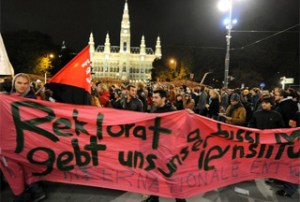 On Tuesday, October 17, students launched an occupation at the University of Fine Arts in Vienna. Two days later, other students occupied the largest lecture hall at the University of Vienna, and the movement has since spread to every leading Austrian university.
The Austrian students are protesting underfunding, corporatization, and overcrowding at Austria’s universities. More broadly, they are part of a wave of European student activists in opposition to the Bologna Accords, a set of proposals for education reform and standardization throughout Europe.
Yesterday, Thursday, saw a mass march through the streets of Vienna whose participation has been estimated at more than thirty thousand students.
There has been very little coverage of the protests in the English-language media, and most of what does exist in English is from non-English-speaking countries, as with this story and this one from a Chinese news agency. This short piece from the Boston Herald, now four days old, is a rare exception.
English-language reports from within the movement include this one, Reports from sympathetic activists include this one.
The primary Twitter feeds for the campaign are #unibrennt (“the university burns”) and #unsereuni (“our university”). Almost all of the traffic is in German, of course, but I’ve found that adding the word “Austria” or the word “students” to a search turns up a fair number of English-language posts.
The Twitter account @unibrennt_en is in English, but it’s infrequently updated. This blog post has an impressively detailed roundup of online sources of information, most of them in German.
I’m obviously still getting up to speed on this story myself. Look for updates in the days to come. If you have any useful info or links, please leave a comment.
We have received a PDF copy of a third statement from the administration of Southwestern College regarding last Thursday’s campus rally and subsequent banning of three professors from campus. Highlights:
The statement appears over the signature of Nicholas C. A. Alioto, who is identified within it as SWC’s “Acting Superintendent/President.” Alioto, a Certified Public Accountant, is a recent hire at SWC — he was named as the college’s Vice President for Business and Financial Affairs in July.
The statement says that the primary protest on October 22 “was conducted in accordance with Policy 5550.” Policy 5550 is Administrative Policy 5550 of the Southwestern Community Colllege District, and can be found here. It is based on, and promulgated in accordance with, Section 76120 of the California Education Code.
Note that Section 76120 and Policy 5550 regulate the conduct of students, not faculty.
The statement expresses the administration’s “concern” about events that took place when a “group of individuals left the free speech area” after the rally. It says that three faculty members are being investigated because of “concerns” that “center around three areas” — “[a] Incitement of students to move outside the free speech area and to violate College policies, [b] Disregard for warnings and directives of police officers, and [c] Physical confrontation with police officers.”
According to the statement, these areas are concern are being explored by “an outside investigator” who is not named or otherwise identified. That investigator has been conducting interviews, and his or her investigation “is expected to be concluded in the very near future.”
The statement denies that the three faculty were suspended. Rather, it says, they were “placed on paid administrative leave” and notified of “withdrawal of consent to be on-site.”
The faculty in question have, according to the statement, requested administrative hearings regarding their non-suspension suspensions. The next passage of the statement is worth quoting in full:
“In the interests of being as transparent as possible, administration offered to conduct the hearings in public; however, legal counsel for the three individuals declined that offer.”
Finally, the statement declares that “in order to provide due process,” the administration “must refrain from commenting further until the investigation is concluded.”
More soon.
On Tuesday night someone left a comment on one of my posts on the Southwestern College faculty suspensions that that passed on the text of SWC Governing Board President Jean Roesch’s Monday statement on the incident. Here’s that statement, quoted in full:
To: College Community
Many of you have learned that four faculty members were placed on paid administrative leave on Thursday, October 22, 2009 and three faculty members remain on paid administrative leave at this time, pending the outcome of the investigation. Please understand that no formal charges or allegations have been made against any College faculty member or employee at this time.
The student rally held between 11 a.m. and 12 p.m. on October 22, 2009, is not the focus of the investigation. The College is investigating safety and security issues that arose after the approved organized student rally. The College respects, values and is committed to lawful free expression and the student rally provided an opportunity for our students to voice their concerns and to underscore the challenges that all community college students, and community colleges, are experiencing.
The College is committed to maintaining a safe environment for our students and staff, which is the focus of the investigation.
I’m guessing, since the comment was placed in response to a blogpost critical of the SWC administration, and since the commenter adopted the moniker “SWC Professor,” that I and my readers are intended to take this statement as a rebuttal to our criticisms. If so, it’s a deeply disappointing one.
President Roesch seems to believe that if you give students and faculty authorization to hold a one-hour rally at a specific on-campus location, you’ve dispensed with your obligations to protect “lawful free expression” in the college community. But that’s not how the First Amendment works, and it’s not how a college should work.
The First Amendment doesn’t just protect free speech. It also explicitly protects the right of the people to peaceably assemble, and to petition the government for redress of grievances. A public college administrator is in a very literal sense an agent of the government, and SWC is a public college.
Students and faculty at a public college have a moral right to hold a peaceful rally on campus. They have a moral right to peacefully march across campus to the president’s office. There should be no difference in the eyes of the law, and there should be no difference in the eyes of any campus administrator, between a “approved organized student rally” and a spontaneous, extemporaneous one.
The SWC administration has so far offered no evidence that any incident that took place on Thursday afternoon placed that day’s march outside the bounds of fundamental First Amendment protections.
The American Civil Liberties Union is offering fifteen college scholarships to high school seniors who have “demonstrated a strong commitment to civil liberties through some form of activism.” The ACLU Youth Activist Scholars will receive $7000 each, and will “be invited to participate in ongoing activities with the ACLU, including the Youth Activist Institute training program at the ACLU National office in New York City.”
Candidates for the scholarships must be nominated by their local ACLU affiliates (a directory of affiliates can be found here), and the application deadline is November 30.

 studentactivism.net
Recent Comments