
You are currently browsing Angus Johnston’s articles.
One of the Supreme Court’s first cases when it returns in the fall will be Fisher v. University of Texas, scheduled for argument on October 10. The Fisher case concerns the constitutionality of affirmative action policies in undergraduate admissions at UT.
Campus affirmative action has been on shaky legal ground since 2003, when the Supreme Court ruled in the 5-4 Grutter v. Bollinger decision that race-conscious policies could not be used to remedy the effects of past societal discrimination, but only “to further a compelling interest in obtaining the educational benefits that flow from a diverse student body.”
Four of the Court’s members were then willing to accept a broader role for affirmative action, while four wanted to end it entirely. It was Justice O’Connor, the swing vote, who endorsed the compromise that carried the day, but in the last nine years, four members of the Court — including O’Connor — have left by death or resignation, and their replacements have shifted the Court significantly to the right.
Chief Justice John Roberts, one of the conservative post-Grutter additions to the Court, wrote in a 2007 opinion that “the way to stop discrimination on the basis of race is to stop discriminating on the basis of race” — that the Constitution and sound public policy demand race-blind admissions, in other words. In contrast, Justice Anthony Kennedy, who is likely to be the swing vote this year, held in the same case that the government has a “legitimate interest … in ensuring all people have equal opportunity regardless of their race,” and that “narrowly tailored” affirmative action is permissible in service of that interest.
Just how narrow such a policy must be to meet Justice Kennedy’s standards will likely be the central question before the Court in Fisher. And although Kennedy has so far refused to join the Court’s conservative wing in endorsing a ban on race-conscious admissions, he has never yet voted to uphold an actually existing affirmative action program.
I’ll be following this case as it proceeds through the SCOTUS calendar during the coming year, commenting in more detail on the issues involved, the oral arguments, and the decision when it eventually appears. But for now, as I mentioned above, I wanted to draw your attention to a website and petition that the United States Student Association has put up.
USSA will be submitting an amicus brief in support of UT’s affirmative action policies to the Supreme Court early next month, and they’re currently collecting signatures from students to include in that brief. If you’d like to let SCOTUS know you support affirmative action in college admissions, you can do it by adding your name to the USSA brief here.
I’m pretty sure I read John Scalzi’s terrific essay Being Poor when he first wrote it, back in the days after Katrina, but I don’t think I ever made it all the way through the comments. I’m about halfway through right now, and I wanted to share this one:
Being poor is turning down a college scholarship because the college wanted the parents to contribute $800 for the year (!) and it might as well have been $80,000. (Later I found out that if we had just called the school and explained, they would have found a way for me to attend. But how were we to know? I was the first person in my family to attend college.)
The argument at Penn State over what to do with the university’s statue of beloved/disgraced football coach Joe Paterno heated up considerably about an hour ago, when a small plane trailing the following banner was spotted on campus:
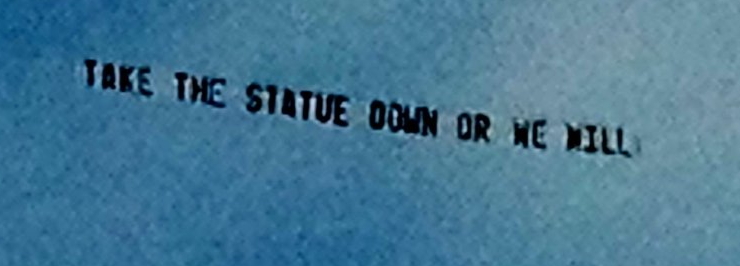
That’s “TAKE THE STATUE DOWN OR WE WILL,” if you can’t make it out.
Update | It’s now almost 3 pm Eastern time, about four hours after the plane first appeared, and nobody has managed to find out who was behind the message. The closest anyone’s come is Harrisburg television station WHTM, which reported half an hour ago that “the plane towing the banner is from Toledo, Ohio. The banner was made in Long Island.”
A quick Google suggests that the cost of such a stunt generally runs to a few hundred bucks.
Though many US universities have cooled to the idea of opening overseas campuses in the last few years, Yale is just now jumping on the bandwagon. Its new Yale-NUS College, scheduled to open next year, will be, Yale says, “Singapore’s first liberal arts college, and the first with a full residential college model.”
What it won’t have, if all goes according to plan, is student protest, or student political organizations.
Singapore’s restrictions on civil liberties and freedom of expression are extensive, and Yale has chosen to accept the government’s limits on its campus. The college’s one thousand students will not be allowed to form political parties or clubs, and protests and demonstrations will be banned on campus just as they are in the rest of the country.
Yale-NUS is funded entirely by the government of Singapore and private donations, primarily originating within Asia.
“I enjoy money, clothes, cars, demonstrations, riots, and anything for the revolution.”
—Gloria Root, Playboy Playmate of the Month, December 1969

 studentactivism.net
Recent Comments