
You are currently browsing Angus Johnston’s articles.
A big point of contention in the argument over Daniel Tosh’s rape jokes has been how to take his suggestion that it’d be funny if a group of guys in his audience raped the woman who’d just called him out for making rape jokes during his set. A lot of folks, myself included, said that statement opened up the woman to harassment and possible assault, while Tosh’s defenders mostly denied that made any sense. Comedy is comedy, they said, and bad acts are bad acts, and you can’t mix up the two.
But now there’s this.
As my friend Kevin pointed out this morning, Tosh did a bit on his Comedy Central show just three months ago in which he encouraged his male viewers to videotape themselves “sneaking up behind women” and “lightly touching” their belly fat. And a bunch of them did, sending the clips into him and posting them on YouTube.
Now, the whole point of this is that it’s non-consensual, invasive, and public. And though some of the women in the clips appear to be in on the gag, others are clearly pissed off. In several cases the women seem to be strangers to the guys doing the touching, and in one — hosted on the Comedy Central website, complete with a revenue-generating ad — a high school student is shown touching his teacher. (That clip, like many others, cuts out before we’re able to see the victim’s reaction.)
What this confirms is that the whole Tosh thing isn’t about jokes. Tosh isn’t just a guy who tells stories on stage. He’s a guy whose comedy includes actually physically assaulting women, and directing his fans to do the same. And this is the guy who, after a woman challenged his rape jokes, mused aloud about how funny it would be if she “got raped by like, five” of those same fans, right then and there.
“Right now? Like right now? What if a bunch of guys just raped her?”
Damn.
An independent report on Penn State’s handling of child sexual abuse allegations against Jerry Sandusky has been released, and it’s damning. The report, written by a team headed by former FBI Director Louis Freeh, finds that PSU’s top leaders engaged in a fourteen-year conspiracy to protect Sandusky from justice, a conspiracy that had beloved football coach Joe Paterno at its center.
Some excerpts from Louis Freeh’s remarks on the report, delivered just moments ago:
- “Our most saddening and sobering finding is the total disregard for the safety and welfare of Sandusky’s child victims by the most senior leaders at Penn State. The most powerful men at Penn State failed to take any steps for 14 years to protect the children who Sandusky victimized. “
- “[Penn State President Graham] Spanier, [Vice President Gary] Schultz, [Coach Joe] Paterno and [Athletic Director Tim] Curley never demonstrated, through actions or words, any concern for the safety and well-being of Sandusky’s victims until after Sandusky’s arrest.”
- Penn State leaders considered reporting Sandusky in 2001 but “changed the plan … after Mr. Curley consulted with Mr. Paterno … and decided not to make a report to the authorities.”
- “Their failure to protect the February 9, 2001 child victim, or make attempts to identify him, created a dangerous situation for other unknown, unsuspecting young boys who were lured to the Penn State campus and football games by Sandusky and victimized repeatedly by him.”
- “Further, they exposed this child to additional harm by alerting Sandusky, who was the only one who knew the child’s identity.”
- Freeh rejects the four administrators’ stated reasons for failing to act, declaring that “it is more reasonable to conclude” that they “repeatedly concealed critical facts relating to Sandusky’s child abuse from the authorities, the Board of Trustees, Penn State community, and the public at large … in order to avoid the consequences of bad publicity.”
- “Although concern to treat the child abuser humanely was expressly stated, no such sentiments were ever expressed by them for Sandusky’s victims.”
- Paterno was aware of an earlier “criminal investigation of Sandusky relating to suspected sexual misconduct with a young boy in a Penn State football locker room shower,” and indeed “followed it closely, but failed to take any action, even though Sandusky had been a key member of his coaching staff for almost 30 years, and had an office just steps away from Mr. Paterno’s.”
- “Spanier, Schultz, Paterno and Curley also failed to alert the Board of Trustees about the 1998 investigation or take any further action against Mr. Sandusky. None of them even spoke to Sandusky about his conduct.”
- “In short, nothing was done and Sandusky was allowed to continue with impunity.”
It goes on like this for another page and a half, detailing what Freeh calls the group’s “callous and shocking disregard for child victims” of sexual abuse by their friend and colleague.
Freeh also notes that the Penn State Board of Trustees “failed in its duty to make reasonable inquiry into these serious matters and to demand action by the President” after they became aware of them via media reports in March 2011. In doing so, the board “failed to create an environment which held the University’s most senior leaders accountable to it,” allowing President Spanier to continue to stonewall them even as Sandusky, Curley, and Schultz were arrested in November of last year.
• • •
More details from the main body of the Freeh Report:
When Sandusky retired in 1999 — after top university officials were already aware of child sexual abuse allegations against him — he asked for and was granted a six-figure lump-sum payment above and beyond his substantial pension, a payment that several PSU officials said was unique in the recent history of the university. He was also granted emeritus status in violation of standard PSU policy on the awarding of that honor.
In addition to the unprecedented $168,000 payment and emeritus status, Sandusky requested while negotiating the terms of his retirement that he be given opportunities “to continue to work with young people through Penn State.” PSU granted this request, giving him and the youth group he worked with open access to the campus. In the next two years Sandusky would go on to sexually assault at least three more children on university property.
In 2001, following new evidence of child sexual abuse against Sandusky, PSU President Graham Spanier signed off on a proposal from his athletic director and head of campus police to “indicate” to Sandusky that “we feel there is a problem and we want to assist [him] to get professional help,” but not to provide their evidence to legal authorities. In a 2001 email, Spanier said that “the only downside for us” to this plan “is if the message isnʹt ‘heard’ and acted upon” — if Sandusky went on to sexually abuse other children — “and we then become vulnerable for not having reported it.” He called the decision not to inform police a “humane” and “reasonable” one.
The only action taken at the time was a March 2001 request that Sandusky no longer bring children to campus, a request he ignored — in August that year he committed another sexual assault on a child in the university’s showers.
“In the meantime, the Mobe held its own counter-inaugural event with a rally and speakers. Later that night they scheduled a counter-inaugural ball. One of the speakers was Marilyn Webb, representing the new women’s consciousness-raising groups. She had prepared a speech about the aspirations of women, demanding equality for women both in the movement and in the larger society. As Marilyn began her speech, dozens of men in the packed audience began to catcall and boo. When she continued, more men joined in and the din got louder. Some of them began to chant, ‘Take it off! Take it off!’ ‘Fuck her down a dark alley!’ Marilyn was stunned and hurt. Shulamith Firestone tried to continue with a second speech, but soon both women were forced to abandon the stage in the pandemonium…
“While the Mobe leadership — all men — were also upset by the attacks, they didn’t join Marilyn on the stage to back her up.”
—Cathy Wilkerson, SDS and Weather Underground activist, on the National Mobilization to End the War in Vietnam’s January 1969 protest of the Nixon inaugural.
Last Sunday on The Newsroom Aaron Sorkin’s anchor-hero Will McAvoy offered up a whirlwind tour of the history of Students for Democratic Society, the Yippies, and the Vietnam antiwar movement that managed to get pretty much everything completely wrong in the service of an analogy that made no sense. Here’s my take, because when else am I going to get a chance like this?
• • •
“Back in 1968 when Rennie Davis and Hayden and their guys organized the SDS,
SDS was put together in 1960, not 1968. Its organizational roots stretch back as far as 1905. And although Rennie Davis and Tom Hayden would both become important figures in the group in the early sixties and after, neither participated in its founding meetings.
it was specifically to end the Vietnam war
Nope. SDS was a broad-based, multi-issue organization from the beginning. It addressed itself to concerns ranging from nuclear testing to civil rights to campus parietal rules. The 1962 Port Huron Statement, SDS’s immensely influential (and just plain immense) manifesto, mentions Vietnam just once, in the context of a discussion of the membership policies of the United Nations.
but that movement got eaten by Abbie Hoffman and Jerry Rubin and the Yippies.
Again, no. The collapse of SDS had almost nothing to do with the rise of the Yippies, and everything to do with government repression, sectarian infighting, and revolutionary overreach. And though SDS died with the sixties, the American seventies would see the ascendancy of other transformative social movements around issues like feminism, gay rights, environmentalism, Native American rights, and so on. Many of those movements had direct links to the New Left.
It’s also worth noting that Tom Hayden and the Yippies were allies for a big chunk of the period under discussion, as demonstrated by this film footage of Hayden speaking alongside Hoffman at a Yippie press conference.
It was impossible to define what the Yippies were protesting.
Ridiculous. The Yippies staged plenty of specific, targeted actions, and participated in plenty more, as we’ll see in a moment. Yes, they were a sprawling, inchoate group. Yes, they offered a vague, unformed vision of the revolution they were trying to achieve. But they also organized focused campaigns.
They were about giving the finger to anyone over thirty,
Abbie Hoffman was well past thirty by 1968. And when Jerry Rubin turned thirty that summer, he wrote that he “was reborn in Berkeley in 1964 in the Free Speech movement. When we say ‘Don’t trust anyone over 30,’ we’re talking about the second birth. … When people 40 years old come up to me and say, ‘Well, I guess I can’t be part of your movement,’ I say, ‘What do you mean? You could have been born yesterday. Age exists in your head.’ Bertrand Russell is our leader. He’s 90 years old.”
generically hating the American establishment,
Sure, the Yippies hated the American establishment. You know why? For starters, the American establishment was trying to put them (and Tom Hayden and Rennie Davis) in prison.
dropping out, getting high.
There was a lot of that going around in those days, or so I’ve heard. Still is, in some circles.
That’s how the progressive movement would be painted for the next forty years.
Attacks on left activists as dirty hippies didn’t begin with Abbie Hoffman. In 1966 Ronald Reagan used hippie-bashing to win the governorship of California, and he wasn’t remotely the only politician beating that gong. The 1960s saw a huge generational cultural upheaval that was inextricably bound up with a youth activist movement in the public mind — neither the Yippies nor anyone else had the power to change that, even if they’d wanted to.
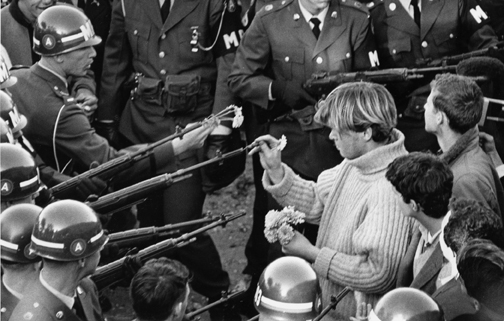
People passing out daisies to soldiers and trying to levitate the Pentagon.
Funny you should mention that. Because the attempt to levitate the Pentagon occurred at a 1967 demonstration against the war, an action that Tom Hayden has described as one of the most potent of the Vietnam War era. Yes, Jerry Rubin was the point person on that demo, but he was recruited for the position by David Dellinger, who was hardly a Yippie. (And if you think this photo actually harmed the antiwar movement, well God, Jed, I don’t even want to know you.)
The Pentagon’s a really big building. You can’t levitate it.
This part is true.
The sixties radicals and the Tea Party are roughly the same, with one big exception. Even at the height of 1968 the Democrats wouldn’t have nominated Abbie Hoffman or Jerry Rubin for any office, and no candidate would have sought their endorsement.
Okay, a few things. First, 1968 wasn’t “the height” of anything in terms of Democratic Party radicalism. That year the Dems nominated their sitting vice president at a convention that saw epidemic police violence against protesters, violence that was essentially ignored by the conventioneers. The party’s presidential nominee, Hubert Humphrey, never came out against the war in Vietnam, and only called for a ceasefire weeks before the general election.
So no, Abbie Hoffman and Jerry Rubin weren’t getting any love from the Democratic Party that year. But neither were Hayden and Davis, or any other figures in the New Left. (By the eighties, however, both Hoffman and Hayden were involved in mainstream left-liberal political activity.)
Can you imagine Humphrey or Kennedy standing for a photo op with Bernardine Dohrn or Allen Ginsberg?”
No, but I can’t quite figure out why we’re talking about them, either.
Bernardine Dohrn wasn’t a Yippie, she was an SDSer. Specifically, she was a member of the Weatherman faction, an advocate of violent revolution in the United States. She wasn’t about “giving the finger to anyone over thirty, generically hating the American establishment, dropping out, getting high,” she was about blowing things up and killing people. Ginsberg I can kind of understand the mention of, since he at least participated in the 1967 Pentagon action, but he did so as a middle-aged gay poet, not a young activist.
Lumping in Ginsberg with Hoffman and Rubin makes a kind of weird sense. But lumping those three gleeful pranksters in with Dohrn is just absurd.
And all this quibbling over details may be beside the point anyway, since Sorkin’s underlying argument is so wrong-headed. His claim is that the New Left and the Tea Party both began as reasonable interventions into party politics, that both were hijacked by bizarre radicals, and differ only in that one was absorbed into the GOP while the other was properly shunned by the Democrats.
And that’s about the least useful analysis of either movement that I’ve ever heard.
July 16 Update | Jesse Walker of Reason has put up a fascinating, illuminating post on the Yippies and the 1972 Democratic National Convention which carries the debunk one step further.
Update | CK says he was unaware of the Tosh incident when he tweeted, a claim I find implausible. But he also says that the whole thing made him more aware of women’s experience of rape than he had been.
Louis CK is about a year older than me. He, like me, is a divorced joint-custody father of two. His daughters are each about a year older than mine, and like mine they go to pretty good New York City public schools. Like me he’s a bearded pasty Manhattanite who could stand to lose a few pounds. Like me he’s trying to be an anti-racist, anti-sexist, decent human being in the face of a hell of a lot of training to the contrary.
And he’s brilliant, so when he talks about his life and his worldview, he frequently says stuff I wish I’d said, or figured out before. Louis CK has stood on my television and told me true things about how I feel about being a parent that I didn’t know until he said them. He’s said serious things about serious things that I’ve repeated over and over.
And so I’m sad tonight, and pissed off.
If you don’t know the background, here it is:
Not long ago, on Tumblr, someone posted a note from a friend about how she’d inadvertently wandered into a Daniel Tosh standup show and how things got really creepy:
So Tosh then starts making some very generalizing, declarative statements about rape jokes always being funny, how can a rape joke not be funny, rape is hilarious, etc. I don’t know why he was so repetitive about it but I felt provoked because I, for one, DON’T find them funny and never have. So I didnt appreciate Daniel Tosh (or anyone!) telling me I should find them funny. So I yelled out, “Actually, rape jokes are never funny!”
I did it because, even though being “disruptive” is against my nature, I felt that sitting there and saying nothing, or leaving quietly, would have been against my values as a person and as a woman. I don’t sit there while someone tells me how I should feel about something as profound and damaging as rape.
After I called out to him, Tosh paused for a moment. Then, he says, “Wouldn’t it be funny if that girl got raped by like, 5 guys right now? Like right now? What if a bunch of guys just raped her…”
Yeah. So she left, obviously, and asked for a refund which she didn’t get, and then told the story to the friend who posted it. And then folks found out about it and reblogged it (or whatever the hell they do on Tumblr, I don’t know), and it got traction and eventually Tosh himself responded on Twitter:
“all the out of context misquotes aside, i’d like to sincerely apologize http://j.mp/PJ8bNs“
That’s a non-apology, of course, since it doesn’t include any specific acknowledgment of wrongdoing. And it’s a particularly churlish non-apology since it accuses his accuser of unspecified sins. It’s bullshit, in short. But whatever, it’s Daniel Tosh, who was always an asshole. Why should today be any different?
And then Louis CK stepped in. Damn it.
Now, I should say that as righteous as CK has often been, he’s stumbled sometimes, as do we all. He’s made some moves I wouldn’t have made, said some things I wish he hadn’t. And he’s also said some things that I wasn’t sure how to take.
Specifically, he’s told some rape jokes. In each case, if I squinted, I could read them as rape culture jokes, jokes about how screwed up our society is when it comes to rape, jokes about how screwed up men are when it comes to sex and power and control. As a white guy, I don’t want to say white guys can’t make weird uncomfortable jokes about race and gender. Sometimes, in some contexts, we can and do. Sometimes in doing so we speak to important truths.
I’m not going to defend any specific joke tonight, and I’m not going to defend the general principle either. Maybe I’ve been wrong when I’ve done it in the past. I don’t know. What I do know is that I gave Louis CK too much credit for navigating those questions thoughtfully and consciously, because what Louis tweeted after Tosh tweeted his non-apology is this:
@danieltosh your show makes me laugh every time I watch it. And you have pretty eyes.
Dude. Come on.
Come on.
What we know about that night is that a woman says Daniel Tosh joked, after she called him on making rape jokes, that it’d be funny if a bunch in the guys in the audience raped her. How on earth is that funny? How on earth is that not fucked up?
I’m not going to say that Tosh was giving the guys in the audience a green light to rape that woman. But you can’t not say he was giving them the green light to screw with her. You can’t say he wasn’t sending them the message he thought it’d be funny if they made a bunch of jokes to her face, in a dark parking lot, about how they ought to rape her right there. You can’t say that if they did that, they’d have any reason to believe he’d think it wasn’t cool.
You know about jokes. You know far more than me about jokes. And that joke just isn’t okay.

 studentactivism.net

Recent Comments