
You are currently browsing Angus Johnston’s articles.
To me, one of the most disturbing provisions of Bill 78, Quebec’s new law criminalizing participation in the province’s ongoing student strike, is one that has received virtually no attention in the media. Here’s an excerpt from the English-language version of Section 18:
“If the [Education] Minister notes that [a college or university] is unable to deliver instructional services as a result of a failure by a student association to comply with an obligation imposed by this Act, the Minister may … order the institution to cease collecting the assessment established by the student association or any successor student association and to cease providing premises, furniture, notice boards, and display stands to the student association or any successor student association free of charge.
“The cessation is effective for a period equal to one term per day or part of a day during which the institution was unable to provide instructional services as a result of the failure to comply.”
What does this mean? It means that if Quebec’s education minister concludes that a campus student association contributed to a disruption of classes, he or she will have the power to cut that student association’s funding, at a rate of one semester’s funding for every day (or part of a day) disrupted.
So let’s say that at four o’clock one afternoon the provincial government announces a new tuition hike, and the student association calls a rally that evening. Because Bill 78 requires organizers of any protest to provide police with eight hours notice, the rally — even if it’s peaceful and non-disruptive — represents “a failure by a student association to comply with an obligation imposed by” the law.
And let’s say that as the rally is breaking up, a group of students decide, on their own, to march off campus. They take over a street, causing a traffic jam. A professor gets caught in that traffic jam and can’t make it to class. That professor is thus rendered “unable to to deliver instructional services.”
According to the text of the law, that student association could have its student activity fee funds withheld for an entire semester. All funds, for all the association’s activities, gone.
And note how quickly the length of the suspensions mount. If, say, a student association officer calls for a blockade that drags on for two weeks, and the Education Minister finds the student association liable, that student association would see its funds withheld for seven years.
For the next seven years, that campus would — because of the actions of one officer — have no student association funding whatsoever. No money for officer stipends, or support staff, or printing. No office space, no speakers or concerts or other programming. And any clubs funded through the association would be similarly cut off — the women’s center, the cultural unions, the chess club. All gone.
And under the law the students of the campus would be prohibited from establishing another student association to replace the one they’ve lost. If a group of students, years later, after everyone involved in the original incident had long since graduated, wanted to set up a new student association, and the students of the campus voted overwhelmingly to fund the new group through their fees, they wouldn’t be allowed to.
Like so much in this law, it’s really quite astonishing.
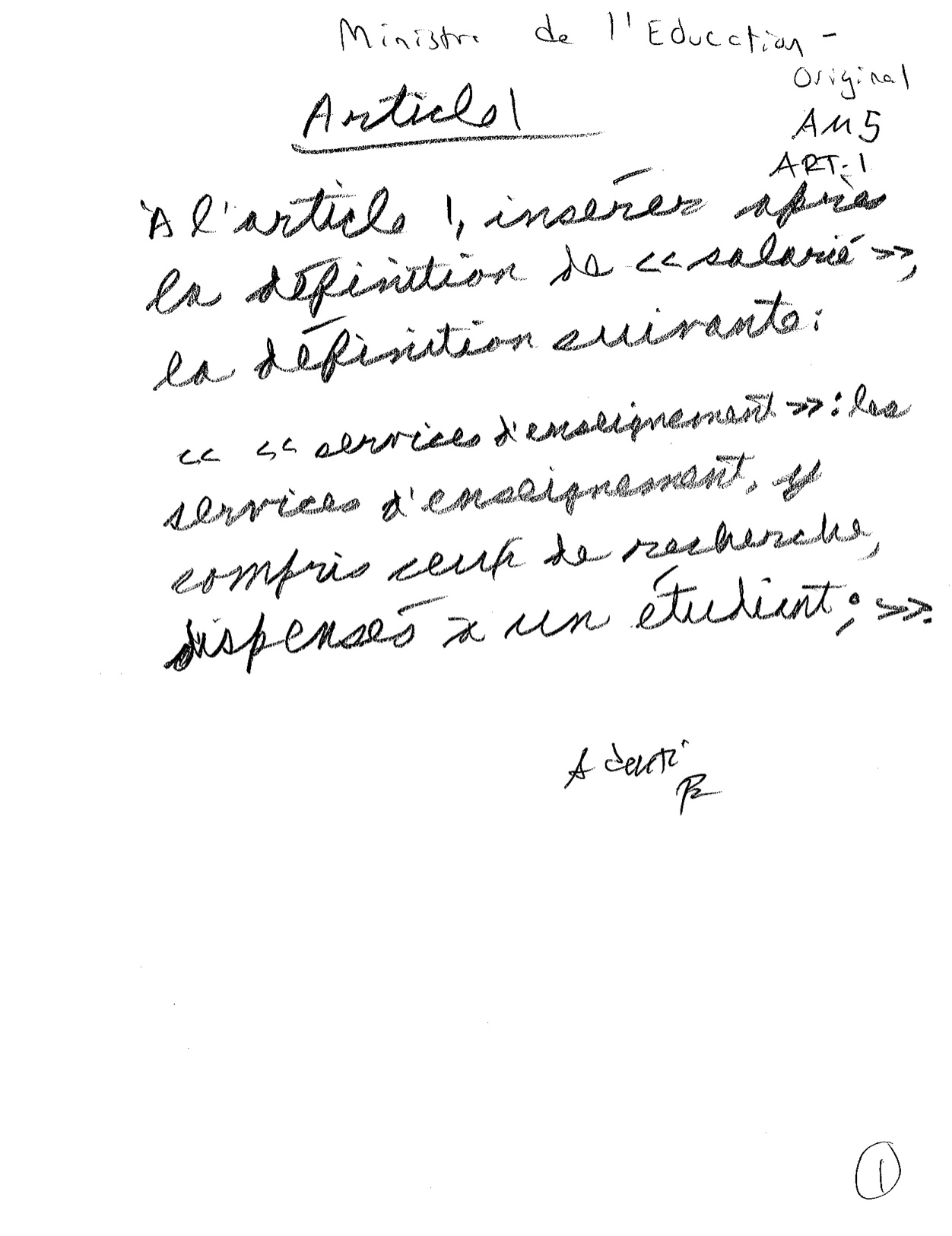 Call me naive, but I find it flabbergasting that major amendments to Bill 78, Québec’s new law criminalizing student strikes, were passed and inserted into the official record of the provincial legislature as hastily scrawled handwritten notes.
Bill 78 was drafted on Thursday, introduced on Thursday night, and debated for 21 straight hours before passage. The amendments in question were adopted on a single party-line vote, as was the bill itself. (The opposition offered a number of laudable amendments, in typewritten form, but all were rejected by the majority.)
What makes this haste extraordinary is the sweeping character of the bill, which regulates not only student strike actions but also any demonstration of any kind at which more than fifty people are in attendance. Several provisions of the bill are so vague that critics of the government have expressed doubt that they can be coherently interpreted — and when asked about these provisions, government officials waved them off with airy expressions of confidence in police and judges’ judgment.
This is big stuff, in other words. A major, controversial law in a delicate area. And it was written and passed on the fly.
You can’t look at these scribbled documents, festooned with false starts and marginal insertions — documents which, again, as of this morning make up a part of the official public text of a law which is even now in force in a province of eight million people — and have any confidence in the sobriety of the process that produced them. You can’t look at these amendments and believe that their authors took the fundamental questions of freedom of speech and assembly at stake with any kind of seriousness.
It’s an embarrassment.
“I read once, passingly, about a man named Shakespeare. I only read about him passingly, but I remember one thing he wrote that kind of moved me. He put it in the mouth of Hamlet, I think, it was, who said, ‘To be or not to be.’ He was in doubt about something — whether it was nobler in the mind of man to suffer the slings and arrows of outrageous fortune — moderation — or to take up arms against a sea of troubles and by opposing end them. And I go for that. If you take up arms, you’ll end it, but if you sit around and wait for the one who’s in power to make up his mind that he should end it, you’ll be waiting a long time.
“And in my opinion, the young generation of whites, blacks, browns, whatever else there is, you’re living at a time of extremism, a time of revolution, a time when there’s got to be a change. People in power have misused it, and now there has to be a change and a better world has to be built, and the only way it’s going to be built is with extreme methods. And I, for one, will join in with anyone — I don’t care what color you are — as long as you want to change this miserable condition that exists on this earth.”
—Malcolm X, speaking at Oxford University on December 3, 1964, eighty days before his death.
Quebec’s legislature, shaken by the province’s ongoing student strike, is now debating passage of an emergency anti-protest law that the chair of the Quebec bar association calls “a breach to the fundamental, constitutional rights” of its citizens.
The legislation, known as Bill 78, would mandate an end to the strike, impose extraordinary restrictions on demonstrations and impel local student associations to prevent their members from engaging in illegal protest. It would impose harsh fines for violations of provisions one legal experts say “are written so vaguely they’re impossible to respect,” while threatening student activists with the dissolution of their student unions in the case of non-compliance.
Key provisions of the bill as presented to the legislature:
- All classes at campuses currently participating in the student strike will be immediately suspended, with the remainder of the spring semester delayed until August.
- It would become a crime for an individual or organization to “directly or indirectly contribute” to the blocking of a campus, with those terms left undefined in the bill. Organizations would be held responsible for the actions of their members in this regard, whether those members were acting with organizational sanction or not.
- Student associations and federations would be required to “employ appropriate means to induce” their members to comply with the law.
- Student associations and regional federations that violated the law would have their funding and use of campus facilities cut for one semester for each day of campus closure.
- Campuses whose student associations were shuttered under this provision would not be permitted to establish interim associations while the suspensions were in place.
- “Any form of gathering that could result” in an interference with the functioning of a college would be banned at all campuses, and for a 50-meter radius surrounding them.
- Organizers of any demonstration larger than ten people would be required to submit the time, location, duration, and other information to the police eight hours in advance. The police would have the authority to amend any of the proposed parameters.
- Organizers of such demonstrations would be held criminally liable if the demonstrators deviated from police-approved parameters, as would associations participating in such demonstrations, even if they were not the organizers.
- Students who violated the act could be fined as much as $5,000. Representatives of student groups that did so could face personal fines of as much as $35,000. Organizations violating the act could face fines of up to $125,000.All such fines would be doubled for subsequent offenses.
Wow.
3:20 pm update | The president of Quebec’s largest faculty union says the implementation of Bill 78 would make the province “a totalitarian society.”
3:40 pm | An open letter from a group of prominent Quebecois historians says Bill 78 “calls into question the principle of the rule of law.” (Link in French, Google translation here.)
3:45 pm | According to activist Kevin Harding, Quebec’s education minister was asked this afternoon whether wearing the red square fabric swatches that have been adopted by activists as a symbol of the student strike would constitute a violation of Bill 78. Her reply? “I trust our prosecutors and judges.”
That’s not a no. That’s quite pointedly not a no.
5:20 pm | Multiple reports on Twitter say the law has passed, and that it wasn’t even close — 68-48. Fasten your seat belts.
6:20 pm | It’s not immediately clear when the law will go into effect, but if it’s anytime in the near future, I expect large-scale mass defiance of the demonstration-notice provisions in the first day. In other news, tweets from @GadflyQuebec indicate that there were some amendments to the bill prior to the vote, but that the core provisions remain intact. More when I get it.
6:55 pm | According to this, ten amendments were made before the bill’s passage, including one that raised the threshold at which a demonstration needs to be cleared with the police from ten participants to fifty. (Link in French, Google translation here.)
Saturday | According to the website of the Quebec legislature, Bill 78 was put into effect yesterday night. It’s still not completely clear what the final text of the law is, though, because as of now the formal public version of the bill includes nine pages of hand-written amendments, some of which are considerably less legible than others. As I noted in a follow-up post, this is an embarrassment.
On Monday evening a group of Indiana high school seniors snuck into their school. Armed with stationery supplies and a borrowed key, they proceeded to redecorate the place. Nobody was harmed, no damage was done. They just slapped up a few thousand Post-Its.
The pranksters included the school’s valedictorian, salutatorian, and senior class president. The key came from the mother of one of the students, who was a school board member and was aware of their plans. A custodian kept an eye out to make sure things didn’t get out of hand. The group even planned to take down the Post-Its themselves.
But when school officials arrived the next morning, they suspended all six for trespassing, and moved to fire the custodian (also the mother of a student, as it happens). When supportive students staged a gym sit-in protest, another 57 were suspended.
I’ve always found this kind of trespassing charge ridiculous, and more than a little chilling. A school (or a college) is a community as much as it is an institution, and these students’ acts were grounded in that sense of community — the sense that the school is their school. When administrators use the language of trespass to punish behavior like a prank or a demonstration they do casual violence to that vision of community.
This particular story, I’m glad to report, has a mostly happy ending. After students, parents, and alumni protested, the six pranksters’ suspensions were revoked and expunged from their records. The plan to fire the custodian has been abandoned. The 57 protesters’ suspensions were reduced to a single day’s after-school detention.
And with a little luck next year’s seniors will pull an even better prank.

 studentactivism.net
Recent Comments