
You are currently browsing the category archive for the ‘Access’ category.
Pittsburgh mayor Luke Ravenstahl is moving forward with a plan to impose a one percent tax on college tuition, and he’s citing universities’ willingness to gouge their students as justification.
“When you look at some of the fees these places charge,” Ravenstahl told the Pittsburgh Post-Gazette, “we think it’s only fair to include a fee for the city.” Ravenstahl pointed to “charges for everything from athletic facility use to orientation to security,” the paper said.
A member of the Pittsburgh city council has introduced a proposal to charge universities a set amount for city services, but such a scheme would depend on voluntary compliance by the institutions, which is unlikely. Mayor Ravenstahl freely admits that students represent a softer target — as tax exempt institutions, universities are protected from such schemes.
I’ll be flying to Croatia in a few days for a three-day symposium on contemporary student activism.
The meeting, “Student Protests of 2009: Methods, Context, and Implications,” (or, in the original Croatian, Studentski Prosvjedi 2009: Metode, Kontekst, I Implikacije) is being sponsored by the Sociology students’ organization at the University of Zagreb, which saw a series of student occupations last spring. The upcoming event grew out of that experience, and out of the broader wave of student activism that’s been sweeping Europe in recent months. (The call for papers can be found here.)
I’ll have more to say about the symposium before it happens, and I’ll be blogging and tweeting about it while it’s going on, but for now here’s the schedule:
Friday
Does the Actual European Bologna strategy Respond to the European Students’ Aspirations?, Guillaume Sylvestre, France
The Struggle to Free Higher Education, Luka Matic, Croatia
Bachelor of Ass, Marcel Mansouri, Germany
Opening Banquet
Saturday
Politics in Education, Adis Sadikovic and Gorica Stevanovic, Bosnia and Herzegovina
From Democracy to Social Issues? Student Protests in Serbia Since the Early 1990s, Dorde Tomic, Germany
American Student Organizing in an Age of Social Networks, Angus Johnston, United States
The Student Protests as a Test for Civic Society, Kristiyan Vladislavov Hristov and Diana Boykova Velcheva, Bulgaria
Transitional Education, Azra Hadzihajdic and Emin Eminagic, Bosnia and Herzegovina
Sunday
Affective Politics, Zdravko Popovic, Croatia
Types of Protest Participants: An Empirical Analysis, panel presentation, Croatia
Croatian Student Protests and Video Cameras: The Importance of Filming as Much As Possible, Igor Bezinovic, Croatia
Short Film
Roundtable Discussion
In the last two days German students have launched lecture hall occupations at the Universities of Heidelberg, Munster, and Potsdam in solidarity with the Austrian student protests that have been going on for the last two weeks.
The German student demonstrators’ website can be found here. (A Google translation can be found here.)
The site’s name, “unsereunis,” is taken from one of the slogans of the Austrian student movement, and translates as “our universities.” Alongwith #unibrennt, #unsereunis is one of the major Twitter hashtags for the movement.
More news as I get it.
The student occupations in Austria are still going on. No major news stories have emerged over the weekend, but a bunch of blogs do have new coverage. Here are some relevant links:
- A good short overview of the situation.
- The protests’ Facebook fan page. (Nearly 25,000 fans, but mostly in German.)
- A discussion of the connections between Austria and the current wave of activism in California.
- An analysis of the domestic political context of the protests within Austria.
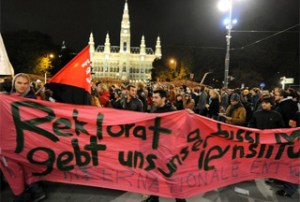 On Tuesday, October 17, students launched an occupation at the University of Fine Arts in Vienna. Two days later, other students occupied the largest lecture hall at the University of Vienna, and the movement has since spread to every leading Austrian university.
The Austrian students are protesting underfunding, corporatization, and overcrowding at Austria’s universities. More broadly, they are part of a wave of European student activists in opposition to the Bologna Accords, a set of proposals for education reform and standardization throughout Europe.
Yesterday, Thursday, saw a mass march through the streets of Vienna whose participation has been estimated at more than thirty thousand students.
There has been very little coverage of the protests in the English-language media, and most of what does exist in English is from non-English-speaking countries, as with this story and this one from a Chinese news agency. This short piece from the Boston Herald, now four days old, is a rare exception.
English-language reports from within the movement include this one, Reports from sympathetic activists include this one.
The primary Twitter feeds for the campaign are #unibrennt (“the university burns”) and #unsereuni (“our university”). Almost all of the traffic is in German, of course, but I’ve found that adding the word “Austria” or the word “students” to a search turns up a fair number of English-language posts.
The Twitter account @unibrennt_en is in English, but it’s infrequently updated. This blog post has an impressively detailed roundup of online sources of information, most of them in German.
I’m obviously still getting up to speed on this story myself. Look for updates in the days to come. If you have any useful info or links, please leave a comment.

 studentactivism.net
Recent Comments