
You are currently browsing the category archive for the ‘Campus Communities’ category.
 FIRE — the Foundation for Individual Rights in Education — is on the right side of the issues a fair chunk of the time. Their (right-wing) politics aren’t mine, by any stretch, but when they’re beating the drums for freedom of expression and due process on campus, they’re doing important work.
I just wish they could do that important work better.
Here’s the latest example. Back in early August, Professor Thomas Thibeault of East Georgia College was called to the office of EGC president John Bryant Black. By Thibeault’s account, Black demanded that he resign from the college that morning, and threatened to make public Thibeault’s “long history of sexual harassment” if he did not.
Thibeault refused to resign and was escorted from the campus, under threat of arrest if he ever returned. In the two months since, Thibeault says, he has not been given a hearing, been permitted to defend himself against the sexual harassment charges, or even been told what exactly he’s being charged with, despite the fact that Black convened a faculty committee to investigate him.
This is seriously screwed up. If Thibeault’s version of events is true (and neither Black nor EGC have publicly disputed it), the EGC administration has behaved shamefully — attempting to bully him into resigning with vague and ominous threats, then refusing to allow him a timely opportunity to be informed of, and respond to, the charges that have led to his removal from the classroom. Bravo to FIRE for shining a light on this situation.
…And that’s where I stop praising them. Here’s why.
Two days before Thibeault was brought into Black’s office, he attended a faculty training session on sexual harassment, where he made some remarks from the floor. In FIRE’s gloss, “he presented a scenario regarding a different professor and asked, ‘what provision is there in the Sexual Harassment policy to protect the accused against complaints which are malicious or, in this case, ridiculous?’ ”
FIRE sees this as “Kafkaesque irony,” saying that “Thibeault made the mistake of pointing out — at a sexual harassment training seminar — that the school’s sexual harassment policy contained no protection for the falsely accused.” But Thibeault’s own account of his remarks makes it clear that FIRE’s summary of his comments is woefully inadequate.
Here’s how Thibeault himself describes the “scenario” he presented at the sexual harassment training:
Last week two students were talking to me in the hallway after class. One student said that she didn’t want to go to a professor’s office because he looked down her cleavage. The woman was wearing clothing that was specifically designed to draw attention to her cleavage. She even sported a tattoo on her chest, but I didn’t get close enough to read it. The cleavage was also decorated in some sort of sparkly material, glitter or dried barbecue sauce. I couldn’t tell. I told the student that she shouldn’t complain, if she drew such attention to herself. The other female student then said, and I hope you’re not offended by her actual words, ‘if you don’t want anyone looking at your titties, I’ll lend you a T-shirt. I have one in the truck.’ The first student then said, ‘No. I’m proud of the way I look.’ I left the conversation at that point.
Let’s break this down, shall we?
- A female student told Thibeault that another professor’s habit of staring at her breasts made her uncomfortable.
- Thibeault told her, in front of another student, that she had no right to complain because she was dressed provocatively.
- A week later, Thibeault recounted this story to a large group of faculty members at a public meeting, complete with identifying details of, and gratuitously offensive comments about, the student’s appearance.
- To top it all off, he presented the student’s complaint about the other professor as an example of a “ridiculous” sexual harassment charge.
According to the EGC faculty handbook, by the way, “conduct of a sexual nature” that “has the purpose or effect of … creating an intimidating, hostile, or offensive academic environment” is sexual harassment.
FIRE has all this background. But they chose not to mention it.
And this is why I find FIRE so frustrating. It’s not “Kafkaesque irony” that Thibeault was hauled in to the president’s office on a sexual harassment complaint two days after the training. It’s not ironic at all. It’s not even surprising. By Thibeault’s own account, he made wildly inappropriate sexualized comments to a female student, told that student that it was her own fault if a professor leered at her while she was wearing a low-cut top, and then shared this anecdote at a faculty meeting in a bizarrely insulting way. (Barbecue sauce? Come on.)
I don’t know whether any of this is actionable as sexual harassment. I’m not a lawyer. I don’t know what Thibeault’s history is, or whether the university’s claims that he has a “long history” of misbehavior have any merit at all. As I said at the top of this post, I’m inclined to believe that Thibeault has been treated unfairly, and that EGC has violated his right to academic due process.
But this whole incident serves as yet another reminder to me that when I see a piece on FIRE’s site, I can’t just take their analysis and run with it. I can’t even assume that they’re presenting the basic outline of the story in a fair and complete way. I have to research and fact-check the whole thing from the beginning. And because they break so much news — because they are out there digging these cases up — I have to ignore their stuff if I can’t find independent corroboration of their claims.
Because they just can’t be trusted to tell a story straight.
And that sucks.
Note: As I indicated above by linking to Thibeault’s statement at FIRE’s website, and again by saying that “FIRE has all this background,” FIRE did post that statement as a PDF document, and link to it from other documents. I never intended to suggest otherwise, and I’m happy to make that clear.
The student senate of the University of North Texas last week rejected a bylaw amendment that would have allowed same-sex couples to run for king and queen of homecoming.
Student government regulations at UNT do not bar LGBT students from running for homecoming king and queen, but they do provide that the court be elected as a male-female couple. The proposed bylaw amendment would have eliminated that restriction.
The bill, which had been introduced a week earlier, generated a strong negative response from UNT parents and alumni.
Debate on the proposal lasted for an hour, and at times grew heated. The final vote was five in favor of the change, ten opposed, and eight abstentions.
One student who voted against the bill said that he had been swayed by threats from alumni to end charitable donations to UNT, and from parents of students who had gone so far as to threaten to force their children to withdraw from the university.
Student government interns conducted an informal poll of two hundred students before the vote, and the UNT student newspaper, the NT Daily, said the results were “generally negative.” Comments on the Daily‘s coverage of the vote have, however, been mostly supportive of the defeated amendment.
(Thanks to @ericstoller on Twitter for the heads-up on this story.)
Evening update: Pitt’s chapter of the ACLU is co-sponsoring an Oakland Unites for First Amendment Rights rally on campus tomorrow at 5:30 pm. A four-point petition will be circulating at the rally — we’ll post the text as soon as we get it.
Last week’s G-20 meeting of the leaders of the world’s 20 largest economies drew massive protests in and around the University of Pittsburgh, and now police and campus administrators are facing heavy criticism for their handling of the incidents.
Over the course of the two-day meeting, police used sonic cannons, tear gas, pepper spray, bean-bag projectiles, smoke canisters, stun grenades, and rubber bullets on demonstrators, making hundreds of arrests. Innocent students, including some student journalists, were caught up in police sweeps on the Pitt campus.
Police arrested nearly two hundred people during the course of the G-20 demonstrations, including more than fifty students. The Allegheny County district attorney has already announced that charges against four students will be dropped, and more dismissals are expected.
Update: In a reversal of a policy announced yesterday, Pitt will allow students seeking dismissal of charges to bring attorneys to their meetings with campus police officials. The university has also confirmed that no campus judicial proceedings will be brought against students whose criminal charges are dismissed.
Dozens of videos from the protests have surfaced online, ranging from the hilarious (three burly cops in face masks attempt to pass as protesters, and failing spectacularly) to the chilling (students trapped on a stairway between two sets of cops, each trying to force them to go the other way).
Two student journalists for the Pitt News were arrested while covering the Friday night protests, and eight more were tear gassed, pepper sprayed, or maced. Stories have also emerged of students being locked out of their dorms, then arrested for failing to return to their rooms.
One student has posted a lengthy account online of how she was arrested for “failing to disperse” while helping students to disperse by holding open the locked doors of one dorm building. She describes students being arrested as they entered the dorms, and other reports suggest that students were arrested while waiting in line at local restaurants, or studying in the campus library.
Violations of students’ rights on campus were not limited to arrests. One video posted online shows police lobbing a tear gas canister onto the balcony of a dorm from which a group of students were quietly watching the protest in the street below. (The canister is thrown just after the two-minute mark in the video.)
The question of what limits should have been set on the actions of municipal police on the Pitt campus is being raised over and over again in the aftermath of the G-20, and evidence is emerging that it was a subject of dispute among police at the time. Police scanner recordings obtained by the Pitt News show that a high-ranking Pitt university police officer intervened personally on Friday night to prevent a non-university police “attack team” from storming the Towers, a campus dorm.
Adding to the confusion, and contributing to the police overreaction, is the fact that Pitt’s campus is an urban one, with no clear boundaries, and and the fact that thepolice were brought in for the G-20 protests from as far away as Tucson, Arizona. Many of the cops present were unfamiliar with the location.
Pitt’s university police have also been criticized, however. The university’s text message based Emergency Notification System was not used at all on Thursday, and only two messages were sent out on Friday — one encouraging them to “be careful” and “exercise good judgment,” and the other advising them to “remain near their residences.” As noted above, a number of students were ultimately arrested at or near their dorms that night.
Pressure on the police and the Pitt administration has been building since the meeting ended, with many claiming that, as one online petition puts it, “the right of citizens — students, professors, families, community members, and media — to assemble and gather peacefully in public was not only denied and violated but suppressed with unnecessary and excessive force.”
Note: Check out What Happened At Pitt?!?! for a huge collection of links and resources.
 As many as ten thousand students, faculty, and staff of the University of California participated in public protests against the defunding of the university yesterday, and untold thousands more walked out of classes, held teach-ins, and walked picket lines. Students at two campuses occupied university buildings, and observers of the Berkeley rally said it was that school’s biggest protest in a generation.
This was big.
And it was even more impressive because yesterday was the first day of classes for the year at every UC campus except for Berkeley and Merced. At UC’s other eight universities, organizers brought hundreds, even thousands, of people into the streets and quads despite the lack of time and facilities for organizing in advance.
Yesterday, then, was just the beginning. UCLA protesters won a commitment from their chancellor to hold a public forum on the budget crisis on October 6, and they’re already organizing to keep the pressure up over the next twelve days. UC Santa Barbara has scheduled a series of teach-ins for October 11. In the coming weeks and months, activists will be building on what was achieved yesterday, growing the movement that will restore the University of California’s health, strength, and accessibility.
Over the course of this afternoon, I’ll be posting detailed reports on yesterday’s events at each of UC’s ten campuses — Berkeley, Davis, Irvine, Los Angeles (UCLA), Merced, Riverside, San Diego (UCSD), San Francisco (UCSF), Santa Barbara (UCSB), and Santa Cruz (UCSB). Check back in to get the whole story!
Note: Josh from Santa Cruz (@alittlefishy on Twitter) has put together the best roundup I’ve seen of media coverage of the UC walkout. The reports below rely heavily on the sources he compiled.
Berkeley
Five thousand was the official police estimate of the size of the crowd, and UC sources called it the largest Berkeley rally in decades. After two hours of speeches and chants, the protest went mobile, streaming off the campus and shutting down traffic for several blocks. A mass meeting later drew hundreds of participants, who voted to meet again next Wednesday to plan strategy for a possible statewide conference October 24.
Davis
A crowd that the UC Davis student newspaper said numbered in the thousands rallied on the campus quad, then staged an impromptu march to — and into — the Mrak administration building. Hundreds of sign-toting protesters occupied the public areas of the building briefly before, as grad student @AMYCHAMP put it on Twitter, deciding “to keep it peaceful, and take it outside.”
Irvine
Morning and evening teach-ins bracketed the day at Irvine, where a crowd estimated at about five hundred attended the noon rally. One source said that 150 Irvine faculty walked out of their classes.
UCLA
The noon rally at Bruin Plaza drew about seven hundred participants, and like those at Berkeley and Davis, it eventually turned into a march. Police blocked protesters when they arrived at the front entrance of Murphy Hall, the site of UCLA’s administrative offices, but a group of about sixty students were able to find alternate routes inside and make their way to the doors to the chancellor’s offices, where they staged a sit-in.
UCLA’s chancellor was not in the building at the time, but a campus official met with sit-in leaders and agreed to their two demands — that he set up a meeting with representatives of the university’s undergrads, grad students, faculty and staff, and that he schedule a town-hall campus forum on the budget crisis. The sit-in ended without any arrests or university judicial action.
Merced
Merced is the newest UC campus — it’s just four years old — and one of the smallest. Their rally was the smallest as well, but the walkout had significant participation, and students and faculty conducted flyering and tabling during the day as well.
Riverside
Hundreds of students participated in the noon rally, with more attending teach-ins before and after.
San Diego
Teach-ins were held on Wednesday and Thursday, and a two-hour rally drew hundreds of participants. At the end of the rally, some protesters marched into classes to urge students and faculty to join the walkout.
A campus-wide planning meeting for future organizing is scheduled for Wednesday.
San Francisco
Hundreds attended a rally at the UCSF Medical Center, where State Senator Leland Yee addressed the crowd. Students at San Francisco State and the City College of San Francisco also held demonstrations in support of the UC walkout.
Santa Barbara
There was a full day of walkout events at UCSB, where more than 125 faculty members signed the walkout pledge. Four hundred university community members attended the noon rally.
There will be a budget teach-in at Santa Barbara on October 14 from 3 pm to midnight.
Santa Cruz
Two rallies were held — one at noon and the second at 3:30 pm. The first drew hundreds of participants, and the second led to a building takeover that (as of Tuesday morning, five days after the walkout) is still ongoing. More on that in a new post soon.
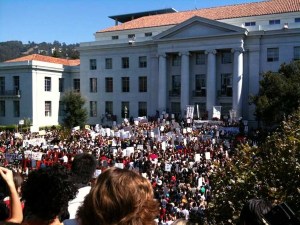 2 pm Pacific time: This was a big protest.
I’ve posted photos from Berkeley, Irvine, UCSB, Davis, and UCLA at the @studentactivism Twitter feed. (The photo at right is from Berkeley.)
2:10 pm: According to @AMYCHAMP on Twitter, UC Davis students briefly occupied the Davis administration building about half an hour ago before deciding “to keep it peaceful, and take it outside.”
2:20 pm: Reports coming in that UCLA students are holding a sit-in at the chancellor’s office, demanding a public forum on the budget crisis.
2:50 pm: The UC Berkeley rally went mobile a while ago, and eventually into a traffic-blocking sit-in/march through the streets of Berkeley. Waiting for word on further developments.
3:40 pm: The San Francisco Chronicle says the Berkeley rally drew five thousand participants.
5:40 pm: Local news says that several hundred students participated in the UC Santa Cruz walkout. Reports on Twitter suggest that there may have been a building takover there too.
5:50 pm: The UCLA Daily Bruin confirms that between 60 and 70 students are staging a sit-in at the campus’s Murphy Hall, demanding that the UCLA chancellor agree to hold a public forum.
6:30 pm: The UC Berkeley Daily Cal’s walkout blog says that Berkeley protesters shut down traffic near the campus for close to two hours this afternoon.
6:50 pm: It’s confirmed — UC Santa Cruz students are occupying the UCSC Graduate Student Commons, a student union building on campus … and the occupation has a blog.
7:30 pm: Odd that neither the Chronicle of Higher Education or Inside Higher Ed has updated their coverage of the walkout since this morning. I guess we’ll see what they have to say tomorrow.
Friday: I’ve compiled a campus-by-campus wrapup, posted here.

 studentactivism.net
Recent Comments