
You are currently browsing the category archive for the ‘Gender’ category.
Bucknell University’s administration has denied a conservative student group permission to hold an affirmative action bake sale.
Such sales, in which cupcakes and cookies are offered at full price to white male students and cheaper for women and students of color, have become a common attention-grabbing tactic for right-wing campus groups in recent years. Clashes with administrators over the sales have been common too, with sponsors claiming that they’re protected speech and universities noting that they’re — by design — a discriminatory practice.
Wikipedia has a pretty extensive article on affirmative action bake sales, including mention of a nice move by the Graduate and Professional Students of Color student organization at the University of Illinois, which responded to one such sale by holding a white privilege popcorn giveaway in which white white men were given a full bag of popcorn, while women and people of color got a mostly-empty bag.
A second Binghamton Student Association representative who used racist slurs against an SA vice president last week has lost his position as a result.
As I reported last Saturday, representative Mike Lombardi resigned from the SA days after telling vice president for finance Alice Liou to “go eat a dog,” while Ehlad Bar-Shai, who had taunted Liou for having “squinty eyes” prior the Lombardi incident, was elected chair of the SA’s Student Assembly in a close vote.
News of Bar-Shai’s comments spread widely on campus after his election, however, and a protest rally was held last weekend calling for him to be removed from office.
Last night, at the final Assembly meeting of the year, Bar-Shai asked to make a formal apology, but a motion to reconsider his election was introduced before he was able to do so.
Bar-Shai argued that the motion to reconsider was out of order, but was turned aside. When the Assembly approved the motion Bar-Shai and several supporters withdrew from the meeting, causing it to lose quorum.
But the Assembly was eventually able to re-establish quorum, a new election was held, and incumbent Assembly chair Josh Berk, who had lost to Bar-Shai at the previous meeting, was re-elected by a vote of 15-4.
Last fall, University of Colorado at Colorado Springs student government president David Williams refused to sign a $2100 budget allocation for a National Coming Out Day event sponsored by Spectrum, a LGBT student group on campus. His action didn’t block the money from being disbursed, but did delay its release.
Williams said that the decision reflected his personal beliefs. Other students said it violated the student goverment constitution, and launched a campaign to remove him from his position.
The removal effort drew broad support, but ran into various bureaucratic and procedural stumbling blocks. Six months later, Williams remains in office, and he even ran for re-election this spring.
That election campaign gave the students of the campus the chance to weigh in on the controversy directly, however, and the result was decisive. Not only did Williams and his running mate lose, they lost to Daniel Garcia and James Burge, who are both gay men of color.
The effort to impeach Williams, whose term ends June 1, continues.
Steven Oliver and Kendra Key met in the contest for the student government presidency at the University of Alabama this year.
More than fourteen thousand students, well over half the campus population, voted — the most in UA history. The race was close, with less than two percentage points separating the two candidates. But in the end Olvier, a white man, defeated Key, a black woman, by two hundred and sixty-one votes.
UA is the flagship campus of Alabama’s state university system, and it has never had a black student body president. In the fourteen years since its current student government was established, seventeen students of color have run for campus-wide office. All have lost.
Race is not the only factor in Alabama’s student government elections, of course. (The campus’s student body is more than eighty-five percent white, to start with, which means the majority of Key’s support came from white students.) Oliver ran with heavy support from fraternities and sororities, and the divide between greeks and independents played a major role in the campaign.
But the fact that UA’s student officers have been — and remain — all white has significant consequences for the student government, and the campus as a whole. UA’s student newspaper, the Crimson White, grapples with those consequences in two articles — here and here.
Note: I’m still digging on this story. Follow me on Twitter to keep up with new info as I get it.
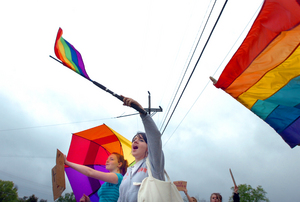 The tremendous Pam Spaulding writes at Pandagon about an administrator at a Kentucky high school who allegedly told teachers to prohibit gay and lesbian students from leaving class to use school bathrooms after two female students were caught kissing in the girls’ restroom.
What she doesn’t mention, though, is that fifteen students held a public protest against the ban in front of the school on Friday.
I’m repulsed by the administrator’s actions here, of course, if the story is true. But I also find it fascinating that high school administrators in Franklin County, Kentucky would assume that teachers would know who their gay and lesbian students were.
And I’m thrilled that these students — gay, straight, both, or neither — were willing to stand up publicly against such nonsense.
1:00 pm update: I’ve found an article on the incident from the Frankfort, Kentucky State Journal. In it, the principal of Franklin County High School says “we would never send out an e-mail that had anything to do with sexual orientations,” which is almost, but not quite, a denial that such an email actually was sent. Assistant principal Karen Buzard, who allegedly sent the email, was unavailable for comment.
The State Journal article also included the above photo from the protest, along with some new details — the protesting students painted “Gay Pride” and rainbows on their faces, and held signs that said “Honk if you’re gay” and “We have a right to pee.”
3:00 pm update: Several anonymous commenters at the State Journal website claim that Buzard’s email restricted the bathroom privileges of specific students, not all gays and lesbians. I have reached out to school officials for comment, but have not yet had a response.
It’s also worth mentioning that if school officials did restrict bathroom privileges of gays and lesbians as a group, what they did is likely legal, as Kentucky has no LGBT civil rights law.
May 4 update: I’ve just received an email from Harrie Buecker, superintendent of the Franklin County Public School system. She says the district is “continuing our investigation” of the email incident. More as I get it.
May 5 update: The principal of Franklin County High School has posted a statement on the school’s website saying that no email was ever sent “barring any specific group of students from using the restrooms.” According to the statement, teachers were told that “certain students should not be allowed to leave the classroom during class because they had been in violation of school rules,” but “all students have time between classes to use the facilities.”

 studentactivism.net
Recent Comments