
You are currently browsing the category archive for the ‘Administration’ category.
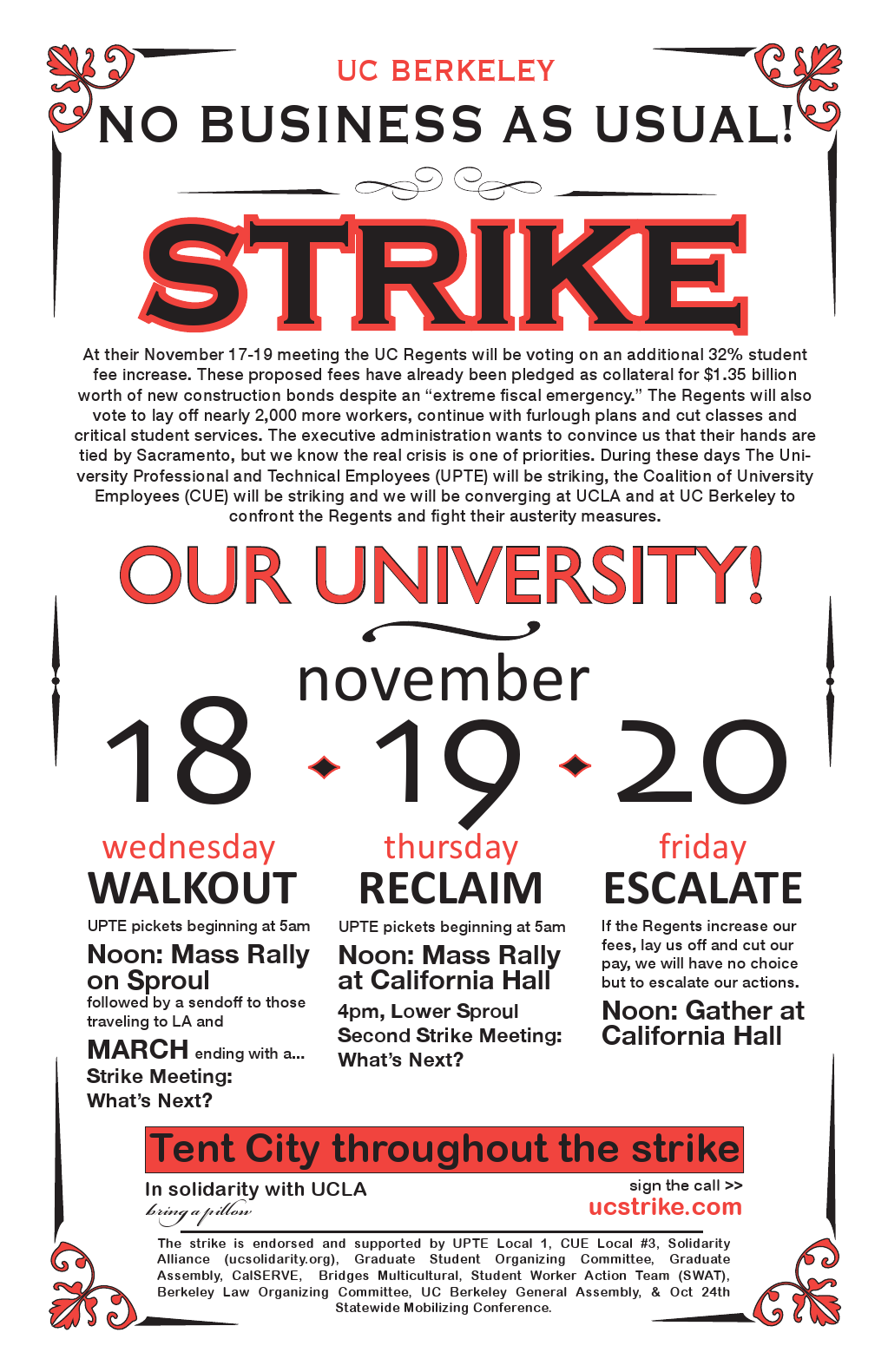 The Regents of the University of California open a three-day meeting at UCLA this morning, where they are expected to approve the largest UC fee increase in eighteen years — and confront some of their strongest student opposition ever.
The hike, which would raise in-state student fees to more than $10,000 a year, is scheduled for consideration by the board’s finance committee on Wednesday. If approved there, it will be sent to the full board for a Thursday vote.
The UC system is technically “tuition free,” but it charges student fees higher than many public universities’ tuition charges. If the current proposal is adopted, fees will rise by 15% this spring and by another 15% this summer, adding up to a hike of about fifty percent over two years.
Student protest actions against the increases — and against cuts to university budgets and enrollment — have already begun, but they’re expected to heat up tomorrow, Wednesday the 18th, with a large-scale walkout, strike, and demonstration at the regents meeting.
We’ll have more detail on planned (and unplanned) events tonight or tomorrow morning, and we’ll be following developments in California all week as they happen.
Pittsburgh mayor Luke Ravenstahl is moving forward with a plan to impose a one percent tax on college tuition, and he’s citing universities’ willingness to gouge their students as justification.
“When you look at some of the fees these places charge,” Ravenstahl told the Pittsburgh Post-Gazette, “we think it’s only fair to include a fee for the city.” Ravenstahl pointed to “charges for everything from athletic facility use to orientation to security,” the paper said.
A member of the Pittsburgh city council has introduced a proposal to charge universities a set amount for city services, but such a scheme would depend on voluntary compliance by the institutions, which is unlikely. Mayor Ravenstahl freely admits that students represent a softer target — as tax exempt institutions, universities are protected from such schemes.
The three faculty members suspended from Southwestern College after a budget protest two weeks ago returned to their jobs on Thursday, but the situation is far from resolved.
Earlier this week college officials floated the possibility that the profs might face criminal charges as a result of their actions, though police at the scene of the protest made no arrests and the only detailed eyewitness report available indicates that the entire event was peaceful and uneventful.
And yesterday the local blog Save Our Southwestern College reported that formal letters of reprimand are to be placed in each suspended professor’s file.
As SOSC notes, SWC has yet to provide any coherent public account of its seemingly erratic actions in the wake of the protest.
Meanwhile SWC president Raj Chopra, who went on vacation just hours after the suspensions were handed down, remains absent and incommunicado.
East Georgia College has reinstated a professor it suspended in August, withdrawing charges of sexual harassment it had lodged against him. But it has reprimanded the prof for using “offensive language” in the workplace, and asked him to sign a letter of understanding that includes the statement that he is “expected to act in a professional manner at all times.”
Professor Thomas Thiebault’s suspension came after a faculty meeting about sexual harassment policy in which he described a recent a conversation with a female student. The student had, Thibeault said, complained about another professor’s habit of staring at her breasts, in response to which he told her that she had no right to complain because she was dressed provocatively. During the course of telling that story, he provided identifying details of, and gratuitously offensive comments about, the student’s appearance.
Update | It’s worth laying out what exactly Thibeault said, and how various news organizations and advocacy sites have characterized it.
Here’s Thibeault’s own account of his remarks:
Last week two students were talking to me in the hallway after class. One student said that she didn’t want to go to a professor’s office because he looked down her cleavage. The woman was wearing clothing that was specifically designed to draw attention to her cleavage. She even sported a tattoo on her chest, but I didn’t get close enough to read it. The cleavage was also decorated in some sort of sparkly material, glitter or dried barbecue sauce. I couldn’t tell. I told the student that she shouldn’t complain, if she drew such attention to herself. The other female student then said, and I hope you’re not offended by her actual words, ‘if you don’t want anyone looking at your titties, I’ll lend you a T-shirt. I have one in the truck.’ The first student then said, ‘No. I’m proud of the way I look.’ I left the conversation at that point.
The purpose of the anecdote is to ask the question “what provision is there in the Sexual Harassment policy to protect the accused against complaints which are malicious, or in this case ridiculous?”
Here’s how the Foundation for Individual Rights in Education characterized Thibeault’s comments:
Thibeault … related a story about another professor and asked, “What provision is there in the sexual harassment policy to protect the accused against complaints which are malicious or, in this case, ridiculous?”
Here’s the Chronicle of Higher Education’s take:
Mr. Thibeault said students’ complaints of sexual harassment could be frivolous, and as evidence he related an encounter he said he’d had with a young woman who he said was dressed provocatively, with her cleavage showing. Yet she complained to Mr. Thibeault that another professor always stared at her breasts, the instructor said.
Inside Higher Ed referred to Thibeault simply as
…an English professor who, ironically, had openly criticized the lack of protections for the falsely accused in its sexual harassment policy.
Conservative news site WorldNetDaily says Thibeault
…questioned the assertion – as he understood it – being presented by Mary Smith, the school’s vice president for legal affairs, that the feelings of the offended constituted proof of offensive behavior.
As I noted in my previous post on this case, I think the way that EGC treated Thibeault is reprehensible. But the nature of his public comments are relevant to the story, and it’s startling to me how far some have been willing to go to obfuscate them.
Inside Higher Ed has a new piece up this morning on the Southwestern College fiasco, bringing the story pretty much up to date. Go check it out.
Also this morning, a source on campus sent me a copy of the latest memo from the administration. It says that hearings for the four suspended (or, to use SWC’s preferred phrasing, withdrawal-of-consent-to-be-on-campused) faculty members have been cancelled at the request of the faculty members involved.
“The Human Resources Deparment,” the memo continues, “is diligently moving to conclude the investigation on this matter in the hopes that it can be resolved and that the three individuals may be returned to campus this week.”
Yet another weird twist in a story composed exclusively of weird twists, in other words. But it gets a little less weird if you look at the text of the law under which the suspensions were authorized.
According to that law, a withdrawal of consent for an individual to be on campus automatically expires after fourteen days, and it cannot be renewed. An individual whose consent has been withdrawn may request a hearing, but the law says nothing about the format of such hearings, who conducts them, or what they are required or empowered to do.
Whether or not “the investigation on this matter … can be resolved” in the next few days, the three suspended professors will be back on campus by the end of the week. The SWC administration’s memo notwithstanding, there’s no “may” about it. On Friday they go back to work.
Assuming that there are no more weird twists, of course.

 studentactivism.net
Recent Comments