
You are currently browsing the category archive for the ‘Administration’ category.
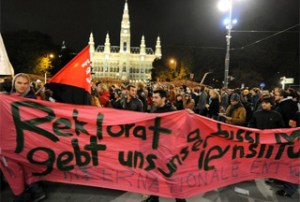 On Tuesday, October 17, students launched an occupation at the University of Fine Arts in Vienna. Two days later, other students occupied the largest lecture hall at the University of Vienna, and the movement has since spread to every leading Austrian university.
The Austrian students are protesting underfunding, corporatization, and overcrowding at Austria’s universities. More broadly, they are part of a wave of European student activists in opposition to the Bologna Accords, a set of proposals for education reform and standardization throughout Europe.
Yesterday, Thursday, saw a mass march through the streets of Vienna whose participation has been estimated at more than thirty thousand students.
There has been very little coverage of the protests in the English-language media, and most of what does exist in English is from non-English-speaking countries, as with this story and this one from a Chinese news agency. This short piece from the Boston Herald, now four days old, is a rare exception.
English-language reports from within the movement include this one, Reports from sympathetic activists include this one.
The primary Twitter feeds for the campaign are #unibrennt (“the university burns”) and #unsereuni (“our university”). Almost all of the traffic is in German, of course, but I’ve found that adding the word “Austria” or the word “students” to a search turns up a fair number of English-language posts.
The Twitter account @unibrennt_en is in English, but it’s infrequently updated. This blog post has an impressively detailed roundup of online sources of information, most of them in German.
I’m obviously still getting up to speed on this story myself. Look for updates in the days to come. If you have any useful info or links, please leave a comment.
We have received a PDF copy of a third statement from the administration of Southwestern College regarding last Thursday’s campus rally and subsequent banning of three professors from campus. Highlights:
The statement appears over the signature of Nicholas C. A. Alioto, who is identified within it as SWC’s “Acting Superintendent/President.” Alioto, a Certified Public Accountant, is a recent hire at SWC — he was named as the college’s Vice President for Business and Financial Affairs in July.
The statement says that the primary protest on October 22 “was conducted in accordance with Policy 5550.” Policy 5550 is Administrative Policy 5550 of the Southwestern Community Colllege District, and can be found here. It is based on, and promulgated in accordance with, Section 76120 of the California Education Code.
Note that Section 76120 and Policy 5550 regulate the conduct of students, not faculty.
The statement expresses the administration’s “concern” about events that took place when a “group of individuals left the free speech area” after the rally. It says that three faculty members are being investigated because of “concerns” that “center around three areas” — “[a] Incitement of students to move outside the free speech area and to violate College policies, [b] Disregard for warnings and directives of police officers, and [c] Physical confrontation with police officers.”
According to the statement, these areas are concern are being explored by “an outside investigator” who is not named or otherwise identified. That investigator has been conducting interviews, and his or her investigation “is expected to be concluded in the very near future.”
The statement denies that the three faculty were suspended. Rather, it says, they were “placed on paid administrative leave” and notified of “withdrawal of consent to be on-site.”
The faculty in question have, according to the statement, requested administrative hearings regarding their non-suspension suspensions. The next passage of the statement is worth quoting in full:
“In the interests of being as transparent as possible, administration offered to conduct the hearings in public; however, legal counsel for the three individuals declined that offer.”
Finally, the statement declares that “in order to provide due process,” the administration “must refrain from commenting further until the investigation is concluded.”
More soon.
On Tuesday night someone left a comment on one of my posts on the Southwestern College faculty suspensions that that passed on the text of SWC Governing Board President Jean Roesch’s Monday statement on the incident. Here’s that statement, quoted in full:
To: College Community
Many of you have learned that four faculty members were placed on paid administrative leave on Thursday, October 22, 2009 and three faculty members remain on paid administrative leave at this time, pending the outcome of the investigation. Please understand that no formal charges or allegations have been made against any College faculty member or employee at this time.
The student rally held between 11 a.m. and 12 p.m. on October 22, 2009, is not the focus of the investigation. The College is investigating safety and security issues that arose after the approved organized student rally. The College respects, values and is committed to lawful free expression and the student rally provided an opportunity for our students to voice their concerns and to underscore the challenges that all community college students, and community colleges, are experiencing.
The College is committed to maintaining a safe environment for our students and staff, which is the focus of the investigation.
I’m guessing, since the comment was placed in response to a blogpost critical of the SWC administration, and since the commenter adopted the moniker “SWC Professor,” that I and my readers are intended to take this statement as a rebuttal to our criticisms. If so, it’s a deeply disappointing one.
President Roesch seems to believe that if you give students and faculty authorization to hold a one-hour rally at a specific on-campus location, you’ve dispensed with your obligations to protect “lawful free expression” in the college community. But that’s not how the First Amendment works, and it’s not how a college should work.
The First Amendment doesn’t just protect free speech. It also explicitly protects the right of the people to peaceably assemble, and to petition the government for redress of grievances. A public college administrator is in a very literal sense an agent of the government, and SWC is a public college.
Students and faculty at a public college have a moral right to hold a peaceful rally on campus. They have a moral right to peacefully march across campus to the president’s office. There should be no difference in the eyes of the law, and there should be no difference in the eyes of any campus administrator, between a “approved organized student rally” and a spontaneous, extemporaneous one.
The SWC administration has so far offered no evidence that any incident that took place on Thursday afternoon placed that day’s march outside the bounds of fundamental First Amendment protections.
A community college dean who blogs anonymously at Inside Higher Ed has weighed in on the faculty suspensions at California’s Southwestern College, and his piece is definitely required reading.
“Dean Dad,” as he styles himself, is not a fan of campus protesters. “People who don’t deal with budgets for a living often don’t understand the constraints within them,” he writes, and too frequently “leap to the moral high ground and start passing judgments, loudly and publicly, based on misinformation.”
That said, he notes that when you’re a college administrator, dealing with such criticism — fair or unfair — is part of your job. And there are a bunch of ways you can do it:
You can work together with your critics to lobby for more government aid. You can bring those critics to the table and ask them for concrete recommendations. You can divide them. You can co-opt them. You can ignore them. You can conduct a PR blitz. (He takes a couple of sentences to describe each of these options, and as I said above it’s all well worth reading.)
Finally, he says, you can adopt the strategy that SWC president Raj Chopra has apparently chosen. You can “do your best imitation of Dr. Evil, go out on limbs that will be sawed off quickly in court, and make yourself look like an idiot in public.”
Again, DD is no friend of Chopra’s critics. He’s writing from the premise that Chopra’s position on the budget is reasonable, and that his student and faculty antagonists are unreasonable and ill-informed. And he still thinks Chopra is acting like a grade-A clod.
The title of DD’s piece is “Power 101.” He’s not concerned with whether Chopra had a technical legal right to authorize the suspensions, or what specifically happened on campus last Thursday. He doesn’t care, because those questions aren’t questions Chopra should have been asking.
A college like Southwestern is an institution, embedded in a network of other institutions — state government, unions, student groups, advocacy groups, non-profits, businesses, media. If you’re looking to transform an institution like that, or you’re hoping to thwart someone else’s attempts to transform it, you need to understand power. You need to understand the response that your actions will provoke, and the effect of that response on your position.
A leader of the ANC in South Africa once chastised a reporter who was trying to understand the long-term strategy of the apartheid government with regard to Nelson Mandela’s imprisonment. “You’re thinking like a chess player,” he said. “They play checkers.”
Most college and university administrators in the 21st century are adept chess players.
Raj Chopra plays checkers.
Update: I’ve posted a further discussion of Chopra’s actions here.
The Chronicle of Higher Education has its first major article up this morning on the Southwestern College faculty suspensions, and it, along with a couple other new stories, clears up some of yesterday’s unanswered questions.
None of those answers make the situation any less bizarre.
To recap: last Thursday a few hundred students and faculty carried out a peaceful protest against budget cuts at SWC, a southern California community college. That night four professors, including the president of the SWC faculty union, were suspended from their positions and barred from campus. The next morning the college’s president and HR director both left on extended vacations, leaving a low-level administrator behind to insist that the suspensions were “unrelated to the student rally.”
That’s what I had gleaned last night. Here’s what I’ve learned this morning…
The claim that the suspensions had nothing to do with “the student rally” can most charitably be described as deceptive. Yesterday the university clarified its previous statement, declaring that the suspensions came about because of an incident that took place during the protest, but after the officially sanctioned rally had formally ended.
SWC, like far too many American colleges, has a designated “free speech zone” in an isolated corner of the campus, and permission for the rally was limited to that area. At the end of the rally, however, a group of students and faculty marched on the offices of college president Raj K. Chopra, where they were stopped by a line of campus police officers.
SWC campus police chief Brent Chartier told the Chronicle that some of the protesters engaged in “illegal activity” at that point, that the incident is currently under investigation, and that criminal charges against protesters are under consideration. In a letter to the campus community yesterday, the president of SWC’s college district board said that “no formal charges or allegations” had yet “been made against any college faculty member or employee.”
Suspended prof Philip Lopez, the president of the faculty union at SWC, reacted with disbelief to the new statements. “If there are no charges,” he asked, “why were we placed on leave? Rumor? Reputation? Union-busting? Poor personal hygiene?”
It should be noted, by the way, that Thursday’s rally was not just a generic response statewide budget cuts. It was a protest against specific policies and tactics of Chopra’s, most notably a plan to balance SWC’s budget by cutting the number of classes the college offers each semester by 25%.
President Chopra has long been a controversial figure at SWC, and was the subject of a no-confidence vote by the campus chapter of CSEA, the faculty union, in May of this year. In that resolution, the CSEA chapter declared that a campus reorganization plan undertaken by Chopra had been conducted “with a complete lack of regard for Southwestern College’sstanding commitment to its own Shared Governance Guidelines.” As noted above and in yesterday’s post, the current president of CSEA’s SWC chapter, and one of the chapter’s former presidents, were among the four professors suspended on Thursday.
One last bit of background: The section of the California state code that allowed Chopra to kick the faculty members off campus empowers him to bar an individual from campus grounds “whenever there is reasonable cause to believe that such person has willfully disrupted the orderly operation of such campus.” It allows him to ban such an individual for no more than fourteen days, and requires that he hold a hearing on such a ban within seven days of receiving a request for one from a banned individual. If any of the three suspended faculty return to the campus before their suspensions are lifted, they are liable to arrest on misdemeanor charges that carry a maximum penalty of six months in jail.

 studentactivism.net
Recent Comments