
You are currently browsing the category archive for the ‘Governance’ category.
I’ve just put up a short think piece about the events of the last few days at the University of California, but those events are worth describing in detail — particularly since they’re a long way from over. Here’s what happened yesterday:
The UC Regents, as expected, voted to impose huge fee increase on undergraduate and graduate students in the university. These new fees represent a tripling of undergraduate costs in the last decade, and a 50% jump since 2007.
After the vote students at UCLA surrounded Covel Hall, where the meeting had taken place, trapping the regents inside. When a group of regents tried to leave campus students surrounded their van, forcing them to retreat to a nearby building. It would be nearly three hours before they, and UC president Mark Yudof, were able to make their escape.
Even before the vote students had occupied two buildings in the UC system, and the afternoon saw two more takeovers.
Fifty-two students were arrested Thursday night at Mrak Hall, the UC Davis administration building, after they defied police orders to clear the building. One local media source said this morning that “dozens” of those arrested were held overnight.
Students at UC Santa Cruz had occupied Kresge Town Hall, an auditorium, on Wednesday evening, and on Thursday they expanded their action to include Kerr Hall, an administration building. Students in Kerr released a 35-point list of demands on Thursday night, and both occupations were apparently still ongoing as of early this morning.
At UCLA itself an occupation generated some controversy, as activists took over Campbell Hall, a building that houses tutoring facilities and services for students of color on campus, in the early morning hours before the regents’ vote. An article in the Daily Bruin suggested that the takeover was initiated primarily by non-UCLA students, and that local and non-local activists disagreed about the wisdom of occupying that building. The Campbell occupation ended peacefully last night with no arrests.
Afternoon update: The Campbell Hall occupiers have issued a response to their critics, and it’s well worth reading. You can find it here.
Yesterday’s events broke through into the national media in a way that student protests rarely do, gaining major coverage at CNN, the New York Times, and USA Today.
8:00 am | Several dozen students have apparently barricaded themselves inside Wheeler Hall in Berkeley, making that the fifth building occupation in the UC system in the last two days.
Note | This post is from Wednesday, November 18. For news of the events of the 19th, including the student takeover of a building on the UCLA campus, click here. For news on the November 20th occupation of a building on the Berkeley campus, click here.
A little before noon today, University of California Students Association president Victor Sanchez posted on Twitter that campus police had used Tasers and batons on student protesters at the UCLA meeting of the UC regents. Sanchez’s post was retweeted more than forty times over the course of the afternoon, but he provided no details then or later.
It wasn’t clear from Sanchez’s post whether he was an eyewitness to the events, and early media reports provided no corroboration. About an hour later, in fact, the UCLA Daily Bruin used Twitter to post a flat denial from Lynn Tierney, director of communications for the UC president, that any student had been Tasered at the protest. The Bruin soon expanded upon that denial in an article, saying Tierney had told them that “police [had] not used tear gas, Tasers or rubber bullets” on the crowd, and that there had been no injuries to student demonstrators.
Within a few hours, however, it had become clear that Tierney’s denial was false, and that Sanchez’s post was accurate.
In a mid-afternoon press release, UCLA admitted that two campus police officers had used tasers “in light stun mode” against student protesters, and that two students had been injured in the protests — though it claimed that those injuries had not been caused by tasers.
Sanchez’s claim that cops had used batons on protesters was confirmed more directly. In a video posted to YouTube this evening, a police officer angrily lashed students with a baton before being restrained by a colleague.
Photos posted at the Daily Bruin website also show campus cops’ aggressive stance on campus. One showed an officer pointing a pellet weapon at protesters, while another showed a different officer threatening a student with a Taser.
Police use of Tasers in non-emergency situations has become far too common in recent years, and such casual violence has at times had tragic results. The students of UCLA deserve an honest accounting of today’s events.
November 20 | A post at LAist notes that UCLA recently settled a lawsuit with a student who was wrongly Tasered on campus in 2006. They wound up paying the guy $220,000.
The blog also posts a photo of a UCLA protester being Tasered in the chest, and notes that just last month the Taser company warned customers that if you Taser someone in the chest, “a lawsuit likely will follow.”
Oops.
It’s 10:30 am in California, and there’s already been a huge amount of activity surrounding the UC Regents’ UCLA meeting to approve huge increases in University of California fees.
Public comment on the fee proposal was the first item on the Regents’ agenda this morning, and UC Student Regent-designate Jesse Chang has been liveblogging events as they happened.
Originally scheduled for just twenty minutes, that time was doubled, and then extended again when the Regents moved to end it while four speakers were waiting for their turn at the microphone — students interrupted the meeting with chants until the chair agreed to allow the last four speakers to be heard.
When the chanting continued even after those speakers, the Regents moved to clear the room. According to Twitter reports, they recessed and left the hearing room while police dispersed the crowd. Eight attendees refused to leave and were arrested.
There’s lots more going on today — a mass rally against the fee hikes is scheduled for noon — and I’ll be updating with news as I get it.
10:40 am | The Mercury News is confirming reports of eight arrests at the meeting. The police say the eight were booked for unlawful assembly and will be released.
10:45 am | I’ve set up a Twitter list of people posting on the meeting and related protests. Please feel free to suggest feeds I should add.
10:55 am | The UCLA Daily Bruin has a live video feed of the meeting.
11:15 am | A group of students stood in the viewing section of the Regents’ meeting room a few minutes after eleven and began singing “We Shall Overcome” alternating with “We Are Not Afraid.” Meeting went into recess, and police arrested the singers. Many students in the viewing area raised fists in solidarity, breaking into cheers of support as the last of the group was arrested.
11:30 am | Number of new arrestees put at six by local media. Chair of Regents committee warned that if there was another disruption the room would be cleared completely. Two students now addressing the committee, opposing the increases.
12:05 pm | Public galleries just cleared after another blowup. Cops declared the gallery an unlawful assembly. Emotional conversation between student protesters and student regents right before the room was cleared.
1:05 pm | Student Regent Designate Jesse Cheng left the meeting room with the students who were expelled, while Student Regent Jesse Bernal stayed inside for the vote. He was the only regent to vote “no.” Cheng is now back inside, continuing to liveblog the meeting.
1:10 pm | Conflicting information circulating about police activity in connection with the protest outside the meeting. Several reports of taserings on Twitter, but the Daily Bruin says the administration officials deny that tasers have been used. Trying to get confirmation of other claims.
1:50 pm | A UCLA press release says that twelve of the fourteen people arrested inside the meeting today were students. The same press release estimates the size of the crowd outside at five hundred, and says that one protester was injured and taken to the hospital.
1:55 pm | The Daily Bruin is reporting on Twitter that protesters outside the Regents’ meeting are planning to block all exits to the building at three o’clock.
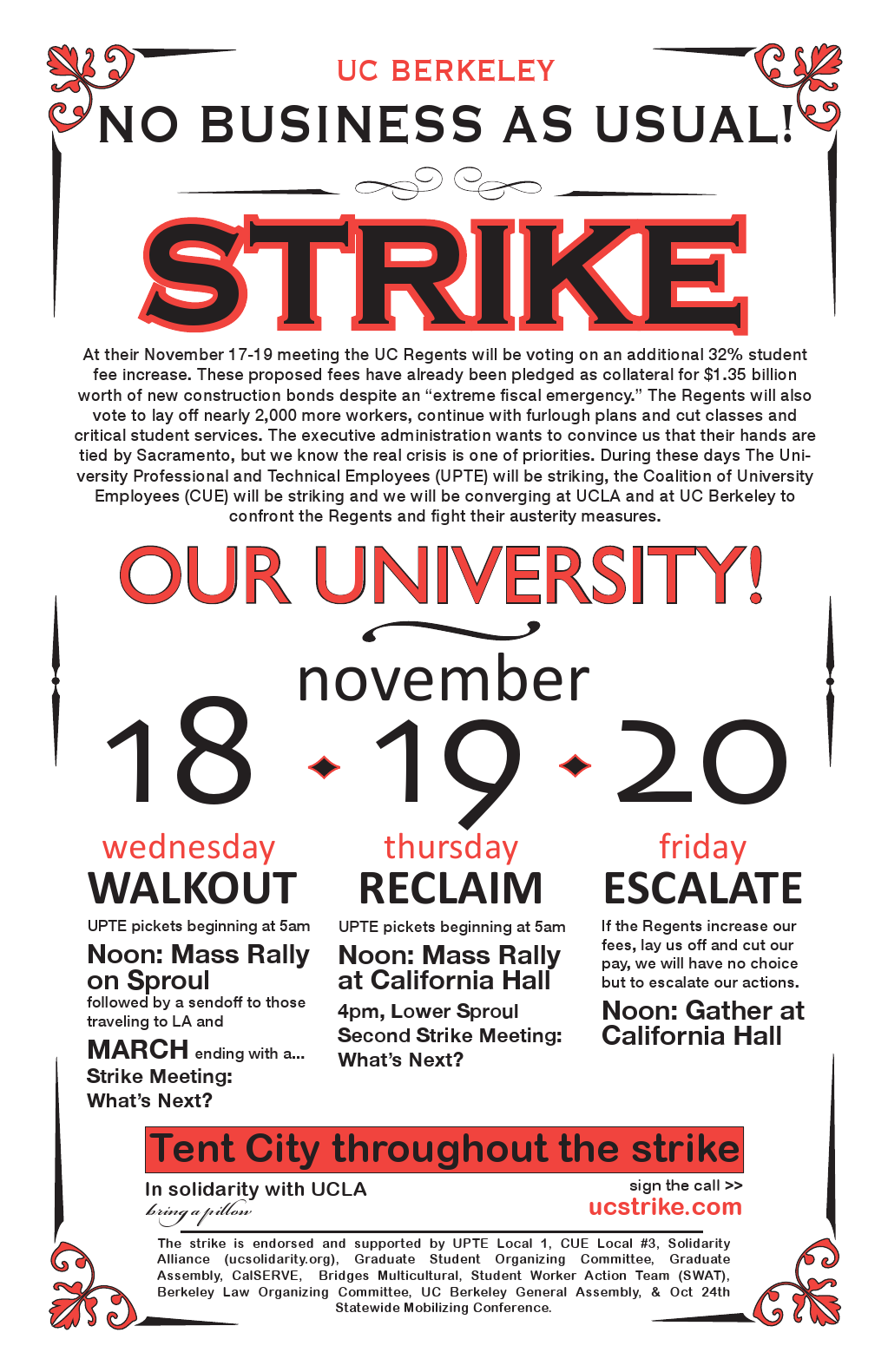 The Regents of the University of California open a three-day meeting at UCLA this morning, where they are expected to approve the largest UC fee increase in eighteen years — and confront some of their strongest student opposition ever.
The hike, which would raise in-state student fees to more than $10,000 a year, is scheduled for consideration by the board’s finance committee on Wednesday. If approved there, it will be sent to the full board for a Thursday vote.
The UC system is technically “tuition free,” but it charges student fees higher than many public universities’ tuition charges. If the current proposal is adopted, fees will rise by 15% this spring and by another 15% this summer, adding up to a hike of about fifty percent over two years.
Student protest actions against the increases — and against cuts to university budgets and enrollment — have already begun, but they’re expected to heat up tomorrow, Wednesday the 18th, with a large-scale walkout, strike, and demonstration at the regents meeting.
We’ll have more detail on planned (and unplanned) events tonight or tomorrow morning, and we’ll be following developments in California all week as they happen.
Pittsburgh mayor Luke Ravenstahl is moving forward with a plan to impose a one percent tax on college tuition, and he’s citing universities’ willingness to gouge their students as justification.
“When you look at some of the fees these places charge,” Ravenstahl told the Pittsburgh Post-Gazette, “we think it’s only fair to include a fee for the city.” Ravenstahl pointed to “charges for everything from athletic facility use to orientation to security,” the paper said.
A member of the Pittsburgh city council has introduced a proposal to charge universities a set amount for city services, but such a scheme would depend on voluntary compliance by the institutions, which is unlikely. Mayor Ravenstahl freely admits that students represent a softer target — as tax exempt institutions, universities are protected from such schemes.



Recent Comments