
You are currently browsing the category archive for the ‘History’ category.
In a 2002 interview Judge Sonia Sotomayor said that she felt “isolated … and very unsure about how I would survive” as an undergraduate at Princeton, and that campus organizations for students of color “provided me with an anchor I needed to ground myself in that new and different world.”
Sotomayor grew up poor in the Bronx, and she discovered in her first semester at Princeton that her educational background “was not on par with that of many of my classmates.” She became involved in Accion Puertorriquena, a Puerto Rican student organization, and the campus’s Third World Center, and she credits “the third-world students who preceded me and those who had supported me while I was at Princeton” for helping her to thrive on campus.
The complete article, from Hispanic Outlook in Higher Education, is not online, but extended excerpts can be found here.
Two fascinating elementary school stories this week: A Colorado third-grader has set up a gay rights rally as an independent study project for school, while a California sixth-grader was made to give an oral report on Harvey Milk at lunchtime, instead of in class.
The Colorado story pretty much speaks for itself, but the California one deserves a bit of explanation.
When Natalie Jones, a sixth grader at Mt. Woodson Elementary School near San Diego, chose Harvey Milk as the subject of a class presentation, the principal of MWES decided that her biographical project fell under the school’s “Family Life/Sex Education” regulations. That policy mandates that students’ parents or guardians be notified in writing “before any instruction on family life, human sexuality, AIDS or sexually transmitted diseases is given.”
But the principal didn’t just send out written notice to the parents of Jones’ classmates. She went further.
According to the ACLU, the principal told Jones that she wouldn’t be able to give the presentation at all, then a few days later rescheduled it for a lunch period. When she sent notice, she told them that students would only be allowed to participate with written parental permission.
Eight of Jones’ thirteen classmates attended her presentation.
The ACLU is demanding that the school apologize, clarify the “Family Life/Sex Education” policy, and allow Jones to give her presentation to the entire class in a regular class session. A PDF copy of Jones’ PowerPoint presentation can be found here.
So this isn’t something I would have expected to see in the Chronicle, even as a guest opinion piece.
In this Friday’s issue of the Chronicle of Higher Education, Charles Schwartz, an emeritus professor of physics at the University of California at Berkeley, argues that students should appoint trustees to public colleges and universities in proportion to the support that their tuition and fees provide to those institutions.
As “state support has dwindled,” Schwartz argues, tuition and fees have come to underwrite an ever-growing part of universities’ operating budgets. Given that, the principle of no taxation without representation argues that students (and, in situations in which they are not paying their own way, their parents) be given a voice in choosing university trustees and regents.
This is more than just a provocation on Schwartz’s part. He offers several sensible mechanisms by which this reform could be implemented, notes a parallel structure in the management of California’s public employees’ retirement fund, and even suggests that such representation could be mandated by federal law if it is not implemented on the state level.
Is such a change coming anytime soon? No, probably not. But it’s absolutely true that students directly fund public colleges and universities to an extent that was unimaginable just a few decades ago, and Schwartz is absolutely right to point out that right now “the industry of higher education treats undergraduate students as cash cows.”
Good for him, and good for the Chronicle for publishing him.
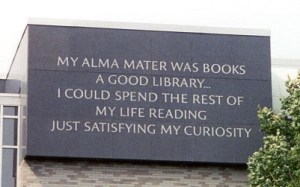 When you enter the main library at the University of Rhode Island, you pass between two inscriptions carved in black granite.
One is from Thomas Jefferson: “Enlighten the people … and tyranny and oppressions of body and mind will vanish like spirits at the dawn of day.”
The other is from Malcolm X: “My alma mater was books, a good library … I could spend the rest of my life reading, just satisfying my curiosity.”
The quotes inscribed on the library were chosen from among student submissions, and according to the artist who prepared them, it was not until after the stones carved that it became known that the Malcolm quote was incomplete. Here is the quote as it appears in his autobiography:
My alma mater was books, a good library. Every time I catch a plane, I have with me a book I want to read — and that’s a lot of books these days. If I weren’t out here every day battling the white man, I could spend the rest of my life reading, just satisfying my curiosity — because you can’t hardy mention anything I’m not curious about.
–Malcolm X.
The unveiling of the bowdlerized quote in the fall of 1992 sparked protest from students of color on the RIU campus, helping to provoke a sit-in that won the creation of a major in African and African-American studies at the university.
Happy Birthday, Malcolm.
When I heard about Wolfram Alpha, I was tickled. It didn’t strike me as anything like a Google-killer, but I did think it had the potential to be a powerful research tool. Historians (and activists) often want to get their hands on quantitative data that can be hard to track down, and if Wolfram makes that tracking down easier, that’ll be a big deal.
So I plugged in some obvious search terms for scholars of higher education, along with a few big subjects from the history of student activism, to see what Wolfram Alpha would turn up.
For the most part, it turned up nothing. When I searched…

 studentactivism.net
Recent Comments