
You are currently browsing the category archive for the ‘History’ category.
I’ve just arrived in Madison, Wisconsin for the 65th annual congress of the United States Student Association.
USSA, a confederation of student governments and state student associations, is the oldest and largest student-run national student organization in the country. Founded (as the US National Student Association) right here in Madison in the aftermath of World War II, USSA has since 1960 been based in Washington DC, working as a political advocacy organization as well as a grassroots organizing group.
I served on the USSA board of directors for two years as an undergrad, and a short internal history of NSA/USSA that I wrote then was (if I’m remembering the chronology right) the first piece of real historical writing I ever did. USSA shaped me as an activist, and it’s a big part of why I became a historian.
Occasionally over the years, and more regularly recently, USSA has invited me to come out to Congress to lend a hand. So I’ll be here for the next six days, holding a workshop on student history, leading a tour of the organization’s archives at the Wisconsin Historical Society, and helping out with chairing plenary sessions. If you’re here at the conference, come say hi. If not, stay tuned for more — I’ll be writing and tweeting (at hashtag #NSC12) a fair amount, I suspect.
One of the Supreme Court’s first cases when it returns in the fall will be Fisher v. University of Texas, scheduled for argument on October 10. The Fisher case concerns the constitutionality of affirmative action policies in undergraduate admissions at UT.
Campus affirmative action has been on shaky legal ground since 2003, when the Supreme Court ruled in the 5-4 Grutter v. Bollinger decision that race-conscious policies could not be used to remedy the effects of past societal discrimination, but only “to further a compelling interest in obtaining the educational benefits that flow from a diverse student body.”
Four of the Court’s members were then willing to accept a broader role for affirmative action, while four wanted to end it entirely. It was Justice O’Connor, the swing vote, who endorsed the compromise that carried the day, but in the last nine years, four members of the Court — including O’Connor — have left by death or resignation, and their replacements have shifted the Court significantly to the right.
Chief Justice John Roberts, one of the conservative post-Grutter additions to the Court, wrote in a 2007 opinion that “the way to stop discrimination on the basis of race is to stop discriminating on the basis of race” — that the Constitution and sound public policy demand race-blind admissions, in other words. In contrast, Justice Anthony Kennedy, who is likely to be the swing vote this year, held in the same case that the government has a “legitimate interest … in ensuring all people have equal opportunity regardless of their race,” and that “narrowly tailored” affirmative action is permissible in service of that interest.
Just how narrow such a policy must be to meet Justice Kennedy’s standards will likely be the central question before the Court in Fisher. And although Kennedy has so far refused to join the Court’s conservative wing in endorsing a ban on race-conscious admissions, he has never yet voted to uphold an actually existing affirmative action program.
I’ll be following this case as it proceeds through the SCOTUS calendar during the coming year, commenting in more detail on the issues involved, the oral arguments, and the decision when it eventually appears. But for now, as I mentioned above, I wanted to draw your attention to a website and petition that the United States Student Association has put up.
USSA will be submitting an amicus brief in support of UT’s affirmative action policies to the Supreme Court early next month, and they’re currently collecting signatures from students to include in that brief. If you’d like to let SCOTUS know you support affirmative action in college admissions, you can do it by adding your name to the USSA brief here.
“I enjoy money, clothes, cars, demonstrations, riots, and anything for the revolution.”
—Gloria Root, Playboy Playmate of the Month, December 1969
“In the meantime, the Mobe held its own counter-inaugural event with a rally and speakers. Later that night they scheduled a counter-inaugural ball. One of the speakers was Marilyn Webb, representing the new women’s consciousness-raising groups. She had prepared a speech about the aspirations of women, demanding equality for women both in the movement and in the larger society. As Marilyn began her speech, dozens of men in the packed audience began to catcall and boo. When she continued, more men joined in and the din got louder. Some of them began to chant, ‘Take it off! Take it off!’ ‘Fuck her down a dark alley!’ Marilyn was stunned and hurt. Shulamith Firestone tried to continue with a second speech, but soon both women were forced to abandon the stage in the pandemonium…
“While the Mobe leadership — all men — were also upset by the attacks, they didn’t join Marilyn on the stage to back her up.”
—Cathy Wilkerson, SDS and Weather Underground activist, on the National Mobilization to End the War in Vietnam’s January 1969 protest of the Nixon inaugural.
Last Sunday on The Newsroom Aaron Sorkin’s anchor-hero Will McAvoy offered up a whirlwind tour of the history of Students for Democratic Society, the Yippies, and the Vietnam antiwar movement that managed to get pretty much everything completely wrong in the service of an analogy that made no sense. Here’s my take, because when else am I going to get a chance like this?
• • •
“Back in 1968 when Rennie Davis and Hayden and their guys organized the SDS,
SDS was put together in 1960, not 1968. Its organizational roots stretch back as far as 1905. And although Rennie Davis and Tom Hayden would both become important figures in the group in the early sixties and after, neither participated in its founding meetings.
it was specifically to end the Vietnam war
Nope. SDS was a broad-based, multi-issue organization from the beginning. It addressed itself to concerns ranging from nuclear testing to civil rights to campus parietal rules. The 1962 Port Huron Statement, SDS’s immensely influential (and just plain immense) manifesto, mentions Vietnam just once, in the context of a discussion of the membership policies of the United Nations.
but that movement got eaten by Abbie Hoffman and Jerry Rubin and the Yippies.
Again, no. The collapse of SDS had almost nothing to do with the rise of the Yippies, and everything to do with government repression, sectarian infighting, and revolutionary overreach. And though SDS died with the sixties, the American seventies would see the ascendancy of other transformative social movements around issues like feminism, gay rights, environmentalism, Native American rights, and so on. Many of those movements had direct links to the New Left.
It’s also worth noting that Tom Hayden and the Yippies were allies for a big chunk of the period under discussion, as demonstrated by this film footage of Hayden speaking alongside Hoffman at a Yippie press conference.
It was impossible to define what the Yippies were protesting.
Ridiculous. The Yippies staged plenty of specific, targeted actions, and participated in plenty more, as we’ll see in a moment. Yes, they were a sprawling, inchoate group. Yes, they offered a vague, unformed vision of the revolution they were trying to achieve. But they also organized focused campaigns.
They were about giving the finger to anyone over thirty,
Abbie Hoffman was well past thirty by 1968. And when Jerry Rubin turned thirty that summer, he wrote that he “was reborn in Berkeley in 1964 in the Free Speech movement. When we say ‘Don’t trust anyone over 30,’ we’re talking about the second birth. … When people 40 years old come up to me and say, ‘Well, I guess I can’t be part of your movement,’ I say, ‘What do you mean? You could have been born yesterday. Age exists in your head.’ Bertrand Russell is our leader. He’s 90 years old.”
generically hating the American establishment,
Sure, the Yippies hated the American establishment. You know why? For starters, the American establishment was trying to put them (and Tom Hayden and Rennie Davis) in prison.
dropping out, getting high.
There was a lot of that going around in those days, or so I’ve heard. Still is, in some circles.
That’s how the progressive movement would be painted for the next forty years.
Attacks on left activists as dirty hippies didn’t begin with Abbie Hoffman. In 1966 Ronald Reagan used hippie-bashing to win the governorship of California, and he wasn’t remotely the only politician beating that gong. The 1960s saw a huge generational cultural upheaval that was inextricably bound up with a youth activist movement in the public mind — neither the Yippies nor anyone else had the power to change that, even if they’d wanted to.
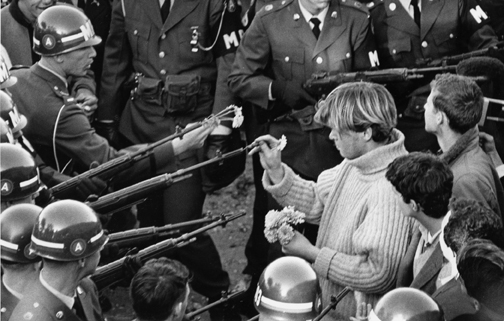
People passing out daisies to soldiers and trying to levitate the Pentagon.
Funny you should mention that. Because the attempt to levitate the Pentagon occurred at a 1967 demonstration against the war, an action that Tom Hayden has described as one of the most potent of the Vietnam War era. Yes, Jerry Rubin was the point person on that demo, but he was recruited for the position by David Dellinger, who was hardly a Yippie. (And if you think this photo actually harmed the antiwar movement, well God, Jed, I don’t even want to know you.)
The Pentagon’s a really big building. You can’t levitate it.
This part is true.
The sixties radicals and the Tea Party are roughly the same, with one big exception. Even at the height of 1968 the Democrats wouldn’t have nominated Abbie Hoffman or Jerry Rubin for any office, and no candidate would have sought their endorsement.
Okay, a few things. First, 1968 wasn’t “the height” of anything in terms of Democratic Party radicalism. That year the Dems nominated their sitting vice president at a convention that saw epidemic police violence against protesters, violence that was essentially ignored by the conventioneers. The party’s presidential nominee, Hubert Humphrey, never came out against the war in Vietnam, and only called for a ceasefire weeks before the general election.
So no, Abbie Hoffman and Jerry Rubin weren’t getting any love from the Democratic Party that year. But neither were Hayden and Davis, or any other figures in the New Left. (By the eighties, however, both Hoffman and Hayden were involved in mainstream left-liberal political activity.)
Can you imagine Humphrey or Kennedy standing for a photo op with Bernardine Dohrn or Allen Ginsberg?”
No, but I can’t quite figure out why we’re talking about them, either.
Bernardine Dohrn wasn’t a Yippie, she was an SDSer. Specifically, she was a member of the Weatherman faction, an advocate of violent revolution in the United States. She wasn’t about “giving the finger to anyone over thirty, generically hating the American establishment, dropping out, getting high,” she was about blowing things up and killing people. Ginsberg I can kind of understand the mention of, since he at least participated in the 1967 Pentagon action, but he did so as a middle-aged gay poet, not a young activist.
Lumping in Ginsberg with Hoffman and Rubin makes a kind of weird sense. But lumping those three gleeful pranksters in with Dohrn is just absurd.
And all this quibbling over details may be beside the point anyway, since Sorkin’s underlying argument is so wrong-headed. His claim is that the New Left and the Tea Party both began as reasonable interventions into party politics, that both were hijacked by bizarre radicals, and differ only in that one was absorbed into the GOP while the other was properly shunned by the Democrats.
And that’s about the least useful analysis of either movement that I’ve ever heard.
July 16 Update | Jesse Walker of Reason has put up a fascinating, illuminating post on the Yippies and the 1972 Democratic National Convention which carries the debunk one step further.

 studentactivism.net

Recent Comments