
You are currently browsing the category archive for the ‘History’ category.
The things she knew, let her forget again —
The voices in the sky, the fear, the cold,
The gaping shepherds, and the queer old men
Piling their clumsy gifts of foreign gold.
Let her have laughter with her little one;
Teach her the needless, tuneless songs to sing;
Grant her her right to whisper to her son
The foolish names one dare not call a king.
Keep from her dreams the rumble of a crowd,
The smell of rough-cut wood, the trail of red,
The thick and chilly whiteness of the shroud
That wraps the strange new body of the dead.
Ah, let her go, kind Lord, where mothers go
And boast his pretty words and ways, and plan
The proud and happy years that they shall know
Together, when her son is grown a man.
–Dorothy Parker, 1928
I recently read A Rap on Race, the book-length transcript of a conversation between James Baldwin and Margaret Mead, recorded in
the summer of 1970. As I said two weeks ago, it’s a fascinating book, and I’m going to be posting excerpts each Wednesday for the next while. I put up the first last week — here’s the second, somewhat condensed from the original:
MEAD: This was, I suppose, twenty-five years ago. I was speaking in those days about three things we had to do: appreciate cultural differences, respect political and religious differences, and ignore race. Absolutely ignore race.
BALDWIN: Ignore race. That certainly seemed perfectly sound and true.
MEAD: Yes, but it isn’t anymore. You see, it really isn’t true. This was wrong, because —
BALDWIN: Because race cannot be ignored.
MEAD: Skin color can’t be ignored. It is real.
BALDWIN: It was a great revelation for me when I found myself finally in France among all kinds of very different people — I mean, at least different from anybody I had met in America. And I realized one day that somebody asked me about a friend of mine who, in fact, when I thought about it, is probably North African, but I really did not remember whether he was white or black. It simply had never occurred to me.
Three things jump out at me about this passage.
First, there’s the obvious fact that Baldwin and Mead, speaking forty years ago, regard the idea of racial “colorblindness” as a quaint relic of Jim Crow-era liberalism. It was something that seemed to make sense back in the fifties, they agree, but not anymore. Not in 1970. The fact that we’re still, as a culture, debating this in 2011 is striking.
There’s also Mead’s troubling use of the phrase “skin color” as a synonym for “race.” I know it’s a traditional synecdoche, but it’s weird and unfortunate in this context, because although race is real, it’s not “real” in the sense that skin color is.
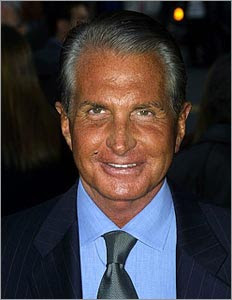
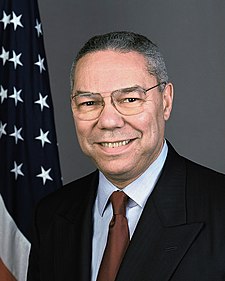
Skin color doesn’t determine race — George Hamilton is darker than Colin Powell, after all. What makes race “real” isn’t its physicality, because race is a cultural, rather than a biological, fact. As I noted last week, the one-drop rule was created for social and economic reasons. Genetics didn’t, and don’t, enter into it.
Skin color, in other words, can be ignored. We ignore it all the time. I had to Google photos of George Hamilton and Colin Powell to make sure I was right about who was darker — I don’t carry that information around in my head. But I do carry around the knowledge that Hamilton is white and Powell is black. And it’s that knowledge which can’t be suppressed or wished away.
Which brings us to Baldwin’s comment about his own race-blindness in Paris. Earlier in the book, Mead had paraphrased his insight that “there are no ‘Negroes’ outside of America,” and it seems that this is what’s operating here. The racial categories carries with him are American racial categories, and French racial structures, differing as they do from the American, don’t resonate for him in the same way. And so although it may seem like a contradiction for Baldwin to say in one breath that “race cannot be ignored” and in the next that it had “never occurred to” him whether a friend was French or French North African, it’s actually completely consistent.
Skin color can be ignored. Race cannot.
“Student fees in state universities are usually confined to minor charges for matriculation, gymnasium, laboratory materials, and breakages, etc., which rarely amount to more than $50 a year for undergraduates. With the exception of Vermont none of the institutions in this group charges a regular tuition fee to residents of their respective states except in the professional departments, and in a few cases in engineering colleges. … The total revenue from student fees in 1910-1911, excluding board and rental of rooms, exceeded $100,000 in only six of the state universities — California, Illinois, Michigan, Minnesota, Ohio, and Wisconsin, Michigan leading with $339,000. … The University of Washington, with half as many students as Michigan, but with only 277 professional students out of 2142, received from student fees $15,000. In contrast to these figures of the revenues from student fees, should be placed those of Harvard, $651,000, Chicago, $581,000, and Columbia, including the Teacher’s College and Summer School, $1,164,000.”
—A Cyclopedia of Education, edited by Paul Monroe, 1913.
If you enrolled in the University of California at Berkeley this fall, and you weren’t a California resident, you paid more than you would have if you had gone to Harvard.
That’s not a joke, or a misprint. Berkeley, a public university, now charges its out-of-state attendees more than Harvard does. Choose Harvard instead of Berkeley, and you’ll save enough to buy a top-of-the-line iPad. With a data plan.
“But that’s just out-of-state students!” I hear you cry. “The University of California is a state university, serving the people of the state of California! Out-of-state students should pay more!”
Well, yeah. Fair enough. But in-state tuition at Berkeley is now brushing up against fifteen grand, and even at that price it’s available to fewer and fewer Californians every year. Why? Because those higher-than-Harvard fees are really hard to pass up.
Berkeley’s out-of-state enrollment historically hovered around ten percent. But it rose to 15% two years ago as the current financial crisis hit, then jumped to 23% last year. For the fall of 2011, it skyrocketed to 29.8%. Even with increased enrollment overall, that translates to a loss of more than one thousand places for California residents in just two years.
Education activists talk about “privatization” of higher education a lot, and there’s a danger of that word losing its meaning through repetition. But here it is — privatization in action in the most concrete way. First Berkeley raises its out-of-state pricing to private university levels, and then it starts jacking up out-of-school enrollments to squeeze the most revenue out of its new policy. The public university withers, replaced by something very very different.
And this process is just getting underway. It’s going to get far worse before it gets better.
Update | An eagle-eyed commenter noticed that the webpage I used as my original source for Harvard’s rates omitted two apparently mandatory fees. Once those are taken into account, Harvard’s tuition costs remain slightly higher than Berkeley’s, for now at least. Once you factor in room and board, however, Berkeley takes the lead again — and by a slightly wider margin than I reported in the original version of this post. Full details in comments.
A recent CBS poll found that 43% of Americans agree with the views of Occupy Wall Street, with only 27% disagreeing. (Other polls have found similar sentiments.) But what do these numbers mean?
Here’s some historical context:
- In 1959, five years after Brown v. Board of Ed, a 53-37 majority of Americans thought the decision had “caused a lot more trouble than it was worth.”
- In 1961, Americans believed by a 57-28 margin that civil rights demonstrations were doing more harm than good to the cause of integration.
- In October 1964, some 57% of Americans thought racial integration was moving “too fast,” and only 18% thought it wasn’t moving fast enough.
- In 1971, a national poll found only 39% percent of Americans “sympathetic … with efforts of the women’s liberation groups,” with 47% unsympathetic.
That’s right. More Americans support Occupy Wall Street than supported Brown v. Board of Ed in 1959, the civil rights movement in 1961, desegregation in 1964, or feminism in 1971.
Oh, and here’s one more: In 1948, Americans disapproved of “women of any age wearing slacks in public” by a 39-34 margin.
Yep. OWS is more popular today than pants on women was 63 years ago.

 studentactivism.net
Recent Comments