
You are currently browsing the category archive for the ‘Media’ category.
Yesterday this site reached a milestone of sorts, registering its 500,000th pageview. It took almost three years to get there, though most of that traffic came in the last few months. (If present trends continue, we’ll rack up our millionth hit sometime in late summer or early fall of this year.)
Those numbers are still small compared to the big kids of the blogosphere, but you all have allowed Student Activism to break some significant stories and draw important attention to others. You’ve also helped to popularize a new model for blogging in the field of student organizing — this beat is a lot less lonely than it was in the spring of 2008.
I’m going to be rolling out some new features for the site this week, so keep checking in. And thanks for all your support!
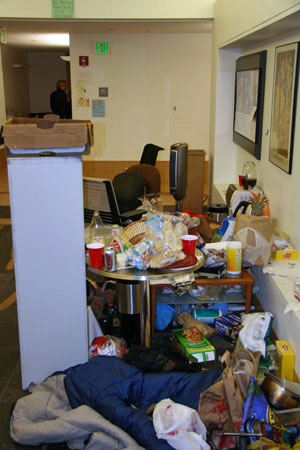 The occupiers of UCSC’s Kerr Hall were barely out of the building Sunday morning when the Santa Cruz administration launched a line of attack that’ll be familiar to observers of last year’s NYU and New School occupations: they said the students trashed the place.
On Sunday, a university spokesman claimed that the occupiers had done thousands of dollars in damage, and those costs, he said, would require the university to divert money “from budgets already strained by budget cuts.”
On Monday, administrators upped the ante. The students had done more than fifty thousand dollars of damage to the building, they said, not including labor costs for cleanup. They posted photos of the mess on the university’s website, and said that some items appeared to have been stolen.
On Tuesday activist Brian Malone posted an open letter in response to the administration’s claims. He said that most of the photos showed “little more than some leftover food and a bunch of paper products in need of recycling,” and that the rest — an overturned refrigerator, some teleconference equipment dumped on the floor, a broken table — would be easily easily fixed or replaced.
Now, I don’t doubt that UCSC is exaggerating its damage estimates. They have no reason to lowball their figures, and every reason to inflate them. As to whether the telecom equipment was “ripped out,” as UCSC claims, or “disconnected,” as Malone suggests, I can’t say either way. The occupiers apparently did use furniture and equipment as material for their barricades, so I expect there was some damage done there.
But I’m not interested in second-guessing strategies or tactics. That’s a big question, and it’s a question for another post. What I do want to offer is one small, simple piece of advice.
If you’re in a long-term occupation, clean up after yourself.
Malone says that tidying up the garbage the Kerr Hall occupiers left behind “would take a small crew no more than one or two hours.” But there were seventy students in that building for three days, and they knew that the cops could bust in at any time. There’s no reason why they couldn’t have been cleaning things up as they went.
A couple of weeks ago, I spoke to one of the students who occupied the school of the humanities and fine arts at the University of Zagreb for thirty-five days this spring. He said that the students in that occupation prided themselves on keeping the place sparkling — they swept and mopped every morning, broken equipment was repaired, replaced, or put in storage, and every occupier was expected to clean up his or her messes as he or she created them. Their occupation was based on the premise that this was the students’ university, he said, and they wanted to show the media and the community that they cared for that university enough to keep it clean, organized, and in working order.
Any time you’re occupying university space, you’re at risk of being evicted or arrested on a moment’s notice. If you’re dumped out and you’ve left the place a mess, you can expect that the administration will carefully photograph every tipped-over Solo cup and crumpled bread wrapper, and post the photos on the net. That’s their job, and that’s what they’re going to do. You can choose to give them that ammunition, or you can choose not to.
Choose not to.
The web journal Inside Higher Ed is a go-to source for anyone interested in the American university. Founded in 2004 as a competitor to the well-regarded but stodgy Chronicle of Higher Education, IHE is an indespensible daily guide to the nation’s campuses.
So why isn’t it covering the biggest student story of the year?
We’re now five days into the wave of student protest that has engulfed California since the UC regents approved huge fee increases for their system’s students. Since then thousands have demonstrated on campuses across the state, often clashing with police. Six university buildings at five universities have been occupied. More than a hundred students have been arrested. And IHE has given the story a total of four words.
“As students protested outside, the University of California’s Board of Regents on Thursday reluctantly approved a 32 percent increase in ‘fees’ …” That’s how the IHE opened a one-paragraph piece on the fee increases in its “Quick Takes” section on Friday. That one clause, “as students protested outside,” was the only mention of student organizing in the piece, and the IHE has yet to return to the topic.
At the time the IHE put up that story, students had taken over four UC buildings in response to the fee hikes. Three of those occupations were still ongoing as of Friday morning, and the fourth had ended with mass arrests. Fourteen students had been arrested within the regents meeting itself, and several — despite UCLA’s initial denials — had been Tasered by campus police during the demonstrations that accompanied it. After the meeting, students blockaded the building in which it had been held, blocking the regents’ exit and at one point compelling them to abandon the van in which they were attempting to leave campus.
Since Friday morning, IHE has covered a lawsuit filed by a woman who was fired by the University of Nebraska when they learned she was a witch. It has published a lengthy piece on academic plagiarism. It has written about a physical fitness requirement for obese students at Lincoln University and an athletics director who quit after applying for reimbursement for expenses relating to an extramarital affair. It has run two stories on tax issues.
But on the largest student uprising in recent American history? Nothing so far.
Now, granted, it’s Sunday, and IHE generally doesn’t publish on the weekends. Only one of the stories I list above went up yesterday, and that one was a blog post. But as I say, this was a huge story by Friday morning, and it only got bigger as that day went on.
I’ll be eager to see what they have on it tomorrow.
Monday morning update | Well, it’s tomorrow, and IHE has a 108-word “Quick Takes” story up reporting on Friday’s events at three universities.
The piece makes no mention of the 52 arrests at UC Davis on Thursday, and declares that UCSC’s Kerr Hall “remains occupied,” even though that occupation ended on Sunday morning. Meanwhile, the journal finds room for 645 words on the end of football at Northeastern.
The conveners of the upcoming Zagreb student protest symposium have made a request of the presenters:
The proposal is this: when you come to Zagreb bring with you a collection of photographs that would give the other participants of the symposium a general idea of everyday context of student life around you. These photographs would ideally include your faculties, dorms and other student-related facilities, and they would provide a general feel of both indoor and outdoor environment in which students spend their time (both study and leisure).
I absolutely love this idea. In fact, the only thing I love more than this idea is the idea of passing the request on to you.
Students around the world are shown Hollywood’s version of college life — now’s your chance to show them the reality. Send me your favorite photos of campus living, and I’ll pass them along to the folks in Zagreb. (I’ll also post them here, if you’re okay with that.)
You can email me the photos at angus at fecko dot com, post links as comments here, or post them to my wall on Facebook. Whatever you like. Just get them to me this week — the symposium starts on Friday!
Over on Twitter about an hour ago, I came across a tweet that said a new study had found that “Social Ntwks make college students more narcissistic.” I’m always interested in the latest research on student culture, so I clicked.
The link took me to a USA Today article on the study. The article doesn’t quite make the claim in the tweet, but it does make some other arguments that are well worth unpacking. (The study itself doesn’t appear to be online anywhere. If anyone reading this finds it, or can get access to it, let me know in comments.)
The tweet I quoted above makes a cause-and-effect claim: that social networking makes students more narcissistic. The lead sentence of the USA Today piece makes a similar, but slightly weaker, claim: that students believe that social networking makes them more narcissistic. But neither of these claims are backed up by the data that follows.
The article is based on the answers to two questions. Students were asked whether their peers “used social networking sites such as MySpace, Facebook and Twitter for self-promotion, narcissism and attention-seeking,” and they were asked whether they agreed that their generation was “more self-promoting, narcissistic, overconfident and attention-seeking than previous generations.” A bit more than half (57%) answered yes to the first question, and 66% agreed “strongly” or “somewhat” with the second statement.
The first thing to point here is that there’s no claim of causality in the students’ answers. Most of them think that their peers (some of them? all of them? a few of them? the article doesn’t say) engage in attention-seeking behavior online (occasionally? frequently? incessantly?). And most of them think their peers are more prone to attention-seeking behavior than previous generations. But the answers provided in the article don’t give any indication that they think social networks themselves are the cause of this behavior, much less any evidence that such a cause-and-effect relationship actually exists.
So the Twitter soundbite version of the study is bunk — the survey doesn’t show that social networking makes people more narcissistic. And the weaknesses of the study don’t end there.
A second big problem is that the survey questions are muddled. Every blogger I know uses social networks for “self-promotion,” and to the extent that seeking attention for your writing is “attention seeking,” I guess they all do that too. But I wouldn’t call that behavior narcissistic, and I don’t think it makes much sense at all to frame the question as if it was. Self-promotion and narcissism aren’t the same thing. They’re not even close to the same thing — nobody thinks USA Today’s own self-promoting Twitter feed is narcissistic.
And here’s a third problem: what basis do young people have for assessing how “self-promoting, narcissistic, overconfident and attention-seeking” their parents’ generation was in their youth, much less their grandparents or great-grandparents? They weren’t there. They don’t know.
What they do know is how previous generations, and their own peers, are perceived in popular culture, and the perception of youth as “self-promoting, narcissistic, overconfident and attention-seeking” is a pop culture cliche. So that second question really only measures the degree to which young people have embraced society’s negative image of them.
And this is where we really go down the rabbit hole.
Where does the perception of today’s young people as narcissistic come from? In large part it comes from the work of researchers like Jean Twenge, who’s written two books and dozens of articles making exactly that argument. Twenge’s most recent project? She’s the author of the study we’re talking about today.
So here’s how it works. Writers come up with the idea — valid or invalid — that today’s youth are narcissists. They write books and publish op-eds and go on talk shows and give quotes to journalists and do public speaking engagements pushing this idea. Then, with their perspective embedded in popular culture, one of them, Twenge, conducts a survey asking young people what they think of it. Most of those young people, having been fed that story for years, admit that it’s at least “somewhat” accurate. And then that survey is presented as evidence that the theory is true.
Jean Twenge graduated from high school in the 1980s, a time when the popular media were full of stories about the entitlement and self-absorption of the nation’s youth. Her parents came of age in the 1960s, an era whose young people were widely condemned as narcissistic by their parents. As strange as it may seem now, the youth of the early 1940s faced similar charges, and anyone who’s ever read an F. Scott Fitzgerald novel knows that the same stereotype was rampant in the 1920s.
Are today’s youth more narcissistic than their parents were at their age? Maybe. I’m not sure that the question is a particularly meaningful one, but it’s possible that I could be convinced that it is, and that Twenge’s answer to it is the right one.
But what I do know for sure is that every generation thinks their children are more frivolous and more selfish than they were as youths, and that every generation is eager to consume “research” that supports this self-perception. Every generation loves to read about how great they are, and how the kids of today just don’t measure up.
And if I had to sum up that attitude in a single word?
I’d be tempted to call it narcissism.

 studentactivism.net
Recent Comments