
You are currently browsing the category archive for the ‘Organizing’ category.
When the Occupy Wall Street protests began on September 16, #OccupyWallStreet was the only related hashtag used on Twitter. Soon some folks started using #OccupyWallSt too.
Shorter is better on Twitter, since you only have 140 characters to say your piece, so when the protests really started getting media traction with the arrests of Saturday, September 26 some folks started using #OWS as a zippier alternative. That tag didn’t really catch on until this last Wednesday, though, when the folks behind @OccupyWallSt tweeted this:
@OccupyWallSt: Let’s stop the hash tag soup and use #ows for OccupyWallStreet
That tweet had an immediate and powerful effect.
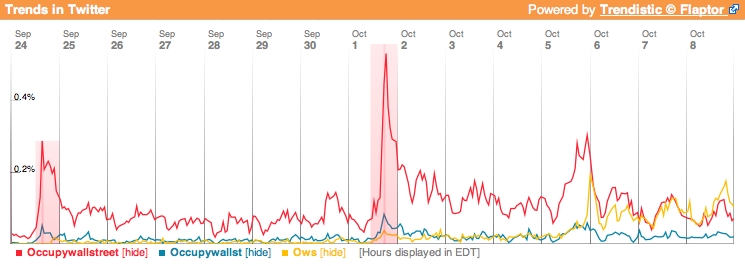
#OWS, represented in yellow on the chart, spiked up on Wednesday evening, while #OccupyWallSt plummeted. At about noon yesterday #OWS actually overtook the original #OccupyWallStreet tag in popularity, and it’s been running at about 50% higher traffic ever since.
#OccupyWallStreet is still getting a lot of traffic, since it’s the most established hashtag, and the clearest. But #OWS is the new default, and #OccupyWallSt is dying. Spread the word…
So I’ve been tweeting up a storm today on the question of whether #OccupyWallStreet needs to compile a formal list of demands. (Spoiler alert: Nope.) I’m not going to rehash my whole argument here right now, but someone just tweeted something at me that gives me an opportunity to explore a piece of it.
Here’s the tweet, posted in response to me saying that “When people say #OccupyWallStreet needs to articulate demands, they usually mean they want it to embrace their demands.”
@dc_dsa: @studentactivism Partially agree. As Frederick Douglass said, “power concedes nothing without a demand.”
That was pretty well played, I must say. Apt, pithy, and deploying one of my favorite quotes from one of my favorite activists. But let’s look at all of what Douglass said there:
“Power concedes nothing without a demand. It never did and it never will. Find out just what any people will quietly submit to and you have found out the exact measure of injustice and wrong which will be imposed upon them, and these will continue till they are resisted with either words or blows, or with both. The limits of tyrants are prescribed by the endurance of those whom they oppress. In the light of these ideas, Negroes will be hunted at the North, and held and flogged at the South so long as they submit to those devilish outrages, and make no resistance, either moral or physical. Men may not get all they pay for in this world; but they must certainly pay for all they get. If we ever get free from the oppressions and wrongs heaped upon us, we must pay for their removal. We must do this by labor, by suffering, by sacrifice, and if needs be, by our lives and the lives of others.”
This is Douglass is at his very best, but when he talks about making a demand he’s talking about planting your feet in the struggle, not drafting a bill of particulars.
The Montgomery bus boycott started out demanding a line separating the whites in the front of the bus from the blacks in the rear, so that black patrons wouldn’t have to give up their seats when the white section filled up. (Rosa Parks was obeying the law when she sat down that day.) Mario Savio made no demands at all in the most famous speech in the history of the American student movement. Malcolm X’s demands shifted weekly, sometimes hourly, and the suffragist and abolitionist movements both encompassed vast, unwieldy coalitions.
Now, I’m not anti-demands in principle. If you happen to be fighting a narrow, single-issue, clearly-defined campaign, then by all means articulate what you’re looking to get. But if you’re not — and Occupy Wall Street isn’t — then any demands you put forward should serve a tactical purpose, and the question of what to demand has to be preceded by a discussion of whether it serves your interests to make any demands at all.
Some folks at Occupy Wall Street want to see Congress overturn the Citizens United decision. Some want to see an end to US military adventurism. Some want to see Nick Kristof’s head on a pike. Would endorsing any one of these demands bring the group together, or would it peel people off from the coalition? If you want OWS to make demands, you’ve gotta have a solid answer to that question.
Some demands are certainly more innocuous than others. I imagine that demanding a financial transaction tax, for instance, wouldn’t in and of itself alienate many people currently in Liberty Plaza, and it might bring a few more on board.
But even if that demand could be approved smoothly and easily and without dissent, would its articulation bring the implementation of such a tax any nearer? I honestly don’t see how it would. A Google search on “transaction tax” and “occupy wall street” already returns more than twenty thousand hits, so the idea is already a big part of the conversation. And it’s not like a formal statement from next Tuesday’s GA is going to upend the legislative dynamic that currently pertains in Washington DC.
No. What’s going to change the dynamic in Washington DC, if anything will, is the continued growth of this movement. If you want to see Occupy Wall Street lead to a transaction tax, you want the movement to grow. If you want it to compel the demise of the legal concept of corporate personhood, you want the movement to grow. If you want it to overthrow global capitalism, you want the movement to grow.
It won’t grow if it’s completely contentless, of course. But it’s not contentless now. The General Assembly passed a “declaration of occupation” a few nights ago, and there’s some real meat there. I said in a recent blogpost that it was my sense that pretty much everyone in Liberty Plaza thought “that something was seriously broken in the American economy, that something was seriously broken in American politics, and that an accelerating concentration of wealth and power in the hands of a small minority was at the root of most of of that brokenness,” and none of the many people who’ve read or linked to that post have yet disagreed.
If you think OWS has no message, you’re just not paying attention.
The OWS critique of our current national (and global) crisis will continue to unfold. Those discussions are ongoing, in a zillion venues. And I’m not convinced that this movement is any less coherent right now than the suffragists at the turn of the century or the lunch-counter sit-in crowd in the spring of 1960 or the London demonstrators over the last few months.
And at any rate the crucial task for Occupy Wall Street right now isn’t coherence, any more than it’s the articulation of specific demands. It’s resonance as an idea, as a movement.
You don’t win by making demands. You win by taking power or by forcing power to bend. Either way your stated demands are peripheral to the outcome — what you demand has only the vaguest relationship to what you win.
Dear Wil,
Yesterday you tweeted what would become the day’s most-retweeted #OccupyWallStreet tweet, linking to a Reddit post that goes pretty much like this:
“Tomorrow, wear a polo and khakis
“Seriously. polos and khakis. Every time you guys DO finally get some fucking press, it’s a scrawny dude with dreads in a ratty t-shirt. You’re going big here, dress it. Tomorrow, Polo shirt and Khakis.
“Why? Because you need to get the right-leaning equivalent of me on your side.”
Now, this isn’t entirely bad advice. It’s not particularly good advice, but it’s not the worst advice ever offered.
As a Twitter intervention into Occupy Wall Street, though, it really really sucks.
I’ve been down to OWS three times. What I saw there was a mix of people, from a mix of backgrounds, wearing a mix of ensembles. There are professionals in suits there, and union workers in jeans and tee shirts and boots. Grandmothers. Hippies. Punks. Secretaries. Dorks.
So if you think it’s important that the nation move beyond the stereotype that OWS is just a bunch of dirty hippies…
Don’t blast your 1.8 million followers with a tweet that stereotypes OWS as a bunch of dirty hippies.
That tweet wasn’t helpful. It was the opposite of helpful. You know what would be helpful? Helpful would be declaring solidarity with the protest without being “helpful.” Helpful would be encouraging your followers to identify with OWS, instead of encouraging them to stand on the sidelines tut-tutting.
That Reddit post uses the word “you” twenty-three times in fourteen short paragraphs. “We”? None. None times. The Reddit guy claims he’s on the side of OWS, claims he wants middle America to see OWS as part of its “us,” but he’s not willing to be a part of that transformation himself.
He’s not willing to show up and put his polo-clad shoulder to the wheel.
And that act, that act of solidarity, is exactly what’s needed right now.
You want to help? Don’t tell a bunch of hippies to go buy polos and khakis. Tell your hundreds of thousands of polo-and-khaki garbed Twitter followers to put on their work clothes and head over to Liberty Plaza. That’s what’s needed, and that’s what’s possible.
Because you and I both know that it’s a hell of a lot easier to get an IT dork to go to a con than it is to convince a trustafarian to shave off his dreads.
Much love,
Angus
So last night I wandered down to Occupy Wall Street for the second time. I’d visited the night before, and been impressed — impressed by the richness of the space, impressed by the process and enthusiasm of the general assembly. I wasn’t (and I’m still not) sure what it all adds up to, but I found it invigorating and compelling. So I went back.
I spent some time strolling around, talking to people and checking out what was happening. I ate some free food. I sat in on a workshop on building democratic structures in progressive organizations. I compared notes with a couple of friends who were there.
And then the general assembly got started. The evening GA is a decision-making meeting, but it’s also a place where lots of announcements get made — OWS has a lot of working groups on issues ranging from first aid to legal support to action planning, and the GA is where they all check in. I’d sat through all those announcements the previous night, and been mostly fascinated, but it was less compelling the second time through and the pavement was cold and hard, so after a while I figured I’d stretch my legs a bit and circle back in time for the meat of the meeting.
So I took a stroll through the neighborhood, and wound up at a deli that was open and had comfortable seating in the front. I bought a beer for a couple of bucks and sat down to check my email and read a few pages of the book I’d brought.
There was a young woman at the register, paying for a soda and chatting with the counter guy about the Occupy Wall Street protests — she worked in the neighborhood and was on her way to check them out for the first time. I didn’t catch much of what she said, but when the counter guy made a comment about Eisenhower, I listened … and tweeted:
@studentactivism: Counterman at a deli 3 blocks from #OccupyWallStreet just quoted Ike’s warning on the military industrial complex.
“And Eisenhower was a general.” I remember the guy saying. “A general.”
A few minutes later I tweeted this:
@studentactivism: “The government has become the puppet of the big corporations.” -The same deli guy. #OccupyWallStreet
And this:
@studentactivism: #OccupyWallStreet. It’s not just for dirty hippies anymore.
And this:
@studentactivism: “Ordinary folks are getting dicked.” -Same deli guy #OccupyWallStreet
I was tweeting all this, by the way, not because it struck me as strange, but because it struck me as so ordinary — while at the same time so at odds with dominant narratives of the Occupy Wall Street protests. (And not just those in the big media, those in the look-down-your-nose left, too.) New York City is a left-liberal city. It’s a city that went for Obama over McCain by an 85-15 margin. It’s a city whose majority white districts went for Obama 2-to-1. It’s a city where what passes for reactionary is Staten Island, where Obama took 47% of the vote. To hear this middle-aged white guy saying this stuff didn’t surprise me at all.
But I kept listening.
@studentactivism: “I buy you a beer today, you buy me a beer tomorrow. That’s the only way it’s gonna work.” -The OTHER deli guy #OccupyWallStreet
The other guy behind the counter was younger, and black. The woman who’d started the conversation had long since moved on, but a couple of regulars had taken up positions with their own beers at a table in front and the discussion was rolling on.
@studentactivism: Now the black deli guy is holding forth on the need for cross-racial class solidarity. #OccupyWallStreet #NotJoking
I wish I’d transcribed more of this, but by the time I thought to try to write down what I hadn’t tweeted, most of it was gone. I do remember him saying “some guys are all ‘The niggers! The spics!’ But niggers contribute to the economy too. Faggots too.”
He repeated the bit about faggots for emphasis, looking around, kind of hoping that someone would say something he could correct. But by now the four of them were all enthusiastically agreeing to everything, egging each other on.
@studentactivism: Black deli guy: “Everybody said ‘Obama’s gonna get shot.’ Nah. He plays the game.” #OccupyWallStreet
This was, I think, in response to the white deli guy saying that no American president in half a century had ever taken the interests of ordinary people seriously.
I’d bought a second beer at some point along the way, but by now it was kicked. As I was about to head out, I piped up for the first time. “You guys are killing me,” I said. The white counter guy grinned. ” I thought the meeting was up there,” I said, pointing in the vague direction of the plaza.
@studentactivism: Me: “I thought the meeting was up there.” Deli guy: “We’ve been saying this for 30 years.” #OccupyWallStreet
We talked for a few minutes more. None of the four of them had been up to the protest, it sounded like, at least not to do more than walk by and check it out on the fly, so I shared some of my impressions. We did the enthusiastically-agreeing-with-each-other bonding thing for a few minutes. We all agreed that the protest was a lovely development. Then one of the guys sitting at the front table said “But what’s their plan?”
I said I’d gotten the impression that people there had a lot of different ideas about what needed to be done, and that I wasn’t sure they were all going to agree on an agenda for change anytime soon. Then I said that I wasn’t sure that was a bad thing.
I said it seemed like pretty much everyone there basically agreed on certain basic principles — that something was seriously broken in the American economy, that something was seriously broken in American politics, and that an accelerating concentration of wealth and power in the hands of a small minority was at the root of most of of that brokenness. People differed on how to address that problem, I said, but they all pretty much agreed about what the problem was, that it needed to be tackled, and that it wasn’t really being tackled now.
I was struck by the “what’s their plan” question in a few ways. First because it was the first even vaguely critical comment about OWS I’d heard in the whole discussion — for half an hour these guys had been been talking about and around the protests, and everything they’d said was emphatically positive. Second because it wasn’t asked in a spirit of attack but a spirit of curiosity, and maybe gentle prodding — a central premise of the conversation I’d snooped on was that there’s no obvious fix for what’s gone wrong. For many on the chattering left “what’s their plan” is the rhetorical leadup to a dismissal, as if it’s the job of five hundred strangers in a park to come up with a concrete step-by-step proposal for reforming (or overthrowing) global capitalism. But here it wasn’t that. Here it was a real question: “What can be done?”
If Occupy Wall Street is as marginal as its liberal-left critics assume, then no answer to the guy at the table’s question would make any sense at all. Five hundred strangers in a park will never themselves be the engines of any profound societal transformation. But if what I saw last night is real, if OWS is offering a critique that resonates in content — if not necessarily in form — with a broader and more eclectic swath of the country, then maybe those five hundred strangers are pounding on a door that’s a bit less well-armored than it looks.
Maybe what they have to offer isn’t a plan so much as an opportunity to have a bigger conversation, or even just an invitation to continue and expand a conversation that’s been going on in small ways in small places for a long time.
And that’s a conversation I’m really eager to see continue.
Last week six UC Berkeley students went on trial on charges stemming from a March occupation of Berkeley’s Wheeler Hall. Unlike the Irvine 11, their fate was decided by a judge, not a jury. And unlike the Irvine 11, they were found not guilty.
The acquittals of these six students, however, were followed just two days later by the arrests of two more, at the campus’s “Day 1” protests marking the start of the fall semester throughout the UC system.
Police say that protesters on September 22 threw chairs, bottles, and chunks of concrete at cops, and that members of the group used oversized book-cover props as shields and offensive weapons. But one officer’s claim that “we respect people’s right to protest, but we ask that they do it safely and peacefully” rings hollow in light of UC’s recent history with nonviolent protest.
As I noted earlier this week, hundreds of student activists have been arrested on UC campuses in the last two years, many in situations in which no protester violence was even alleged. (In the most egregious case, sixty-six students were woken from their sleep and arrested in the unlocked building they were peacefully and non-disruptively occupying, just hours before that occupation’s scheduled end.) One student journalist was not only put through the wringer of the campus judicial system — in an incident I’ll be writing about tomorrow — but forced to pay court costs when a legal challenge to the university’s procedures failed.
Berkeley, and the UC system generally, have systematically criminalized nonviolent confrontational protest over the course of the last two years. The result has been a wave of questionable arrests and prosecutions, a ratcheting up of student tactics, and a dramatic increase in police violence. With students chaining themselves together on high ledges and police officers pointing guns at angry crowds, the whole situation is a tragedy waiting to happen.
Something’s got to give.

 studentactivism.net
Recent Comments