
You are currently browsing the category archive for the ‘Race’ category.
Today is the 70th anniversary of #EO9066, the FDR executive order that authorized Japanese deportation from the West Coast during WWII.
— Angus Johnston (@studentactivism) February 19, 2012
I just posted a string of tweets, including the one above, to commemorate the 70th anniversary of Executive Order 9066. EO 9066, signed by Franklin Delano Roosevelt on February 19, 1942, authorized the exclusion of Japanese Americans from large portions of the United States solely on the basis of their ethnicity. It led almost immediately to seizure of property, ethnic curfews, and — on May 3, 1942 — the authorization of the establishment of internment camps to house those who would be relocated from exclusion zones.
- 70 years ago today FDR #EO9066 created the Japanese-American internment policy. 120,000 people, 2/3 of them citizens, were imprisoned.
- The number of Japanese Americans interned without cause by FDR was greater than the population of Wichita, KS. #EO9066
- 62% of Japanese Americans interned by FDR were US citizens. (The rest were immigrants barred from naturalization due to their race.) #EO9066
- Americans with as little as 1/8 Japanese ancestry were interned, including orphan infants. #EO9066
- Internment order included Americans of Taiwanese and Korean descent, since Japan occupied those countries. #EO9066
- “A viper is nonetheless a viper wherever the egg is hatched.” —LA Times editorial endorsing Japanese-American internment #EO9066
- Surviving #EO9066 internees received $20,000 compensation each in 1988. Families of internees who had died got nothing.
- I said a few minutes ago that Americans with as little as 1/8 Japanese ancestry were interned. I was wrong. The cutoff was 1/16th. #EO9066
- The 1944 Korematsu decision declared the Japanese-American internment constitutional. It has never been overturned. #EO9066
- “I dissent, therefore, from this legalization of racism.” —Justice Frank Murphy dissenting in Korematsu. #EO9066
- Justice Murphy’s Korematsu dissent was the first Supreme Court opinion ever to use the word “racism.” #EO9066
- “military urgency…demanded that all citizens of Japanese ancestry be segregated from the West Coast.” —Korematsu, majority opinion. #EO9066
- “Korematsu…has been convicted…merely of being present in the state…where all his life he has lived.” –Korematsu dissent. #EO9066
- Fred Korematsu was born in Oakland, CA in 1919. He was arrested in San Leandro in 1942 for being Japanese-American. #EO9066
- In 1946 Fred Korematsu married Kathryn Pearson in Michigan. (Interracial marriage was illegal in California at the time.) #EO9066
- Fred and Kathryn Korematsu moved back to California in 1949, the year after interracial marriage was legalized in the state. #EO9066
- Fred Korematsu’s conviction was set aside in 1983. He received the Presidential Medal of Freedom in 1998. He died in 2005. #EO9066
- Two years before his death Korematsu filed an amicus brief with the Supreme Court arguing for legal rights for Guantanamo detainees. #EO9066
- Survivors of the Japanese-American internment camps include George Takei, Norman Mineta, Isamu Noguchi, and Pat Morita. #EO9066
- Los Angeles internees were housed in stables at the Santa Anita racetrack while awaiting relocation. #EO9066
- George Takei’s first schooling was under the grandstands at Santa Anita while his family was interned in a stable. #EO9066
- “We gave the fancy name of ‘relocation centers’ to these dust bowls, but they were concentration camps nonetheless.” –Harold Ickes. #EO9066
I wrote about this last year and while it’s not exactly a secret it’s a story surprisingly few people know, so I think it’s worth repeating:
In November 1964, weeks before Martin Luther King was to travel to Oslo to receive the Nobel Peace Prize, an anonymous correspondent sent him a package in the mail. The package contained an audiotape, and a letter.
The tape was a compilation of material recorded via Bureau wiretaps over the previous year. It consisted of off-color jokes and remarks King had made in private, among friends, interspersed with the sounds of him having sex with someone other than his wife. The letter included the following challenge:
King, look into your heart. You know you are a complete fraud and a great liability to all us Negroes. … you are no clergyman, and you know it. … You could have been our greatest leader. You, even at an early age have turned out to be not a leader but a dissolute, abnormal moral imbecile. … You are done. Your “honorary” degrees, your Nobel Prize (what a grim farce) and other awards will not save you. King, I repeat you are done. No person can overcome facts, not even a fraud like yourself. … The American public, the church organizations that have been helping — Protestant, Catholic and Jews will know you for what you are — an evil, abnormal beast. So will others who have backed you. You are done.
King, there is only one thing left for you to do. You know what it is. You have just 34 days in which to do [it]. … You are done. There is but one way out for you. You better take it before your filthy, abnormal fraudulent self is bared to the nation.
The letter was mailed 34 days before Christmas.
King did not receive the package until after he returned from Oslo, and after the 34-day deadline had passed. When he listened to the tape he quickly concluded that it could have come from only one source — the Federal Bureau of Investigation.
He was right.
The FBI had been wiretapping King for over a year by then, and Bureau chief J. Edgar Hoover made no secret of his loathing for the civil rights leader. The suicide package was prepared by Hoover deputy William Sullivan, an Assistant Director of the Bureau and the head of its Domestic Intelligence Division.
When you teach American history as I do, you get asked about conspiracies a lot. As it happens, I’m skeptical about some of the biggest conspiracy theories out there — unlike nearly all of my students, for instance, I think it’s highly likely that Lee Harvey Oswald acted alone.
But I’m not one to ridicule such theories either, and I find the smug dismissal with which they’re so often greeted deeply obnoxious. Because forty-seven years ago one of America’s highest ranking law enforcement agents launched a secret campaign intended to blackmail the country’s most prominent civil rights activist into committing suicide.
That’s not a theory, it’s a fact. And once you know that, it gets a lot harder to dismiss other people’s stories of shadowy government goings-on.
Ron Paul’s various publications from the 1980s and 1990s have gotten a lot of attention recently, due to various bigoted statements that appeared in their pages. But it’s not until you sit down and read the originals at length, as I’ve done over the last few days, that the full scope of their ugliness becomes apparent.
The worldview of the Ron Paul newsletters is the worldview of the late 20th century American rightwing fringe — not merely racist, but paranoid, conspiracist, sexist, anti-Jewish. It is, in short, the worldview of The Turner Diaries, the apocalyptic novel that inspired Timothy McVeigh’s 1995 attack on the federal building in Oklahoma City.
The Turner Diaries, a bizarre fantasy of race war, white supremacist revolution, and nuclear holocaust, is far more extreme than the Ron Paul newsletters, but the obsessions and even the writing style of the two documents resonate powerfully with one another. The two are even weirdly contemporaneous — though The Turner Diaries were written in 1978 and revised in 1980, they are set in the years 1991-1993.
I’ve compiled twenty-five short quotes below, about half from The Turner Diaries and about half from Ron Paul’s newsletters. If any of you can identify them all correctly without cheating, I’ll buy you a beer next time you’re in town. Do your best, leave your guesses in comments, and I’ll post the answers before too long.
- A lady I know saw a black couple in the supermarket with a cute little girl, three years old or so. My friend waved to the tiny child, who scowled, stuck out her tongue, and said “I hate you, white honkey.”
- On September 1, a federal data bank for tracking health-care professionals began operating. This program is designed to monitor physicians, but it will spread to all professions and businesses.
- Our biggest difficulty is that the public sees us and everything we do only through the media.
- Washington—with its racist government, racist radio, racist ministers, racist universities, and racist attitudes–is the black New Jerusalem, so no white is supposed to question it.
- I had a chance to do some thinking on the plane from Washington. From 35,000 feet one gets a different perspective on things. Seeing all those sprawling suburbs and freeways and factories spread out below makes one realize just how big America is and what an awesomely difficult task we have undertaken.
- Perhaps the most scandalous aspect was the response by the media and the Washington politicians. They all came together as one to excuse the violence and to tell white America that it is guilty, though the guilt can be assuaged by handing over more cash. It would be reactionary, racist, and fascist, said the media, to have less welfare or tougher law enforcement.
- In January 1990, I predicted major race riots before this decade ends. I may have to move up my timetable!
- For the first time in our nation’s history, the organized forces of perversion were feted at the White House.
- All ticket counters, motels, physicians’ offices, and the like will be equipped with computer terminals linked by telephone lines to a huge national data bank and computer center.
- Most of all, though, many of them seem to be convinced that any effort at self-defense would be “racist,” and they fear being thought of as racist, even more than they fear death.
- “Let’s do a victory dance,” barked one minister, as a sea of fists gave the Communist/black power salute and the congregation shouted anti-white slogans.
- If you’re trying to convince the public that the races are really equal, how can you admit that it’s worse to be locked in a cell full of black criminals than in a cell full of white ones?
- We learned long ago not to count our enemies, only our friends.
- It’s astounding how many dark, kinky-haired Middle Easterners have invaded our country in the last decade.
- The president also promised to look the other way when the Soviets crush the Baltic states and the other captive nations in the USSR. The timetable for the planned massacre is as soon as US troops move against Iraq, and the media’s attention is riveted there. The wonders of the New World Order.
- In San Francisco the rioting was led by red-flag carrying members of the Revolutionary Communist Party. A friend of Burt’s, a jewelry store owner, had his store on Union Square looted by blacks, and when the police arrived in response to his frantic calls, their orders were not to interfere with the rioting.
- The largest blood bank in San Francisco succumbed to political pressure and holds blood drives in the Castro district, where the people give at three times the usual level. Either they are public spirited, or they are trying to poison the blood supply.
- We have to do an end-run around the controlled media and get our message onto TV ourselves.
- None of the politicians are willing to face the real issues involved here, one of which is the disastrous effect Washington’s Israel-dominated foreign policy during the last few decades has had on America’s supply of foreign oil.
- The reporter, who certainly had an axe to grind, and that’s not easy with a limp wrist, claimed that Roony believed that blacks have watered down their genes because the less intelligent ones are the ones that have the most children. Roony denied making the remarks, although only in today’s crazed environment could such statements get you in trouble.
- Is this really the same race that walked on the moon and was reaching for the stars 20 years ago? How low we have been brought!
- The inability to face reality and make difficult decisions, that is the salient symptom of the liberal disease. Always trying to avoid a minor unpleasantness now, so that a major unpleasantness becomes unavoidable later.
- The streets of New York City are terror zones, and home burglaries are not even investigated unless someone is hurt or more than $10,000 of property is taken. There are a zillion well-paid police, but they are of virtually no use.
- We now know, if we did not before, that we are under assault from thugs and revolutionaries who hate Euro-American civilization and everything it stands for: private property, material success for those who earn it, and Christian morality.
- As everyone is aware, the bands of mutants which roam the Waste remain a real threat, and it may be another century before the last of them has been eliminated.
On your mark, get set … GO!
I recently read A Rap on Race, the book-length transcript of a conversation between James Baldwin and Margaret Mead, recorded in
the summer of 1970. As I said two weeks ago, it’s a fascinating book, and I’m going to be posting excerpts each Wednesday for the next while. I put up the first last week — here’s the second, somewhat condensed from the original:
MEAD: This was, I suppose, twenty-five years ago. I was speaking in those days about three things we had to do: appreciate cultural differences, respect political and religious differences, and ignore race. Absolutely ignore race.
BALDWIN: Ignore race. That certainly seemed perfectly sound and true.
MEAD: Yes, but it isn’t anymore. You see, it really isn’t true. This was wrong, because —
BALDWIN: Because race cannot be ignored.
MEAD: Skin color can’t be ignored. It is real.
BALDWIN: It was a great revelation for me when I found myself finally in France among all kinds of very different people — I mean, at least different from anybody I had met in America. And I realized one day that somebody asked me about a friend of mine who, in fact, when I thought about it, is probably North African, but I really did not remember whether he was white or black. It simply had never occurred to me.
Three things jump out at me about this passage.
First, there’s the obvious fact that Baldwin and Mead, speaking forty years ago, regard the idea of racial “colorblindness” as a quaint relic of Jim Crow-era liberalism. It was something that seemed to make sense back in the fifties, they agree, but not anymore. Not in 1970. The fact that we’re still, as a culture, debating this in 2011 is striking.
There’s also Mead’s troubling use of the phrase “skin color” as a synonym for “race.” I know it’s a traditional synecdoche, but it’s weird and unfortunate in this context, because although race is real, it’s not “real” in the sense that skin color is.
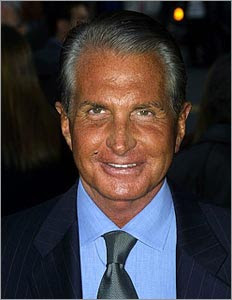
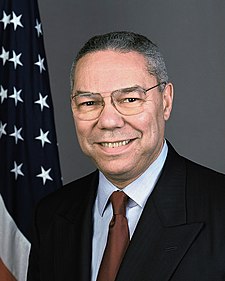
Skin color doesn’t determine race — George Hamilton is darker than Colin Powell, after all. What makes race “real” isn’t its physicality, because race is a cultural, rather than a biological, fact. As I noted last week, the one-drop rule was created for social and economic reasons. Genetics didn’t, and don’t, enter into it.
Skin color, in other words, can be ignored. We ignore it all the time. I had to Google photos of George Hamilton and Colin Powell to make sure I was right about who was darker — I don’t carry that information around in my head. But I do carry around the knowledge that Hamilton is white and Powell is black. And it’s that knowledge which can’t be suppressed or wished away.
Which brings us to Baldwin’s comment about his own race-blindness in Paris. Earlier in the book, Mead had paraphrased his insight that “there are no ‘Negroes’ outside of America,” and it seems that this is what’s operating here. The racial categories carries with him are American racial categories, and French racial structures, differing as they do from the American, don’t resonate for him in the same way. And so although it may seem like a contradiction for Baldwin to say in one breath that “race cannot be ignored” and in the next that it had “never occurred to” him whether a friend was French or French North African, it’s actually completely consistent.
Skin color can be ignored. Race cannot.
UC Berkeley’s chapter of the College Republicans plan to host a bake sale on campus this morning as a commentary on affirmative action policies under consideration in the state legislature. (The idea is to critique affirmative action by offering food for sale to some groups for less than others.)
The “affirmative action bake sale” is a bit of a relic in conservative organizing — it had its heyday in the early 2000s. But it always provokes, and Berkeley is no exception. Some of the institutional reactions, however, have been fascinating.
Sunday, a group calling itself the Multicultural Coalition for Affirmative Action released a list of demands in response to the planned sale, calling on the Berkeley administration to — among other things — add clear anti-discrimination statements to the university’s Principles of Community, and to add those principles to the Berkeley code of student conduct.
On Sunday night ASUC — Berkeley’s student government — unanimously passed a resolution that, after a page of careful laying out of the various jurisdictional issues and imperatives involved, “condemn[ed] the use of discrimination whether it is in satire or seriousness by any student group.”
And yesterday Berkeley’s chancellor sent out an open letter on the sale. The event, he said, was “hurtful or offensive to many” at Berkeley, though he didn’t say why. It was not the politics of the sale, he implied, that were problematic, but the form of their expression: “Regardless what policies or practices one advocates, careful consideration is needed on how to express those opinions.”
Absent from each of these formal statements was any explicit statement of what exactly was wrong with the Republicans’ sale. (ASUC indicated that actually selling treats to certain students at reduced prices might violate anti-discrimination regulations, but of course actually selling stuff was never the point of the event.)
I wrote yesterday about the hundreds of non-violent protesters who have been arrested at UC campuses in the last three years, and I’ll be writing more about those events as this week rolls on. Seen in that light, the failure of ASUC and Chancellor Birgenau to do more than merely place themselves on the side of sensitivity and civility rings hollow.
As an act of political theater, the affirmative action bake sale is a pretty paltry one. It offers a weak and overplayed analogy to the admissions debate, rehashing claims that have been batted around for ages. What makes it provocative isn’t its form but its message: that affirmative action is an immoral act of discrimination.
That’s what the College Republicans of Berkeley believe, and that is the message they are attempting to convey with their sale. They believe that affirmative action is racist and sexist against against whites and men, and there’s no polite way to call someone a bigot.
Birgenau wants to make the debate about the bake sale a debate about how polite the Berkeley community should be. But that’s not what it’s about, on either side. It’s about who should be allowed to enroll in the university, and on what terms.
That’s what’s under discussion. That’s what’s at stake.
Update | Zunguzungu has provided a report from the scene in comments, and there’s a lot more info to be had at the Twitter hashtag #theaffirmation. All in all, it sounds like student supporters of affirmative action responded cogently and soberly to the bake sale. And it’s worth noting that a list of demands released today by “The Coalition,” an anti-bakesale group, pretty much ignores the bake sale, and the College Republicans, altogether.
The coalition demand the passage and implementation of California’s Senate Bill 185, which would allow race and ethnicity to be taken into consideration in UC admissions, and Assembly Bill 540, which addresses admissions and tuition issues for undocumented students. They demand new funding and staffing for support services for students of color at Berkeley. They demand a restructuring of the school’s American culture course requirement to center scholarship on race, ethnicity, and gender, and the inclusion of the university’s “Principles of Community” on course syllabi. They demand representation of underrepresented campus communities in admissions hiring.
Each of these demands is addressed to the functioning of the University of California as an institution. None of them have the College Republicans or those who share their views as their target. Crucially absent from the list are demands that appeared in a draft version that appeared on Friday, calling on the university to bolster its code of conduct with new restrictions on bigoted student behavior.
As I said above, Berkeley’s chancellor Birgenau is seeking to frame this conflict as a dispute between students over standards of civility. Berkeley’s campus activists have rejected that framing, and are properly centering the government and the university itself in their response.

 studentactivism.net
Recent Comments