
You are currently browsing the category archive for the ‘Student Bashing’ category.
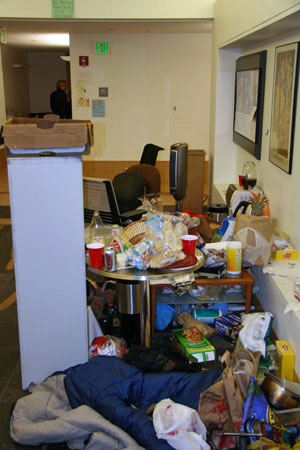 The occupiers of UCSC’s Kerr Hall were barely out of the building Sunday morning when the Santa Cruz administration launched a line of attack that’ll be familiar to observers of last year’s NYU and New School occupations: they said the students trashed the place.
On Sunday, a university spokesman claimed that the occupiers had done thousands of dollars in damage, and those costs, he said, would require the university to divert money “from budgets already strained by budget cuts.”
On Monday, administrators upped the ante. The students had done more than fifty thousand dollars of damage to the building, they said, not including labor costs for cleanup. They posted photos of the mess on the university’s website, and said that some items appeared to have been stolen.
On Tuesday activist Brian Malone posted an open letter in response to the administration’s claims. He said that most of the photos showed “little more than some leftover food and a bunch of paper products in need of recycling,” and that the rest — an overturned refrigerator, some teleconference equipment dumped on the floor, a broken table — would be easily easily fixed or replaced.
Now, I don’t doubt that UCSC is exaggerating its damage estimates. They have no reason to lowball their figures, and every reason to inflate them. As to whether the telecom equipment was “ripped out,” as UCSC claims, or “disconnected,” as Malone suggests, I can’t say either way. The occupiers apparently did use furniture and equipment as material for their barricades, so I expect there was some damage done there.
But I’m not interested in second-guessing strategies or tactics. That’s a big question, and it’s a question for another post. What I do want to offer is one small, simple piece of advice.
If you’re in a long-term occupation, clean up after yourself.
Malone says that tidying up the garbage the Kerr Hall occupiers left behind “would take a small crew no more than one or two hours.” But there were seventy students in that building for three days, and they knew that the cops could bust in at any time. There’s no reason why they couldn’t have been cleaning things up as they went.
A couple of weeks ago, I spoke to one of the students who occupied the school of the humanities and fine arts at the University of Zagreb for thirty-five days this spring. He said that the students in that occupation prided themselves on keeping the place sparkling — they swept and mopped every morning, broken equipment was repaired, replaced, or put in storage, and every occupier was expected to clean up his or her messes as he or she created them. Their occupation was based on the premise that this was the students’ university, he said, and they wanted to show the media and the community that they cared for that university enough to keep it clean, organized, and in working order.
Any time you’re occupying university space, you’re at risk of being evicted or arrested on a moment’s notice. If you’re dumped out and you’ve left the place a mess, you can expect that the administration will carefully photograph every tipped-over Solo cup and crumpled bread wrapper, and post the photos on the net. That’s their job, and that’s what they’re going to do. You can choose to give them that ammunition, or you can choose not to.
Choose not to.
Note | This post is from Wednesday, November 18. For news of the events of the 19th, including the student takeover of a building on the UCLA campus, click here. For news on the November 20th occupation of a building on the Berkeley campus, click here.
A little before noon today, University of California Students Association president Victor Sanchez posted on Twitter that campus police had used Tasers and batons on student protesters at the UCLA meeting of the UC regents. Sanchez’s post was retweeted more than forty times over the course of the afternoon, but he provided no details then or later.
It wasn’t clear from Sanchez’s post whether he was an eyewitness to the events, and early media reports provided no corroboration. About an hour later, in fact, the UCLA Daily Bruin used Twitter to post a flat denial from Lynn Tierney, director of communications for the UC president, that any student had been Tasered at the protest. The Bruin soon expanded upon that denial in an article, saying Tierney had told them that “police [had] not used tear gas, Tasers or rubber bullets” on the crowd, and that there had been no injuries to student demonstrators.
Within a few hours, however, it had become clear that Tierney’s denial was false, and that Sanchez’s post was accurate.
In a mid-afternoon press release, UCLA admitted that two campus police officers had used tasers “in light stun mode” against student protesters, and that two students had been injured in the protests — though it claimed that those injuries had not been caused by tasers.
Sanchez’s claim that cops had used batons on protesters was confirmed more directly. In a video posted to YouTube this evening, a police officer angrily lashed students with a baton before being restrained by a colleague.
Photos posted at the Daily Bruin website also show campus cops’ aggressive stance on campus. One showed an officer pointing a pellet weapon at protesters, while another showed a different officer threatening a student with a Taser.
Police use of Tasers in non-emergency situations has become far too common in recent years, and such casual violence has at times had tragic results. The students of UCLA deserve an honest accounting of today’s events.
November 20 | A post at LAist notes that UCLA recently settled a lawsuit with a student who was wrongly Tasered on campus in 2006. They wound up paying the guy $220,000.
The blog also posts a photo of a UCLA protester being Tasered in the chest, and notes that just last month the Taser company warned customers that if you Taser someone in the chest, “a lawsuit likely will follow.”
Oops.
Pittsburgh mayor Luke Ravenstahl is moving forward with a plan to impose a one percent tax on college tuition, and he’s citing universities’ willingness to gouge their students as justification.
“When you look at some of the fees these places charge,” Ravenstahl told the Pittsburgh Post-Gazette, “we think it’s only fair to include a fee for the city.” Ravenstahl pointed to “charges for everything from athletic facility use to orientation to security,” the paper said.
A member of the Pittsburgh city council has introduced a proposal to charge universities a set amount for city services, but such a scheme would depend on voluntary compliance by the institutions, which is unlikely. Mayor Ravenstahl freely admits that students represent a softer target — as tax exempt institutions, universities are protected from such schemes.
East Georgia College has reinstated a professor it suspended in August, withdrawing charges of sexual harassment it had lodged against him. But it has reprimanded the prof for using “offensive language” in the workplace, and asked him to sign a letter of understanding that includes the statement that he is “expected to act in a professional manner at all times.”
Professor Thomas Thiebault’s suspension came after a faculty meeting about sexual harassment policy in which he described a recent a conversation with a female student. The student had, Thibeault said, complained about another professor’s habit of staring at her breasts, in response to which he told her that she had no right to complain because she was dressed provocatively. During the course of telling that story, he provided identifying details of, and gratuitously offensive comments about, the student’s appearance.
Update | It’s worth laying out what exactly Thibeault said, and how various news organizations and advocacy sites have characterized it.
Here’s Thibeault’s own account of his remarks:
Last week two students were talking to me in the hallway after class. One student said that she didn’t want to go to a professor’s office because he looked down her cleavage. The woman was wearing clothing that was specifically designed to draw attention to her cleavage. She even sported a tattoo on her chest, but I didn’t get close enough to read it. The cleavage was also decorated in some sort of sparkly material, glitter or dried barbecue sauce. I couldn’t tell. I told the student that she shouldn’t complain, if she drew such attention to herself. The other female student then said, and I hope you’re not offended by her actual words, ‘if you don’t want anyone looking at your titties, I’ll lend you a T-shirt. I have one in the truck.’ The first student then said, ‘No. I’m proud of the way I look.’ I left the conversation at that point.
The purpose of the anecdote is to ask the question “what provision is there in the Sexual Harassment policy to protect the accused against complaints which are malicious, or in this case ridiculous?”
Here’s how the Foundation for Individual Rights in Education characterized Thibeault’s comments:
Thibeault … related a story about another professor and asked, “What provision is there in the sexual harassment policy to protect the accused against complaints which are malicious or, in this case, ridiculous?”
Here’s the Chronicle of Higher Education’s take:
Mr. Thibeault said students’ complaints of sexual harassment could be frivolous, and as evidence he related an encounter he said he’d had with a young woman who he said was dressed provocatively, with her cleavage showing. Yet she complained to Mr. Thibeault that another professor always stared at her breasts, the instructor said.
Inside Higher Ed referred to Thibeault simply as
…an English professor who, ironically, had openly criticized the lack of protections for the falsely accused in its sexual harassment policy.
Conservative news site WorldNetDaily says Thibeault
…questioned the assertion – as he understood it – being presented by Mary Smith, the school’s vice president for legal affairs, that the feelings of the offended constituted proof of offensive behavior.
As I noted in my previous post on this case, I think the way that EGC treated Thibeault is reprehensible. But the nature of his public comments are relevant to the story, and it’s startling to me how far some have been willing to go to obfuscate them.
Linda Sue Warner, the president of Haskell Indian Nation University, isn’t having a good year.
Warner, who has served as president of HINU since 2007, took criticism in February for a bizarre episode in which she forced a student critic of her administration to graduate early. At the time, Warner was summoned to Washington DC for an emergency meeting with university trustees and government officials.
Warner kept her job after that incident, but it wasn’t long before she was in the spotlight again.
As part of a campaign to improve and expand the campus, Warner sought to raise tuition from $215 a semester to $1000. HINU is, however, the only four-year college for Native American students that is operated by the federal government, and it has a long tradition of free or nearly-free education. Warner’s plans to nearly quintuple fees sparked a huge campus backlash, and the university’s board of regents called for her to be fired.
That hasn’t happened … yet.
At the beginning of the fall semester, Warner was told by her bosses at the Bureau of Indian Education that she would not be returning to HINU this year. Instead, she would be sent to the Southwestern Indian Polytechnic Institute, a two-year college in New Mexico, to help them with their accreditation process. HINU would have an interim president while she was away.
According to news reports, Warner has been forbidden to talk to the press.
As of now, Warner is slated to return to HINU in January. We’ll keep an eye on the story and let you know whether that happens.
In the meantime, be sure to check out our coverage of that involuntary early graduation story from the spring. It’s a weird one.

 studentactivism.net
Recent Comments