
You are currently browsing the category archive for the ‘Student Power’ category.
In the last two days German students have launched lecture hall occupations at the Universities of Heidelberg, Munster, and Potsdam in solidarity with the Austrian student protests that have been going on for the last two weeks.
The German student demonstrators’ website can be found here. (A Google translation can be found here.)
The site’s name, “unsereunis,” is taken from one of the slogans of the Austrian student movement, and translates as “our universities.” Alongwith #unibrennt, #unsereunis is one of the major Twitter hashtags for the movement.
More news as I get it.
In late September the Student Government Association of the University of North Texas, under heavy pressure from UNT parents and alumni, voted down a bylaw amendment that would have allowed same-sex couples to run for homecoming king and queen.
Now the SGA is letting UNT’s students decide the issue for themselves.
In a 22-1 vote on October 21, the UNT student senate voted to call a student referendum on the bylaw change. Balloting will be conducted online from November 16th through the 20th.
The vote reportedly followed a protest at the SGA one week earlier, at which more than fifty students descended on a meeting chanting pro-equality slogans.
The original proposal to allow same-sex couples in the homecoming court deeply divided the student senate, who rejected it by a vote of 10-5 with 8 abstentions.
Update | Students rejected the proposal to allow same-sex homecoming couples by a margin of 58% to 42%. Thirteen percent of UNT students took part in the referendum.
Inside Higher Ed has a new piece up this morning on the Southwestern College fiasco, bringing the story pretty much up to date. Go check it out.
Also this morning, a source on campus sent me a copy of the latest memo from the administration. It says that hearings for the four suspended (or, to use SWC’s preferred phrasing, withdrawal-of-consent-to-be-on-campused) faculty members have been cancelled at the request of the faculty members involved.
“The Human Resources Deparment,” the memo continues, “is diligently moving to conclude the investigation on this matter in the hopes that it can be resolved and that the three individuals may be returned to campus this week.”
Yet another weird twist in a story composed exclusively of weird twists, in other words. But it gets a little less weird if you look at the text of the law under which the suspensions were authorized.
According to that law, a withdrawal of consent for an individual to be on campus automatically expires after fourteen days, and it cannot be renewed. An individual whose consent has been withdrawn may request a hearing, but the law says nothing about the format of such hearings, who conducts them, or what they are required or empowered to do.
Whether or not “the investigation on this matter … can be resolved” in the next few days, the three suspended professors will be back on campus by the end of the week. The SWC administration’s memo notwithstanding, there’s no “may” about it. On Friday they go back to work.
Assuming that there are no more weird twists, of course.
The student occupations in Austria are still going on. No major news stories have emerged over the weekend, but a bunch of blogs do have new coverage. Here are some relevant links:
- A good short overview of the situation.
- The protests’ Facebook fan page. (Nearly 25,000 fans, but mostly in German.)
- A discussion of the connections between Austria and the current wave of activism in California.
- An analysis of the domestic political context of the protests within Austria.
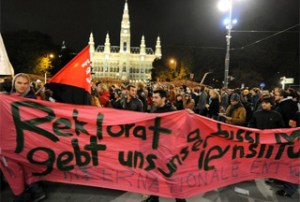 On Tuesday, October 17, students launched an occupation at the University of Fine Arts in Vienna. Two days later, other students occupied the largest lecture hall at the University of Vienna, and the movement has since spread to every leading Austrian university.
The Austrian students are protesting underfunding, corporatization, and overcrowding at Austria’s universities. More broadly, they are part of a wave of European student activists in opposition to the Bologna Accords, a set of proposals for education reform and standardization throughout Europe.
Yesterday, Thursday, saw a mass march through the streets of Vienna whose participation has been estimated at more than thirty thousand students.
There has been very little coverage of the protests in the English-language media, and most of what does exist in English is from non-English-speaking countries, as with this story and this one from a Chinese news agency. This short piece from the Boston Herald, now four days old, is a rare exception.
English-language reports from within the movement include this one, Reports from sympathetic activists include this one.
The primary Twitter feeds for the campaign are #unibrennt (“the university burns”) and #unsereuni (“our university”). Almost all of the traffic is in German, of course, but I’ve found that adding the word “Austria” or the word “students” to a search turns up a fair number of English-language posts.
The Twitter account @unibrennt_en is in English, but it’s infrequently updated. This blog post has an impressively detailed roundup of online sources of information, most of them in German.
I’m obviously still getting up to speed on this story myself. Look for updates in the days to come. If you have any useful info or links, please leave a comment.

 studentactivism.net
Recent Comments