
You are currently browsing the category archive for the ‘Students’ category.
Yesterday was the second day of the 65th annual USSA National Student Congress, and it was mostly been given over to workshops and caucus/region/committee meetings. But there was also a lot of discussion in the meetings and the hallways about legislation and regulations to put forward at Monday’s plenaries, and a new electric charge in the air.
The big event of the day was nominations for national officers, which took place at lunch and set up the most interesting, and least predictable, USSA leadership race in a very long time.
For several decades, each year’s USSA vice president has run for — and won — the presidency. This means that running for veep, in practice, has meant setting yourself up for a two-year commitment, since it’s always been correctly assumed that you’d run for and win the presidency the following year.
For a long stretch before and after the time that I was involved as an undergrad, each year’s outgoing vice president/incoming president made it clear who they wanted to work with, and the organization ratified that choice in the vice presidential election. The incoming president had to choose someone who would win, which meant that they had to take organizational opinion into account, but the system wasn’t particularly democratic. My own memory suggests that folks who ran against the insider candidates tended to do so assuming they’d lose, and often made that fact close to explicit by running for president instead of veep.
But vice president races have gotten more contested in recent years, while interest in running protest candidacies for president has declined. When the current president, Victor Sanchez, won the vice presidency two years ago, it was in a closely fought race, and this year there are no fewer than four candidates for veep — each with a real constituency and a plausible path to victory.
The first vice presidential candidate nominated yesterday was Dylan Jambrek (Facebook | Website). Jambrek served as vice president of Wisconsin’s United Council, one of the country’s pre-eminent state student associations, last year, and if elected he would be the association’s first white male officer since the 1980s.
The next nominee was Sophie Zaman (Facebook | Website). Zaman has worked as the director of the Center for Education Policy and Advocacy, a student-run group at the University of Massachusetts Amherst. She is the only vice presidential candidate never to have served on the USSA board of directors.
Next to be nominated was Ernesto Zumaya (Facebook | Website). An undocumented student and activist from UCLA, Zumaya would be the third consecutive USSA vice president — and the fourth in five years — to emerge from the University of California system.
Finally the delegates nominated Matt Corder0. Cordeiro is the immediate past president of the student association at Rutgers, perhaps USSA’s most activist member campus, and a founding organizer in New Jersey’s new state student association. (Cordeiro’s campaign has neither a Facebook page nor a website, but he did have the standout line of yesterday’s nominating speeches: “I like long walks on the picket line and revolutions in the rain.”)
A candidate Q & A is scheduled for dinner tonight, and voting will be by secret ballot at tomorrow’s plenary session. If no candidate receives a majority the two vote leaders will meet in a run-off.
Today is the second day of the 2012 National Student Congress of the United States Student Association. In this excerpt from my dissertation I describe the 1966 Congress of USSA’s predecessor the United States National Student Association, a meeting that took place in a watershed moment in American student history.
• • •
NSA’s health improved substantially in 1965-66 — attendance at the 1965 Congress had been among the lowest in NSA history, but in 1966 it rose above 250 schools. In the wake of Berkeley and the Vietnam escalation, student activism acquired a cultural resonance that it had not previously possessed. As protest became more pervasive — and as it became a mass-media phenomenon — the task of political organizers changed. At the very moment when campus activists had given up on organizing student governments, they discovered that student governments were beginning to organize themselves.
After Berkeley, an activist self-presentation was increasingly an electoral advantage for a student government candidate, whether that candidate was backed by an organized campaign or not. Across the country, activists were swept into office almost inadvertently by student bodies whose attitudes toward political organizing were undergoing a dramatic and rapid transformation.
In the summer of 1966 the new president of the Stanford student government, David Harris, was one such activist. A leader in campus protests, he had been approached by a leader of the small activist faction in the campus student legislature, and asked to run as a protest candidate for student government president. He would lose, he was told, but in running he would have a platform from which to publicize an activist agenda.
In a field of seven candidates that year, Harris stood out. Fraternities had long dominated the Stanford student government, and while Harris strolled the campus in jeans and what the campus newspaper called a “beatnik-style” haircut, the others campaigned in suits and ties. He ran on a platform that he described later as elimination of the Board of Trustees, student control of student regulations, equal policies for men and women, the option to take classes on a pass-or-fail basis, legalization of marijuana, and the end of all university co-operation with the conduct of the War in Vietnam, and he was a sensation. He led the field in the first round of voting, and a week later beat a fraternity candidate in the runoff, an election that saw the highest turnout in Stanford history. At the NSA Congress that summer he emerged as one of the strongest radical voices in the Association, and soon he would be a movement celebrity — co-founder of the draft-resistance group The Resistance, subject of an Esquire feature on “The New Student President,” and husband of folksinger Joan Baez, whom he met while both were jailed for their participation in a draft protest.
In a 1965 article in the Congress News, Hendrik Hertzberg had described that Congress as “in some indefinable way hipper, more aware that life does not begin and end with resolutions and caucuses, than the one that preceded it.” For all the upheavals of the previous year, though, the 1965 Congress had been a meeting whose most significant speech had been given by Hubert Humphrey, one which had closed with a mass singing of “We Shall Overcome” and the national anthem. The 1965 Congress was certainly hipper than 1964’s, but “hipper” is not the same as “hip.”
The 1966 Congress, at the University of Illinois, would require less equivocation. That year Allen Ginsberg appeared on a panel on drug policy reform, and stayed to give a poetry reading afterwards. (“Language, language … you pour it forth like napalm,” he intoned, in an apparent reference to the plenary.) One delegate put forward a resolution advocating the legalization of homosexuality, and another introduced a proposal to remove the word “God” from the NSA constitution. Longtime Conservative Caucus stalwart Danny Boggs put forward a libertarian argument for the regulation of LSD on the same basis as alcohol, and the plenary itself endorsed the repeal of the nation’s marijuana possession laws.
The center of gravity of the Congress was shifting rapidly. In 1966 each of the political caucuses at the Congress repositioned itself to the left — the Conservative Caucus renamed itself the Moderate Caucus, the Radical Middle Caucus renamed itself the Progressive Caucus, and the Liberal Caucus faced a schism between its liberals and its radicals.
The Liberal Caucus had been formed as an oppositional force, but it now stood at the Association’s heart. In 1966 the caucus didn’t merely debate the merits of pending legislation, it drafted and voted on resolutions of its own, and possessed the delegate strength to bring its proposals to the floor outside of the Congress’s formal legislative process. On Vietnam and the draft its majority position was by now essentially that of the Congress as a whole. This convergence of identity between the caucus and the larger delegate pool left the Congress’s most radical delegates with little incentive to continue to subsume their identity into that of the caucus — as the caucus mainstream gained power in the national office and influence with other delegates, it fell to the radical faction to take up the oppositional role that the caucus itself had previously played.
The radicals proposed their own Vietnam resolution in 1966, one that described the war as an attempt to advance “the American empire … in a calculated barbaric fashion.” The caucus balked — both at the analysis and at the way in which it was expressed — but the plenary majority went much farther in their own resolution than they had at any previous Congress. They declared, by a vote of 181-83 with only ten abstentions, that the United States had ignored the “legitimate aspirations for social revolution” of the Vietnamese people, and that the escalation of the conflict had alienated the Vietnamese, made the establishment of democracy there “virtually impossible,” and brought the world closer to nuclear war. They called for an immediate halt to American bombing and other offensive operations, and for the opening of multilateral negotiations.
On the draft as well as on Vietnam, attitudes were evolving. There was broad opposition among the delegates to the draft as it stood but disagreement about whether to call for immediate abolition or a gradual phase-out, whether to concede the government’s authority to institute a draft under any circumstances, and whether to propose the expansion of conscientious objector status and alternative service as interim reforms while the draft still existed.
The question of tactics divided the liberals from the radicals as much as that of goals, and on the question of tactics an NSA alumnus — 1950-51 president Allard Lowenstein — was a formidable voice at the Congress. Lowenstein argued that opposition to the war should present itself moderately and reasonably. “This country is not as sick as some people think it is,” he said, in a debate with David Harris. “There is a tremendous reservoir of American conscience which can be tapped if we approach it in the right way.” As an example of such a tactic he proposed sending an open letter to Lyndon Johnson from the nation’s student body presidents on the subject of the war. The suggestion was greeted with enthusiasm, $83 was raised from Liberal Caucus members to pay for an outreach mailing, and Lowenstein set to work on the text.
Gene Groves was Phil Sherburne’s chosen successor as NSA president, and he had a long history in NSA. He had been the chair of the Liberal Caucus in 1964, and a member of the NSB the following year. But he had spent the 1965-66 academic year at Oxford on a Rhodes scholarship, and so he had no immediate ties to any American university. To run for office he would need credentials from a member campus.
Groves had arranged with the student government at the University of Chicago, his alma mater, to be seated as an alternate in their delegation. But that placement had been challenged by longtime NSA conservative Danny Boggs — at the time a University of Chicago law student — and overturned by a campus judiciary committee. A few weeks before the Congress Groves approached Roosevelt College, which proved to have fewer compunctions. He applied for admission to their graduate school, and their student government credentialed him while that application was still pending.
Such credentials had in past years been provided to establishment candidates with little fuss, but by 1966 NSA’s membership was growing more restive. Groves’ Roosevelt credentials were challenged, and the issue became one of the consuming debates of the Congress. Ultimately the CSC supported Groves by a vote of 16-7 and the plenary upheld his credentials in a 278-95 vote, but after doing so they closed the loophole that he had used to secure his eligibility for office. They passed a constitutional amendment that restricted campus delegate and alternate seats to individuals who had been “registered and in attendance” at the school in question within the past two and a half years. A student government could, in other words, extend credentials to a recent alum if it chose, but not to a supplicant with no connection to that campus, or to one who, like Groves, merely pledged to enroll in the future. In the Groves battle, as in the ISC election dispute the previous year, the establishment prevailed, but the dispute left them diminished. This is how reform came to NSA — not through the overthrow of the establishment, but through insurgencies forcing insiders to make concessions, and through the leadership clique weakening from within as a result.
At the end of the Congress, Groves faced Danny Boggs in the presidential race. Boggs, running as an anti-establishment candidate at least as much as a candidate of the right, won one-third of the total vote. Significantly, Groves had won more support in the credentials battle than he did in the presidential race — a significant number of delegates appear to have voted to put him on the ballot, and then voted against him.
The argument at Penn State over what to do with the university’s statue of beloved/disgraced football coach Joe Paterno heated up considerably about an hour ago, when a small plane trailing the following banner was spotted on campus:
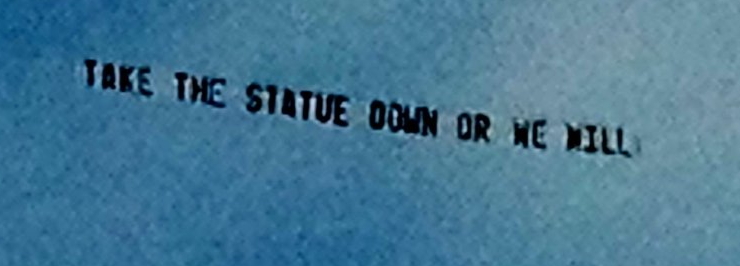
That’s “TAKE THE STATUE DOWN OR WE WILL,” if you can’t make it out.
Update | It’s now almost 3 pm Eastern time, about four hours after the plane first appeared, and nobody has managed to find out who was behind the message. The closest anyone’s come is Harrisburg television station WHTM, which reported half an hour ago that “the plane towing the banner is from Toledo, Ohio. The banner was made in Long Island.”
A quick Google suggests that the cost of such a stunt generally runs to a few hundred bucks.
A big point of contention in the argument over Daniel Tosh’s rape jokes has been how to take his suggestion that it’d be funny if a group of guys in his audience raped the woman who’d just called him out for making rape jokes during his set. A lot of folks, myself included, said that statement opened up the woman to harassment and possible assault, while Tosh’s defenders mostly denied that made any sense. Comedy is comedy, they said, and bad acts are bad acts, and you can’t mix up the two.
But now there’s this.
As my friend Kevin pointed out this morning, Tosh did a bit on his Comedy Central show just three months ago in which he encouraged his male viewers to videotape themselves “sneaking up behind women” and “lightly touching” their belly fat. And a bunch of them did, sending the clips into him and posting them on YouTube.
Now, the whole point of this is that it’s non-consensual, invasive, and public. And though some of the women in the clips appear to be in on the gag, others are clearly pissed off. In several cases the women seem to be strangers to the guys doing the touching, and in one — hosted on the Comedy Central website, complete with a revenue-generating ad — a high school student is shown touching his teacher. (That clip, like many others, cuts out before we’re able to see the victim’s reaction.)
What this confirms is that the whole Tosh thing isn’t about jokes. Tosh isn’t just a guy who tells stories on stage. He’s a guy whose comedy includes actually physically assaulting women, and directing his fans to do the same. And this is the guy who, after a woman challenged his rape jokes, mused aloud about how funny it would be if she “got raped by like, five” of those same fans, right then and there.
“Right now? Like right now? What if a bunch of guys just raped her?”
Damn.
This afternoon I’ll be heading uptown for a march against the NYPD’s stop-and-frisk policies.
The stats on NYC stop and frisk are by now well known. Cops stopped 685,724 people in the city last year, of whom 84% were black or Latino. They conducted more stops of black boys and men aged 14-24 then there are people in that demographic category. Just 9% of all stops ended in an arrest and just 2% led to the recovery of a weapon, even though half included frisks and more than 20% involved the use of force.
But I don’t want to talk about any of that today. What I want to talk about is the constitution.
Under the Fourth Amendment to the US Constitution, adopted as part of the Bill of Rights in 1791, “The right of the people to be secure in their persons, houses, papers, and effects, against unreasonable searches and seizures, shall not be violated.” What constitutes an “unreasonable” search or seizure under the Fourth Amendment in the context of a stop-and-frisk was decided by the Supreme Court in its 1968 Terry v. Ohio ruling. If you want to know whether a stop-and-frisk is a violation of someone’s constitutional rights, in other words, Terry is the place to go.
On October 31, 1963 a veteran police officer in Cleveland, Ohio saw two men standing together on a street corner. As he watched, one of the men walked down the block to a storefront and peered inside, then walked on for a short distance before turning around and returning to talk to the other man. After that, the second man did the same. The two continued like this — one walking over to the store, looking in, continuing on for a few steps, returning, talking to the other, then the other doing the same — for a period of at least ten minutes before being joined by a third man who talked to them for a moment, left, then rejoined them some distance away.
Believing that the three were casing the store for a robbery, the officer approached them. After asking them to identify themselves, he turned one around and patted him down, finding a revolver. At that point he searched the other two, finding a gun on one of them, and arrested the two men for carrying concealed weapons. The question before the Supreme Court was whether this was a constitutional search.
The Court began its discussion of that issue by quoting a 19th century case in which they had held that there is “no right … more sacred, or is more carefully guarded … than the right of every individual to the possession and control of his own person, free from all restraint or interference of others, unless by clear and unquestionable authority of law.” Given that, they said, the Terry case posed “difficult and troublesome issues,” particularly given “the wholesale harassment by certain elements of the police community, of which minority groups, particularly Negroes, frequently complain.”
Let’s pause there for a second. We have here a case in which a cop watched three men casing a store over a period of more than ten minutes, engaging in what the Court described as “elaborately casual and oft-repeated reconnaissance.” During questioning, the officer did no more than pat the three down for weapons — and in fact, even after finding guns on two of them, he didn’t conduct an invasive search of the third. And the Supreme Court of the United States, in the landmark case governing stop and frisk policies, called the question of the search’s constitutionality a “difficult and troublesome” one.
Got that? Okay. Back to the decision.
The first question the Court addressed was whether a stop and frisk constitutes a search and seizure under the meaning of the Fourth Amendment. They “emphatically” found that it does, finding that “it is quite plain” that “whenever a police officer accosts an individual and restrains his freedom to walk away,” that person has been “seized” for the purposes of the Fourth Amendment. Similarly, they declared that it is “nothing less than sheer torture of the English language” to deny that a patdown is a “search.”
Such a patdown, they said, cannot be dismissed as a mere “petty indignity.” It is, rather, “a serious intrusion upon the sanctity of the person, which may inflict great indignity and arouse strong resentment, and it is not to be undertaken lightly.”
…But now I have to go pick up my kid from a sleepover. More later.
• • •
Hi! I’m back.
By rejecting the idea that a stop-and-frisk was something milder than a real, constitutional “search,” the Court insisted on the seriousness of any “governmental invasion of a citizen’s personal security.” Any stop, they said, matters, and a frisk matters a lot. So what makes a stop-and-frisk reasonable?
The short answer is that the reason for the frisk must be serious enough, and the extent of the frisk limited enough, to convince an objective observer “of reasonable caution” that the violation to the subject was justified. An “inarticulate hunch” is not enough, they said. The officer’s “good faith” is not enough.
So what’s enough?
First, the officer must observe activity that “warrants further investigation.” In the Terry case, the Court made clear, the officer would not have been justified in stopping the men he stopped if they had just been standing on a corner talking, or “strolling up the street,” or looking in shop windows. It was only the whole of their actions, over a period of more than ten minutes, that justified any stop at all.
And the frisk, they said, didn’t automatically follow from the stop. The frisk, they said, was only justified by the “interest of the police officer in taking steps to assure himself that the person with whom he is dealing is not armed with a weapon that could unexpectedly and fatally be used against him.”
Their next paragraph is worth quoting in full.
“When an officer is justified in believing that the individual whose suspicious behavior he is investigating at close range is armed and presently dangerous to the officer or to others, it would appear to be clearly unreasonable to deny the officer the power to take necessary measures to determine whether the person is in fact carrying a weapon and to neutralize the threat of physical harm.”
It’s only an officer’s concern for his or her own immediate physical safety, in other words, or that of others in the vicinity, that justifies a frisk. And that frisk must be limited in scope and duration, because — quoting again —
“Even a limited search of the outer clothing for weapons constitutes a severe, though brief, intrusion upon cherished personal security, and it must surely be an annoying, frightening, and perhaps humiliating experience.”
An officer has the constitutional right to conduct a warrantless frisk, in other words, only where that frisk is “a reasonable search for weapons for the protection of the police officer, where he [or she] has reason to believe that he is dealing with an armed and dangerous individual.”
That’s it. That’s the sole circumstance that justifies a stop-and-frisk under Terry v. Ohio, which is the controlling Supreme Court precedent on the question as I write this sentence.
Can a cop conduct such a search in hopes of finding evidence of another crime? No. “Such a search, unlike a search without a warrant incident to a lawful arrest, is not justified by any need to prevent the disappearance or destruction of evidence of crime.” The search in Terry, they found, was constitutional specifically because “Officer McFadden confined his search strictly to what was minimally necessary to learn whether the men were armed and to disarm them once he discovered the weapons. He did not conduct a general exploratory search for whatever evidence of criminal activity he might find.”
And in case that wasn’t clear enough the first time, or the second, or the third, they closed by saying it again — where an officer has specific reason for reasonable concern that criminal activity is occurring or imminent, and specific reason to believe that the person he or she is observing may be armed, he or she may conduct questioning that leads to “a carefully limited search of the outer clothing of such persons in an attempt to discover weapons which might be used to assault him [or her].”
To recap:
- Stopping someone on a hunch? Unconstitutional.
- Stopping someone because they fit a broad demographic profile? Unconstitutional.
- Stopping someone without specific articulable reasonable belief that they are associated with criminal activity? Unconstitutional.
- Frisking someone as policy the course of a stop? Unconstitutional.
- Frisking someone you don’t have specific reason to believe may be armed and dangerous? Unconstitutional.
- Conducting a more intrusive frisk than is necessary to uncover weapons? Unconstitutional.
And again, more than 80% of NYPD stop-and-frisks end in neither an arrest nor a summons. More than 98% end without recovery of a weapon. If you compare pre-Bloomberg stats to today’s, only one in every three thousand new stops conducted under Bloomberg policies produce a weapon, even though recovery of weapons is the only constitutional basis for a frisk.
This is why I’m marching today. This is why I’m bringing my kids.

 studentactivism.net
Recent Comments