At this week’s huge General Assembly on the UC Davis campus, students voted by a margin of 1720 to 3 to hold a general strike next Monday. That call has been taken up by student activists across the country, including the folks at Occupy Colleges.

It’s not clear yet how widespread next Monday’s actions will be. On the one hand, the strike has been called for the first day back from the Thanksgiving break, leaving organizers little time to plan and get the word out to students on campuses. On the other hand, last week’s pepper spray incident at Davis has galvanized American student activists like no other event in recent memory.

I’ll be tracking planning for the Monday strike over the weekend and reporting back what I find. I’ll also be covering events on Monday as they occur.

Stay tuned.

Saturday Update | More info here.

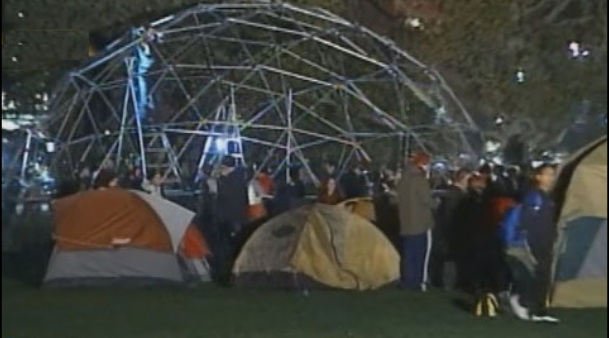
In the aftermath of last Friday’s pepper-spraying on the UC Davis campus, and the subsequent benching of two campus police officers and the chief of the UC Davis PD, Davis activists have set up a number of tents on the quad.

And one gigantic geodesic dome.


That’s a big dome.

The panel discussion I participated in yesterday at the Center for American Progress in Washington DC is now online. It was a good discussion, I think, and particularly timely given the events of the last week in California.

http://www.americanprogress.org/images/rd2/flash/flowplayer.commercial-3.0.5.swf

Along with myself, the panel included Tiffany Loftin, vice president of the United States Student Association, and PIRG campus organizer Dan Herb. Louis Soares of CAP and White House education policy advisor Zakiya Smith gave opening remarks, and the panel was moderated by CAP Policy Analyst Julie Morgan, lead author of a new report on student involvement in higher education governance.

C-SPAN broadcast the panel live, and they’ve got a copy of it up as well. (Not sure why they chose to title the event “Students Discuss Higher Education,” by the way. Though two of the three of us on the panel were young activists, none were actual students.)

A recurring theme in criticism of the students pepper-sprayed at UC Davis last week is that in forming a ring around police and their fellow activists they were violating the principles of nonviolent resistance. “A fundamental tenet of civil disobedience is to accept arrest when protesting injustice,” Berkeley Daily Cal columnist Casey Given wrote yesterday, and so the UC activists of today have no right to “compare … their struggle to … the Free Speech and Civil Rights Movements of the 1960s.”

Casey Given is right that civil rights activists mostly submitted to arrest willingly (though one of the movement’s greatest unsung heroes did not). But to invoke the Berkeley Free Speech Movement as an example of this supposed rule of nonviolence is a deeply strange choice.

The Free Speech Movement at Berkeley was christened on September 30, 1964, at a sit-in following the citation of eight students for violating the university’s leafleting policies. The very next day, on the morning of October 1, the university administration escalated the conflict by arresting former student Jack Weinberg for tabling in support of the civil rights movement in Sproul Plaza.

When police told Weinberg he was under arrest, he refused to move, and the officers were forced to call for backup. As they waited, the crowd grew. Eventually a squad car arrived. As police carried Weinberg into the car, the students standing nearby spontaneously sat down, blocking it from leaving Sproul. Police ordered them to move. They refused. Soon Mario Savio climbed onto the roof of the car and declared a noon rally at that location.

Savio was granted a meeting with university administrators not long after, at which he declared that the students surrounding the police car would disperse if and only if the administration released Weinberg, dropped charges against him and the eight students cited the previous day, and opened serious negotiations on campus regulations. Several hundred students spent that night surrounding the car, many of them in sleeping bags. (The demonstrators continued to use the car’s roof as a podium, denting it severely. They also deflated its tires.)

It was not until the following evening, after the administrators had accepted most of their demands, that the students allowed the police car to exit the plaza.

This is the history of nonviolent student protest at Berkeley. It is the history of peaceful student organizing, yes, but it’s also a history of students disrupting police business, refusing to submit to arrest, damaging police property, even holding police hostage.

That is the history of the students of the University of California. That is the inheritance of the student activists of today.

From the homepage of the UC Davis Department of English:

The faculty of the UC Davis English Department supports the Board of the Davis Faculty Association in calling for Chancellor Katehi’s immediate resignation and for “a policy that will end the practice of forcibly removing non-violent student, faculty, staff, and community protesters by police on the UC Davis campus.” Further, given the demonstrable threat posed by the University of California Police Department and other law enforcement agencies to the safety of students, faculty, staff, and community members on our campus and others in the UC system, we propose that such a policy include the disbanding of the UCPD and the institution of an ordinance against the presence of police forces on the UC Davis campus, unless their presence is specifically requested by a member of the campus community. This will initiate a genuinely collective effort to determine how best to ensure the health and safety of the campus community at UC Davis.

About This Blog

n7772graysmall
StudentActivism.net is the work of Angus Johnston, a historian and advocate of American student organizing.

To contact Angus, click here. For more about him, check out AngusJohnston.com.
