
Students launched an occupation of the gardens outside the offices of the president of Scotland’s University of St. Andrews early this morning, protesting skyrocketing tuition fees.

Scottish tuition rates aren’t just high, they’re also bizarrely structured. Scotland’s universities are free for Scottish students, and free for European Union residents under EU rules that say that member state universities can’t charge more for other EU nationals than they do for locals.

But the rest of Britain isn’t subject to those rules, weirdly, so English, Welsh, and Northern Irish students, falling between the “free for Glaswegians” category and the “free for Latvians” categories, are charged high fees.

At St. Andrews those fees amount to £9,000 a year, which is $14,000 in American money. According to the organizers of today’s protest, that makes the university the most expensive in all of Europe — for those students who pay anything at all.

The high fees for “RUK” (rest of UK) students in Scotland were introduced this summer in reaction to massive fee hikes in English universities. The Scottish government defended the move as an effort to keep Scotland’s universities from being swamped with “fee refugees” from the rest of Britain.

The occupiers intend to stay for 36 hours, symbolizing the full four-year £36,000 fee. They have a Twitter account and a website if you want to learn more.
Last week a campus walkout in support of Occupy Wall Street, originally called for New York City, mushroomed in a matter of days to include dozens of campuses across the country. The Wednesday actions drew numbers ranging from hundreds to — on at least five campuses — single students, starting from scratch and organizing on their own.

And this week they’re doing it again.

After a frenzy of discussion and several straw polls on Facebook, the folks at Occupy Colleges have announced this Thursday, October 13, as their next day of action. They’re presenting this as a day of protest rather than a walkout, and they say they already have forty campuses on board. (They’ve also produced a handy-dandy guide to mounting an action.)

More to come…

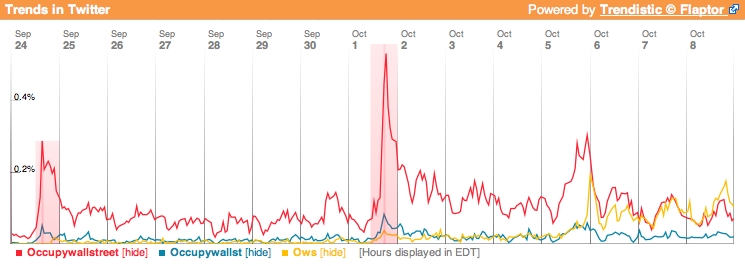
When the Occupy Wall Street protests began on September 16, #OccupyWallStreet was the only related hashtag used on Twitter. Soon some folks started using #OccupyWallSt too.

Shorter is better on Twitter, since you only have 140 characters to say your piece, so when the protests really started getting media traction with the arrests of Saturday, September 26 some folks started using #OWS as a zippier alternative. That tag didn’t really catch on until this last Wednesday, though, when the folks behind @OccupyWallSt tweeted this:

 @OccupyWallSt: Let’s stop the hash tag soup and use #ows for OccupyWallStreet

That tweet had an immediate and powerful effect.


#OWS, represented in yellow on the chart, spiked up on Wednesday evening, while #OccupyWallSt plummeted. At about noon yesterday #OWS actually overtook the original #OccupyWallStreet tag in popularity, and it’s been running at about 50% higher traffic ever since.

#OccupyWallStreet is still getting a lot of traffic, since it’s the most established hashtag, and the clearest. But #OWS is the new default, and #OccupyWallSt is dying. Spread the word…

Lots of computer problems this week. Mostly offline while I get everything squared away and do some long-neglected backing up and clearing out. Good stuff coming this weekend, I promise.

As I write this, it’s about two hours since the AP reported the death of Apple founder Steve Jobs. Jobs is receiving an overwhelming amount of attention on Twitter — according to the Trendistic site, the words “Steve Jobs” appeared in 15.85% of all tweets posted in the last hour. Yes, you read that right. Nearly one in every six tweets on the entire Twitter site included the words “Steve Jobs.” That’s more than used the words “of” or “you” or “and.”

And yet “Steve Jobs” isn’t trending on Twitter.

“#ThankYouSteve” is, with far less traffic. “iSad” is, with one percent of the traffic. Hell, “Apple II” is, with 0.02% of all tweets. But “Steve Jobs” isn’t.

Why? Because Twitter’s trending algorithm, for better or worse, values novelty over volume, and people tweet about Steve Jobs all the time. But they don’t usually tweet “RIP STEVE JOBS,” and so that phrase, with just a fifth of the traffic of the man’s name on its own, is currently leading the worldwide trending topics list.

So next time you get upset that your favorite cause isn’t trending, do two things before you accuse Twitter of censorship. First, check to see whether the phrase in question is really getting the volume of traffic you think it is. (Right now #OccupyWallStreet, my own current favorite cause, is running about a sixtieth of the traffic of Steve Jobs’ name, and about a twelfth of the traffic of RIP STEVE JOBS.)

And second, if the topic is getting a lot of traffic, check to see whether associated phrases are trending. If #OccupyWallStreet isn’t trending, is Zuccotti Square? Or NYPD? Or “pepper spray”? If so, then Twitter’s algorithm is doing what it’s intended to do — finding the unusual terms that are associated with a novel development, and shining a spotlight on them for a few short hours.

October 11 Update | Interesting new datapoint in the wake of the arrest of a hundred Occupy Boston demonstrators late last night. “Occupy Boston” trended, but #OccupyBoston didn’t. Here’s my best guess as to why.

About This Blog

n7772graysmall
StudentActivism.net is the work of Angus Johnston, a historian and advocate of American student organizing.

To contact Angus, click here. For more about him, check out AngusJohnston.com.
