The exclusion of students, faculty, and staff from university decisionmaking isn’t a new story or a shocking one. From CUNY to California, administrators have in recent years been dismantling shared governance, eliminating traditional oversight structures, and arrogating power to themselves.

The story is so common nowadays that it’s easy to become inured to it, particularly in circumstances in which no particular drama attaches to the fight. When administrators take down entire departments or trample individuals’ due process rights we take notice, but when they just steamroll on, doing what administrators do? It’s easy to lose interest.

We shouldn’t. We shouldn’t, and I’ll let Dave Wyman, a sophomore at the University of Michigan, tell you why.

Michigan is looking for a new president right now. The last time they went on that hunt, back in 2002, students, staff, and non-tenured faculty were represented on the committee. Today none of those constituencies are.

Here’s what Dave has to say about that:

The strength of our University community is in its diversity. As undergraduate and graduate students, tenured and non-tenured instructors, staff and Ann Arbor residents, we all have interests, hopes and concerns for the new president and the direction of the University in general. We’re all stakeholders in this, and deserve to have our ideas taken as seriously as those of the narrow fraction of the community that makes up the administration and the committee…

We find ourselves on a campus where in-state undergraduate tuition has risen 63 percent in the last decade, making the University continually less accessible and forcing many students to take out dauntingly large loans. And, yet, we’re surrounded with new construction geared to boost rankings and draw out-of-state students. We have less say than ever in how the University operates. If we want these things to change — if we want a president who will rethink the model the administration has imposed — we have to take a stand for student rights.

When state funding subsidized the majority of University costs, perhaps it might have been fair for the regents to claim the broad authority they now do over University affairs. But when our tuition money is 62 percent of the budget, it’s unjustifiable for the administration to disenfranchise students in this fashion…

The time has passed for us to quietly petition the administration for a voice in the direction of the University. The time has passed for us to accept a powerless “assistive” role in vital decisions like the presidential search. We must demand a binding voice in the selection of Michigan’s next president and a deciding role in the way our university is run.

Damn straight.

This Thursday at noon, the Student Union of Michigan will be rallying at The Cube on the U of M campus to demand that the administration reconstitute the presidential search committee in a manner that reflects the importance of all the communities that make up the campus.

I’ll be watching what happens on Thursday, and I hope you will be too.

When you think of American student peace activism, you probably don’t think of the late 1950s and early 1960s. But you probably should, and today is the fiftieth anniversary of one huge reason why.

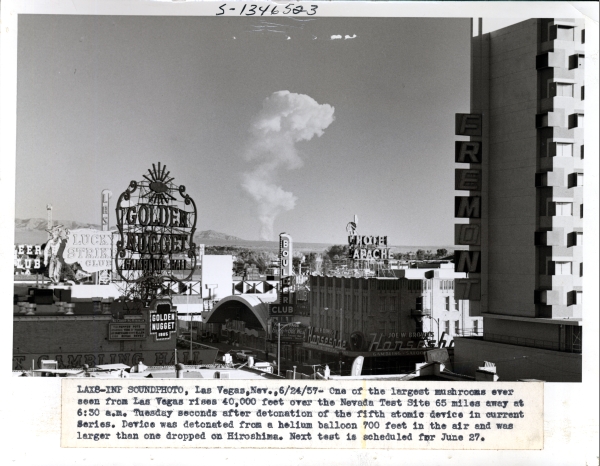
For most of the 1950s the United States was regularly testing nuclear weapons above ground, and in ways that today seem almost unimaginably reckless. Dozens of atomic bombs were set off in Nevada, barely sixty miles from Las Vegas. Other tests were conducted near populated islands in the Pacific, including one that led to large-scale evacuations after the bomb turned out to be nearly twice as powerful as planned. In 1958 the US detonated a nuclear weapon in space, and planned to use several more to carve out an artificial harbor in northern Alaska to use as a transit point for oil and coal shipments from the area.

For student activists of the age, nuclear weapons represented everything that was wrong about modern militarism — the threat of global war, the targeting of civilians, the recklessness of US-Soviet brinksmanship, ties between the military and corporations. In 1957 students created a campus affiliate of the new National Committee for a Sane Nuclear Policy (SANE), and two years later, in 1959, they established two independent student antiwar groups, the Student Peace Union and the College Peace Union.

This campus organizing of the late 1950s was limited in comparison with the protests that came later, but it helped to build toward what followed — Student SANE, SPU , and CPU were organizing on campuses before SDS or SNCC were even conceived. (Student SANE was set adrift by its parent group in 1960 after SANE tried to purge students who refused to support a strict anti-Soviet political line. Many Student SANE members migrated to the SPU after that. CPU merged with SPU that same year, taking the latter’s name.)

The United States, the Soviet Union, and the United Kingdom, then the world’s only nuclear powers, declared a moratorium on nuclear testing in 1958, but the moratorium collapsed after France tested its first bomb in early 1960. The Soviet Union resumed testing that fall, and the United States followed suit the following year.

The resumption of testing prompted a wave of campus protest, with demonstrations held across the country. In February 1961, ten thousand student marched on Washington to urge the US to continue its testing ban. In March 1962, after testing had resumed, hundreds of anti-testing Berkeley students picketed President Kennedy when he spoke on campus. (In a prelude to the Free Speech Movement of 1964 SLATE, the activist campus political party at Berkeley, had been forced to withdraw its formal support for an anti-testing vigil the previous fall when the administration declared that any “action of a social or political nature” by student organizations was prohibited.)

At its height, the Student Peace Union had dozens, perhaps hundreds, of campus chapters, and a paid individual membership roster of four thousand — in 1962 and 1963 it was, as historian Philip Altbach has described it, “the largest radical student organization in the United States.” Campus activists kept up public pressure for a test ban in those years, pressure that helped bring American, British, and Soviet negotiators to the table in 1963. A ban on all atmospheric, underwater, and space-based nuclear testing was agreed to late that summer, and ratified by the United States Senate on September 24, 1963 — fifty years ago today.

The SPU lost focus after the signing of the test ban treaty, as many of its members took their skills and their energy into the civil rights movement, campus organizing, or the growing Students for a Democratic Society. In doing so, they helped to build the student movements of the sixties that followed — without their work and their example, the sixties would not be the sixties we know today.

I’ve got three very exciting speaking engagements coming up in the next few weeks, with others in the works. I’ll be updating the full list as the year goes on at the Speaking page on the blog — check back there for more as the fall semester unfolds.

This Saturday, September 28, I’ll be giving a keynote speech at a conference of the Connecticut Students Organization, a new statewide student group. I’ll be talking about the importance of statewide associations in American student activism, and about some of the pitfalls such groups face when they’re getting organized.

The next day, Sunday, September 29, I’ll be speaking at BHQFU as part of their fall lecture series on education. I’ll be discussing the roots of contemporary student organizing struggles in the higher education transformations of the 1970s and the neglected but transformative campus activist movements of that decade.

And on Saturday, October 19, I’ll be participating in a panel discussion capping off a CUNY Student Summit that’s being held downtown. On that panel, a group of past and present student organizers from across New York will be talking about the history of activism in the state and its relevance to the organizers of today.

•          •          •

If you’d like information about bringing me to your campus or event, click here.

In the early morning hours of September 15, 1963, fifty years ago today, four white supremacists planted a box of dynamite under the steps of the 16th Street Baptist Church in Birmingham, Alabama. When the bomb exploded at 10:22 am, it killed four young parishioners, injuring nearly two dozen others.

Speaking at the funeral of three of the girls, Martin Luther King eulogized the four as martyrs to “a holy crusade for freedom and human dignity.” His words were prescient — the bombing galvanized American public opinion in support of the civil rights movement as no previous act of racist violence had, and helped to pave the way for the passage of the Civil Rights Act of 1964 nine and a half months later.

The Birmingham church bombing is now remembered as a milestone in American history, and today, on the fiftieth anniversary of the attack, media and social media are filled with commemorations. But there are some elements of the story that are misremembered, and some that have been largely forgotten. We would do well to fill in the gaps.

When I ask my students and activists I know about the girls killed in Birmingham that day, they almost always describe them as six or eight years old. In public memory they are remembered as the “four little girls,” shown in pigtails and bows in photographs from when they were in first or second grade. But Addie Mae Collins, Carole Robertson, and Cynthia Wesley were all fourteen years old on the day they were killed, while Denise McNair was eleven. They were kids, but they weren’t the tykes of popular memory. Their lives were taken from them as they were on the verge of becoming young women.

And they weren’t the only black kids killed in Birmingham that day.

As news of the bombing spread the city erupted into riot. Black businesses and homes were burned, whites drove through black neighborhoods waving confederate flags. Crowds of black residents confronted police in standoffs that lasted for hours.

When the whites with their confederate flags appeared, shouting racial slurs and throwing soda bottles, some black youths fought back, throwing rocks at the cars. When police arrived at one such confrontation, the rock-throwers ran. Officer Jack Parker fired his shotgun, twice, from the back seat of his cruiser. Johnny Robinson, sixteen years old, was shot in the back as he ran. He was dead by the time he arrived at the hospital.

Later that day, Virgil Ware, thirteen, was riding on the handlebars of his brother’s bike when he was shot by Larry Joe Sims, a white sixteen-year-old returning from an anti-integration rally.

The teen who killed Virgil Ware was convicted of second-degree manslaughter and sentenced to two years probation. The officer who killed Johnny Robinson was never charged with a crime.

Too often in America our narratives of race and history are constructed around a false oversimplification of the past.

In this telling, Rosa Parks becomes a saintly, vaguely elderly, seamstress whose feet were tired, rather than the seasoned 32-year-old civil rights activist who knew exactly what she was setting off when she refused to go to the back of the bus. Martin Luther King is remembered more for a few poetic snippets of the “I Have A Dream” speech than his decades of fierce and effective agitation. And four girls — innocent, yes, blameless, yes, but middle-schoolers, not kindergarteners — are transformed into symbols, denied their actual biographies. Meanwhile, angry, rock-throwing Johnny Robinson and Virgil Ware, a teenager senselessly shot down by another teenager, are erased entirely.

When we mythologize the civil rights movement, when we transform the raucous, unruly righteousness of the integrationist cause into a fantasy of passive, pastel-colored innocence, we deny ourselves the opportunity to learn how social change — and history — is truly made. And when we measure the complexity and uncertainty and messiness of the present against the sepia tones of that fictitious past, the present will always suffer by comparison.

Rosa Parks didn’t win because she was a saint. She won because she was an organizer. Martin Luther King didn’t change the world by giving feel-good speeches, he changed the world by doggedly mobilizing a fractious and complex and divided movement for social justice. Addie Mae Collins, Carole Robertson, Cynthia Wesley, Denise McNair, Johnny Robinson, and Virgil Ware weren’t adorable tykes, they were the kids we see on the subway every day, and too often recoil from. One of them was so angry at the violence and humiliation that had been inflicted on him and his community that he picked up a rock and was shot in the back by a police officer who never spent a day in jail.

We should remember Addie Mae Collins, Denise McNair, Carole Robertson, and Cynthia Wesley — and Johnny Robinson and Virgil Ware, too. And we should do them the honor of remembering them as they were.

In a mass email and blogpost last night, Hugo Schwyzer confirmed what he told this website the day before — that he intends to resign his teaching position at Pasadena City College.

In the email, Schwyzer, who last week acknowledged multiple recent sexual relationships with students, cited “the advice of my doctors and the pressure from the public and the PCC community” as prompting the decision to quit. In the blogpost, he said merely that “I will not be returning to my teaching position at Pasadena City College, a position I have held since 1993.”

Schwyzer had previously suggested that he would use his ongoing employment at PCC as leverage in his attempt to secure a retirement agreement. Though he now says that he will “will transition into disability retirement status” at the end of his current medical leave, his application for disability retirement is apparently still pending with the state.

PCC administrators say that Schwyzer’s plans to quit will not derail the college’s investigation of his sexual misconduct. The college’s general counsel, Gail Cooper, told the PCC student newspaper yesterday that “people resign, but that doesn’t mean you don’t investigate because there are still victims.”

October 2 Update | Despite multiple reports to the contrary, Schwyzer has not yet “unequivocally and irrevocably” resigned from PCC, and the college is now moving to terminate him if he does not do so. In the wake of a DUI incident last week in which Schwyzer seriously injured a woman while under the influence of prescription drugs, the college is stepping up its efforts to remove Schwyzer from its payroll on an accelerated schedule.

In a letter dated yesterday, a college attorney informed Schwyzer that district officials consider his “recent conduct and the past conduct which [he has] revealed in [his] recent public statements and writings as grounds for termination.” Formal efforts to remove him from his position will begin, the letter said, “well before” the January 1, 2014 date that Schwyzer has announced for his intended resignation.

The letter advised Schwyzer that he can avoid removal or other disciplinary action if he “unequivocally and irrevocably” resigns.

In the second media interview that he has given since announcing his retirement from public life two days ago, Schwyzer told the Los Angeles Daily News today that although he is “guilty” and “worthy of perhaps being terminated,” he was “also a successful professor” whose “entire career is not defined by a few affairs with students.” He is asking, he said, that the college “forestall termination until December 31” — apparently because his retirement benefits will not kick in until January 1.

About This Blog

n7772graysmall
StudentActivism.net is the work of Angus Johnston, a historian and advocate of American student organizing.

To contact Angus, click here. For more about him, check out AngusJohnston.com.