Last Sunday on The Newsroom Aaron Sorkin’s anchor-hero Will McAvoy offered up a whirlwind tour of the history of Students for Democratic Society, the Yippies, and the Vietnam antiwar movement that managed to get pretty much everything completely wrong in the service of an analogy that made no sense. Here’s my take, because when else am I going to get a chance like this?

•          •          •

“Back in 1968 when Rennie Davis and Hayden and their guys organized the SDS,

SDS was put together in 1960, not 1968. Its organizational roots stretch back as far as 1905. And although Rennie Davis and Tom Hayden would both become important figures in the group in the early sixties and after, neither participated in its founding meetings.

 it was specifically to end the Vietnam war

Nope. SDS was a broad-based, multi-issue organization from the beginning. It addressed itself to concerns ranging from nuclear testing to civil rights to campus parietal rules. The 1962 Port Huron Statement, SDS’s immensely influential (and just plain immense) manifesto, mentions Vietnam just once, in the context of a discussion of the membership policies of the United Nations.

but that movement got eaten by Abbie Hoffman and Jerry Rubin and the Yippies.

Again, no. The collapse of SDS had almost nothing to do with the rise of the Yippies, and everything to do with government repression, sectarian infighting, and revolutionary overreach. And though SDS died with the sixties, the American seventies would see the ascendancy of other transformative social movements around issues like feminism, gay rights, environmentalism, Native American rights, and so on. Many of those movements had direct links to the New Left.

It’s also worth noting that Tom Hayden and the Yippies were allies for a big chunk of the period under discussion, as demonstrated by this film footage of Hayden speaking alongside Hoffman at a Yippie press conference.

It was impossible to define what the Yippies were protesting.

Ridiculous. The Yippies staged plenty of specific, targeted actions, and participated in plenty more, as we’ll see in a moment. Yes, they were a sprawling, inchoate group. Yes, they offered a vague, unformed vision of the revolution they were trying to achieve. But they also organized focused campaigns.

They were about giving the finger to anyone over thirty,

Abbie Hoffman was well past thirty by 1968. And when Jerry Rubin turned thirty that summer, he wrote that he “was reborn in Berkeley in 1964 in the Free Speech movement. When we say ‘Don’t trust anyone over 30,’ we’re talking about the second birth. … When people 40 years old come up to me and say, ‘Well, I guess I can’t be part of your movement,’ I say, ‘What do you mean? You could have been born yesterday. Age exists in your head.’ Bertrand Russell is our leader. He’s 90 years old.”

generically hating the American establishment,

Sure, the Yippies hated the American establishment. You know why? For starters, the American establishment was trying to put them (and Tom Hayden and Rennie Davis) in prison.

dropping out, getting high.

There was a lot of that going around in those days, or so I’ve heard. Still is, in some circles.

That’s how the progressive movement would be painted for the next forty years.

Attacks on left activists as dirty hippies didn’t begin with Abbie Hoffman. In 1966 Ronald Reagan used hippie-bashing to win the governorship of California, and he wasn’t remotely the only politician beating that gong. The 1960s saw a huge generational cultural upheaval that was inextricably bound up with a youth activist movement in the public mind — neither the Yippies nor anyone else had the power to change that, even if they’d wanted to.

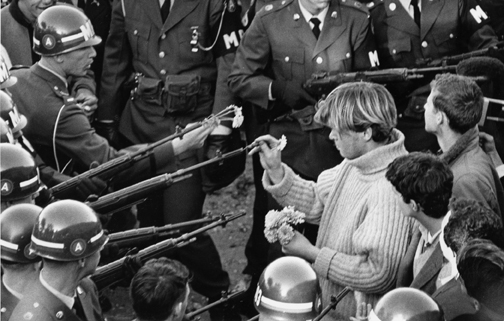
People passing out daisies to soldiers and trying to levitate the Pentagon.

Funny you should mention that. Because the attempt to levitate the Pentagon occurred at a 1967 demonstration against the war, an action that Tom Hayden has described as one of the most potent of the Vietnam War era. Yes, Jerry Rubin was the point person on that demo, but he was recruited for the position by David Dellinger, who was hardly a Yippie. (And if you think this photo actually harmed the antiwar movement, well God, Jed, I don’t even want to know you.)

The Pentagon’s a really big building. You can’t levitate it.

This part is true.

The sixties radicals and the Tea Party are roughly the same, with one big exception. Even at the height of 1968 the Democrats wouldn’t have nominated Abbie Hoffman or Jerry Rubin for any office, and no candidate would have sought their endorsement. 

Okay, a few things. First, 1968 wasn’t “the height” of anything in terms of Democratic Party radicalism. That year the Dems nominated their sitting vice president at a convention that saw epidemic police violence against protesters, violence that was essentially ignored by the conventioneers. The party’s presidential nominee, Hubert Humphrey, never came out against the war in Vietnam, and only called for a ceasefire weeks before the general election.

So no, Abbie Hoffman and Jerry Rubin weren’t getting any love from the Democratic Party that year. But neither were Hayden and Davis, or any other figures in the New Left. (By the eighties, however, both Hoffman and Hayden were involved in mainstream left-liberal political activity.)

Can you imagine Humphrey or Kennedy standing for a photo op with Bernardine Dohrn or Allen Ginsberg?”

No, but I can’t quite figure out why we’re talking about them, either.

Bernardine Dohrn wasn’t a Yippie, she was an SDSer. Specifically, she was a member of the Weatherman faction, an advocate of violent revolution in the United States. She wasn’t about “giving the finger to anyone over thirty, generically hating the American establishment, dropping out, getting high,” she was about blowing things up and killing people. Ginsberg I can kind of understand the mention of, since he at least participated in the 1967 Pentagon action, but he did so as a middle-aged gay poet, not a young activist.

Lumping in Ginsberg with Hoffman and Rubin makes a kind of weird sense. But lumping those three gleeful pranksters in with Dohrn is just absurd.

And all this quibbling over details may be beside the point anyway, since Sorkin’s underlying argument is so wrong-headed. His claim is that the New Left and the Tea Party both began as reasonable interventions into party politics, that both were hijacked by bizarre radicals, and differ only in that one was absorbed into the GOP while the other was properly shunned by the Democrats.

And that’s about the least useful analysis of either movement that I’ve ever heard.

July 16 Update | Jesse Walker of Reason has put up a fascinating, illuminating post on the Yippies and the 1972 Democratic National Convention which carries the debunk one step further.

Update | CK says he was unaware of the Tosh incident when he tweeted, a claim I find implausible. But he also says that the whole thing made him more aware of women’s experience of rape than he had been.

Louis CK is about a year older than me. He, like me, is a divorced joint-custody father of two. His daughters are each about a year older than mine, and like mine they go to pretty good New York City public schools. Like me he’s a bearded pasty Manhattanite who could stand to lose a few pounds. Like me he’s trying to be an anti-racist, anti-sexist, decent human being in the face of a hell of a lot of training to the contrary.

And he’s brilliant, so when he talks about his life and his worldview, he frequently says stuff I wish I’d said, or figured out before. Louis CK has stood on my television and told me true things about how I feel about being a parent that I didn’t know until he said them. He’s said serious things about serious things that I’ve repeated over and over.

And so I’m sad tonight, and pissed off.

If you don’t know the background, here it is:

Not long ago, on Tumblr, someone posted a note from a friend about how she’d inadvertently wandered into a Daniel Tosh standup show and how things got really creepy:

So Tosh then starts making some very generalizing, declarative statements about rape jokes always being funny, how can a rape joke not be funny, rape is hilarious, etc. I don’t know why he was so repetitive about it but I felt provoked because I, for one, DON’T find them funny and never have. So I didnt appreciate Daniel Tosh (or anyone!) telling me I should find them funny. So I yelled out, “Actually, rape jokes are never funny!”

I did it because, even though being “disruptive” is against my nature, I felt that sitting there and saying nothing, or leaving quietly, would have been against my values as a person and as a woman. I don’t sit there while someone tells me how I should feel about something as profound and damaging as rape.

After I called out to him, Tosh paused for a moment. Then, he says, “Wouldn’t it be funny if that girl got raped by like, 5 guys right now? Like right now? What if a bunch of guys just raped her…”

Yeah. So she left, obviously, and asked for a refund which she didn’t get, and then told the story to the friend who posted it. And then folks found out about it and reblogged it (or whatever the hell they do on Tumblr, I don’t know), and it got traction and eventually Tosh himself responded on Twitter:

“all the out of context misquotes aside, i’d like to sincerely apologize http://j.mp/PJ8bNs

That’s a non-apology, of course, since it doesn’t include any specific acknowledgment of wrongdoing. And it’s a particularly churlish non-apology since it accuses his accuser of unspecified sins. It’s bullshit, in short. But whatever, it’s Daniel Tosh, who was always an asshole. Why should today be any different?

And then Louis CK stepped in. Damn it.

Now, I should say that as righteous as CK has often been, he’s stumbled sometimes, as do we all. He’s made some moves I wouldn’t have made, said some things I wish he hadn’t. And he’s also said some things that I wasn’t sure how to take.

Specifically, he’s told some rape jokes. In each case, if I squinted, I could read them as rape culture jokes, jokes about how screwed up our society is when it comes to rape, jokes about how screwed up men are when it comes to sex and power and control. As a white guy, I don’t want to say white guys can’t make weird uncomfortable jokes about race and gender. Sometimes, in some contexts, we can and do. Sometimes in doing so we speak to important truths.

I’m not going to defend any specific joke tonight, and I’m not going to defend the general principle either. Maybe I’ve been wrong when I’ve done it in the past. I don’t know. What I do know is that I gave Louis CK too much credit for navigating those questions thoughtfully and consciously, because what Louis tweeted after Tosh tweeted his non-apology is this:

@danieltosh your show makes me laugh every time I watch it. And you have pretty eyes.

Dude. Come on.

Come on.

What we know about that night is that a woman says Daniel Tosh joked, after she called him on making rape jokes, that it’d be funny if a bunch in the guys in the audience raped her. How on earth is that funny? How on earth is that not fucked up?

I’m not going to say that Tosh was giving the guys in the audience a green light to rape that woman. But you can’t not say he was giving them the green light to screw with her. You can’t say he wasn’t sending them the message he thought it’d be funny if they made a bunch of jokes to her face, in a dark parking lot, about how they ought to rape her right there. You can’t say that if they did that, they’d have any reason to believe he’d think it wasn’t cool.

You know about jokes. You know far more than me about jokes. And that joke just isn’t okay.

This afternoon I’ll be heading uptown for a march against the NYPD’s stop-and-frisk policies.

The stats on NYC stop and frisk are by now well known. Cops stopped 685,724 people in the city last year, of whom 84% were black or Latino. They conducted more stops of black boys and men aged 14-24 then there are people in that demographic category. Just 9% of all stops ended in an arrest and just 2% led to the recovery of a weapon, even though half included frisks and more than 20% involved the use of force.

But I don’t want to talk about any of that today. What I want to talk about is the constitution.

Under the Fourth Amendment to the US Constitution, adopted as part of the Bill of Rights in 1791, “The right of the people to be secure in their persons, houses, papers, and effects, against unreasonable searches and seizures, shall not be violated.” What constitutes an “unreasonable” search or seizure under the Fourth Amendment in the context of a stop-and-frisk was decided by the Supreme Court in its 1968 Terry v. Ohio ruling. If you want to know whether a stop-and-frisk is a violation of someone’s constitutional rights, in other words, Terry is the place to go.

Let’s go.

On October 31, 1963 a veteran police officer in Cleveland, Ohio saw two men standing together on a street corner. As he watched, one of the men walked down the block to a storefront and peered inside, then walked on for a short distance before turning around and returning to talk to the other man. After that, the second man did the same. The two continued like this — one walking over to the store, looking in, continuing on for a few steps, returning, talking to the other, then the other doing the same — for a period of at least ten minutes before being joined by a third man who talked to them for a moment, left, then rejoined them some distance away.

Believing that the three were casing the store for a robbery, the officer approached them. After asking them to identify themselves, he turned one around and patted him down, finding a revolver. At that point he searched the other two, finding a gun on one of them, and arrested the two men for carrying concealed weapons. The question before the Supreme Court was whether this was a constitutional search.

The Court began its discussion of that issue by quoting a 19th century case in which they had held that there is “no right … more sacred, or is more carefully guarded … than the right of every individual to the possession and control of his own person, free from all restraint or interference of others, unless by clear and unquestionable authority of law.” Given that, they said, the Terry case posed “difficult and troublesome issues,” particularly given “the wholesale harassment by certain elements of the police community, of which minority groups, particularly Negroes, frequently complain.”

Let’s pause there for a second. We have here a case in which a cop watched three men casing a store over a period of more than ten minutes, engaging in what the Court described as “elaborately casual and oft-repeated reconnaissance.” During questioning, the officer did no more than pat the three down for weapons — and in fact, even after finding guns on two of them, he didn’t conduct an invasive search of the third. And the Supreme Court of the United States, in the landmark case governing stop and frisk policies, called the question of the search’s constitutionality a “difficult and troublesome” one.

Got that? Okay. Back to the decision.

The first question the Court addressed was whether a stop and frisk constitutes a search and seizure under the meaning of the Fourth Amendment. They “emphatically” found that it does, finding that “it is quite plain” that “whenever a police officer accosts an individual and restrains his freedom to walk away,” that person has been “seized” for the purposes of the Fourth Amendment. Similarly, they declared that it is “nothing less than sheer torture of the English language” to deny that a patdown is a “search.”

Such a patdown, they said, cannot be dismissed as a mere “petty indignity.” It is, rather, “a serious intrusion upon the sanctity of the person, which may inflict great indignity and arouse strong resentment, and it is not to be undertaken lightly.”

…But now I have to go pick up my kid from a sleepover. More later.

•          •          •

Hi! I’m back.

By rejecting the idea that a stop-and-frisk was something milder than a real, constitutional “search,” the Court insisted on the seriousness of any “governmental invasion of a citizen’s personal security.” Any stop, they said, matters, and a frisk matters a lot. So what makes a stop-and-frisk reasonable?

The short answer is that the reason for the frisk must be serious enough, and the extent of the frisk limited enough, to convince an objective observer “of reasonable caution” that the violation to the subject was justified. An “inarticulate hunch” is not enough, they said. The officer’s “good faith” is not enough.

So what’s enough?

First, the officer must observe activity that “warrants further investigation.” In the Terry case, the Court made clear, the officer would not have been justified in stopping the men he stopped if they had just been standing on a corner talking, or “strolling up the street,” or looking in shop windows. It was only the whole of their actions, over a period of more than ten minutes, that justified any stop at all.

And the frisk, they said, didn’t automatically follow from the stop. The frisk, they said, was only justified by the “interest of the police officer in taking steps to assure himself that the person with whom he is dealing is not armed with a weapon that could unexpectedly and fatally be used against him.”

Their next paragraph is worth quoting in full.

“When an officer is justified in believing that the individual whose suspicious behavior he is investigating at close range is armed and presently dangerous to the officer or to others, it would appear to be clearly unreasonable to deny the officer the power to take necessary measures to determine whether the person is in fact carrying a weapon and to neutralize the threat of physical harm.”

It’s only an officer’s concern for his or her own immediate physical safety, in other words, or that of others in the vicinity, that justifies a frisk. And that frisk must be limited in scope and duration, because — quoting again —

“Even a limited search of the outer clothing for weapons constitutes a severe, though brief, intrusion upon cherished personal security, and it must surely be an annoying, frightening, and perhaps humiliating experience.”

An officer has the constitutional right to conduct a warrantless frisk, in other words, only where that frisk is “a reasonable search for weapons for the protection of the police officer, where he [or she] has reason to believe that he is dealing with an armed and dangerous individual.”

That’s it. That’s the sole circumstance that justifies a stop-and-frisk under Terry v. Ohio, which is the controlling Supreme Court precedent on the question as I write this sentence.

Can a cop conduct such a search in hopes of finding evidence of another crime? No. “Such a search, unlike a search without a warrant incident to a lawful arrest, is not justified by any need to prevent the disappearance or destruction of evidence of crime.” The search in Terry, they found, was constitutional specifically because “Officer McFadden confined his search strictly to what was minimally necessary to learn whether the men were armed and to disarm them once he discovered the weapons. He did not conduct a general exploratory search for whatever evidence of criminal activity he might find.”

And in case that wasn’t clear enough the first time, or the second, or the third, they closed by saying it again — where an officer has specific reason for reasonable concern that criminal activity is occurring or imminent, and specific reason to believe that the person he or she is observing may be armed, he or she may conduct questioning that leads to “a carefully limited search of the outer clothing of such persons in an attempt to discover weapons which might be used to assault him [or her].”

To recap:

  • Stopping someone on a hunch? Unconstitutional.
  • Stopping someone because they fit a broad demographic profile? Unconstitutional.
  • Stopping someone without specific articulable reasonable belief that they are associated with criminal activity? Unconstitutional.
  • Frisking someone as policy the course of a stop? Unconstitutional.
  • Frisking someone you don’t have specific reason to believe may be armed and dangerous? Unconstitutional.
  • Conducting a more intrusive frisk than is necessary to uncover weapons? Unconstitutional.

And again, more than 80% of NYPD stop-and-frisks end in neither an arrest nor a summons. More than 98% end without recovery of a weapon. If you compare pre-Bloomberg stats to today’s, only one in every three thousand new stops conducted under Bloomberg policies produce a weapon, even though recovery of weapons is the only constitutional basis for a frisk.

This is why I’m marching today. This is why I’m bringing my kids.

Just a week ago, the Washington Post ran a lengthy piece on President Obama’s sometimes strained relationship with LGBT and immigration reform activists, a story that featured numerous accounts of Obama’s pushback against activist demands for action:

“The president grew visibly frustrated as each successive advocate spoke. He said that … he sympathized with their concerns but that he did not have the legal authority to stop deportations.”

That was in March of 2010, more than two years ago. And of course he had the power then that he has today. But this afternoon he will step forward and announce a dramatic revision to immigration enforcement policy that DREAM Act supporters have been pushing for since his election. So what changed?

One change is that the DREAM Act itself died. It passed the House and Senate late in 2010, and again in 2011, but was killed by a Republican filibuster both times. By the end of 2011 it was clear that past GOP supporters of the bill weren’t going to budge anytime soon. It’s understandable that Obama didn’t want to muddy the DREAM Act waters with unilateral action while the bill still stood a chance of passage. It’s been clear for more than a year that the DREAM Act wasn’t happening, though, and Obama hasn’t acted.

Today’s current shift likely has two sources.

First, there’s the upcoming election. The DREAM Act is broadly popular with the American people, and particularly so with youth and Latinos. As I noted on Twitter earlier today, “stop being a douchebag” can be an effective re-election tactic. And because this policy is unlikely to be extended by a Romney administration, this isn’t just a rhetorical gesture or a policy pivot — it raises the stakes in November.

There’s another angle on the timing of the announcement too, though. For the last week, DREAM-eligible young people have been staging occupations at Obama campaign offices, first in Colorado and then in Michigan and California. Because the demonstrators were themselves undocumented immigrants, an administration decision to remove and arrest them would have subjected them to possible deportation, making the decision of how to handle the protests a delicate one. With today’s announcement, that decision goes away, as does the possibility that the occupations could spread to more politically problematic states — Florida, say, or Arizona, or the campaign’s national headquarters in Illinois.

What we’ve seen today, in other words, is new proof that you shouldn’t listen when an elected official tells you his hands are tied, as well as evidence of the power of electoral organizing combined with creative direct action.

As I write this, it’s an hour and a half until the voting booths close in Wisconsin for the Walker recall. This week’s polling shows the margin closing, and Twitter rumor says that turnout has been through the roof, but I tend to suspect that what we thought was going to happen last month is going to happen tonight: Walker will win in another squeaker.

He outspent Barrett seven-to-one, after all, and had an even bigger margin in soft money. There are a lot of Republicans in Wisconsin. Not enough to win the state for the presidency, usually, but enough — for instance — to send Russ Feingold packing.

It’s not a deep blue state. The polls have mostly showed Walker up 3-5 points, and polls don’t usually lie. So I think the good guys are going to lose this one. I hope I’m wrong, but that’s what I think.

And here’s what I want to tell you if I’m not wrong: Folks are going to say this is a disaster for progressives, and for unions, and for grass-roots Dems, and for politically engaged students.

To hell with them.

The weird alchemy of electoral politics and horserace reporting says that 50.01 is more meritorious than 49.99 (and — even weirder, that 23.45 is more meritorious than 23.42). It’s not. It’s just the side that wins, that’s all. It’s just the side that the rules of the game say gets to go live in the big house and wield the big stick.

And not to say that the game is rigged, but the game is rigged. One side likes it when people don’t vote, and organizes to make that happen. One side likes it when people get turned away from the polling place, and legislates to make that happen. One side thinks that if rich people shovel money at you, you should be able to throw money at the voters with impunity, in secret, in volume.

And that’s bullshit.

I was thinking tonight at dinner about what it would be like to be a Republican and to wake up on election day excited if it was raining. To wake up excited because people who’d planned to vote wouldn’t make it to the polls. To wake up happy that old people wouldn’t chance a slip-and-fall with one hand on the umbrella and another unsteady hand on the cane. And what I thought was that that would suck. That it would suck to be that person. That it would suck to be a Republican, because — if you were serious about winning elections, serious about wanting to come out on top — you’d have to find the prospect of lots of people voting a drag.

I don’t know that I’m a Democrat, but I know that I’m not a Republican. And one thing that means is that I like people, and I like voting, and I like people voting. I like it when rich people vote, and I like it when middle-class people vote, but I particularly like it when poor people vote. I particularly like it when homeless people vote. I particularly like it when couch-surfing students vote. I especially like it when fifty-seven-year-old first-time voters with no birth certificates vote, and I like that my soupy sappy snuggly attachment to all those people voting isn’t undercut by panic about who they might be voting for.

Because I trust them. I trust their votes.

And so maybe Scott Walker is going to win tonight. Maybe the Koch brothers and #tcot and the big money and the union busters and the grammatically-challenged bigots are going to pop the cork in an hour and sixteen minutes. Maybe that’s going to happen.

But if it does happen, they have to wake up tomorrow morning and be them, and we get to wake up tomorrow morning and be us. And we get to start working on the next beautiful project, whatever the hell that is.

And I’d rather be us losing than them winning, any day of the week.

About This Blog

n7772graysmall
StudentActivism.net is the work of Angus Johnston, a historian and advocate of American student organizing.

To contact Angus, click here. For more about him, check out AngusJohnston.com.