
You are currently browsing the category archive for the ‘Tuition and Fees’ category.
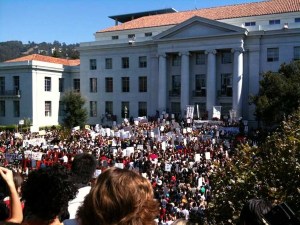 2 pm Pacific time: This was a big protest.
I’ve posted photos from Berkeley, Irvine, UCSB, Davis, and UCLA at the @studentactivism Twitter feed. (The photo at right is from Berkeley.)
2:10 pm: According to @AMYCHAMP on Twitter, UC Davis students briefly occupied the Davis administration building about half an hour ago before deciding “to keep it peaceful, and take it outside.”
2:20 pm: Reports coming in that UCLA students are holding a sit-in at the chancellor’s office, demanding a public forum on the budget crisis.
2:50 pm: The UC Berkeley rally went mobile a while ago, and eventually into a traffic-blocking sit-in/march through the streets of Berkeley. Waiting for word on further developments.
3:40 pm: The San Francisco Chronicle says the Berkeley rally drew five thousand participants.
5:40 pm: Local news says that several hundred students participated in the UC Santa Cruz walkout. Reports on Twitter suggest that there may have been a building takover there too.
5:50 pm: The UCLA Daily Bruin confirms that between 60 and 70 students are staging a sit-in at the campus’s Murphy Hall, demanding that the UCLA chancellor agree to hold a public forum.
6:30 pm: The UC Berkeley Daily Cal’s walkout blog says that Berkeley protesters shut down traffic near the campus for close to two hours this afternoon.
6:50 pm: It’s confirmed — UC Santa Cruz students are occupying the UCSC Graduate Student Commons, a student union building on campus … and the occupation has a blog.
7:30 pm: Odd that neither the Chronicle of Higher Education or Inside Higher Ed has updated their coverage of the walkout since this morning. I guess we’ll see what they have to say tomorrow.
Friday: I’ve compiled a campus-by-campus wrapup, posted here.
Students, faculty and staff of the University of California, facing an unprecedented assault on their system’s funding, will be walking out of classes tomorrow, September 24. I’ll be posting more about the walkout soon, and updating during the day tomorrow, but here’s a quick intro:
Last fall’s economic collapse hit American higher education hard, and as the new academic year gets underway its effects are being felt all over the country, but the California budget crisis is in a class by itself.
California’s initiative system, and a state law that bars the legislature from raising taxes without a two-thirds vote, make it almost impossible to fund ordinary expenses in a recession. The state is in a financial free-fall, and political leaders are looking to higher education for revenue.
In the face of this assault, top administrators at the University of California are rolling over.
Last week, UC official released a proposal that would increase the cost of attendance by 15% for the winter term and another 15% in the spring — coming on top of a 9.3% increase approved in May, this would bring in-state fees to more than $11,000 a year.
As UC Berkeley’s student government president has said, “not even during the depression of the 1930’s did student fees rise as suddenly and as much as they are now proposed to rise.” And the attack on higher education isn’t limited to fee increases. California politicians and UC administrators are laying off faculty and staff and cutting employees’ pay while reducing enrollment and increasing class sizes.
Tomorrow’s walkout began as a faculty initiative, and more than a thousand UC professors have signed on, but the protest has been picking up steam among students and non-teaching staff as well. The statewide University of California Student Association has unanimously passed a resolution of support for the walkout, there are two student websites up spreading the word, and folks are sharing news via the #UCWalkout hashtag on Twitter as well.
More to come…
The long-term residency of millions of undocumented immigrants in the United States, many of whom came here as children with their families, provokes an ambivalence in American voters and politicians that’s unmatched by any other issue.
The governing board of North Carolina’s community college system, the third largest in the country, has changed its rules on the admission of undocumented students four times in the last nine years. On Friday, the board board reversed itself yet again, overturning a 16-month-old policy that had barred such students from its campuses.
The victory for such students is a limited one, however. Under the new regulations, only those who have graduated from an American high school will be eligible to enroll. They will also be required to pay tuition at out-of-state rates — more than $7,000 a year — and will be ineligible for financial aid.
The policy, which will face a final vote in the state’s General Assembly next spring, is intended to bring CC admissions procedures in line with those of the UNC system, which recently adopted a similar approach.
Nine states have passed laws allowing undocumented students to enroll in their public colleges and universities at in-state tuition rates, while only three have explicitly banned such eligibility by statute. According to Inside Higher Ed, this policy change would leave South Carolina as the only state that bars such students from higher education completely.
Policies on undocumented students are attracting new attention this fall as the DREAM Act — a federal law that would allow some undocumented immigrants to establish permanent legal residency by completing college coursework — moves forward in the US Congress.
Earlier this week I posted news about student struggles for access to higher education in the US. Here’s a taste of what’s been going on in the rest of the world in the last seven days:
In Ireland, students camped outside of parliament overnight on Monday in a protest against government plans to introduce new university fees.
South Africa’s Witwatersrand University saw three days of protests this week over plans to raise tuition for the coming academic year. Demonstrations were suspended after the university threatened police action, but the country’s public university system is said to be exploring new revenue streams to alleviate student unrest over fee hikes.
Students shut down community colleges and secondary schools in Nepal for several days this week in protest against the commercialization of education, presenting a thirteen-point list of demands that included a cap on tuition charges.
A new law in Cyprus, put forward in response to student complaints, would require all public colleges in that nation to establish clear tuition rates when students enroll and prohibit increases during a student’s course of study.
Gabriel Matthew Schivone, a reporter for the University of Arizona at Tucson’s Daily Wildcat, snagged an interview with Noam Chomsky recently, and Chomsky had some interesting things to say about student activism in the sixties and today.
The whole thing — including Schivone’s analysis of the role of protest on the campus — is worth reading, but here are a couple of choice Chomsky quotes:
When people talk about “the sixties,” what they are thinking of is about two years. You know, 1968, 1969, roughly. A little bit before, a little bit later. And it’s true that student activism today is not like those two years. But, on the whole, I think it’s grown since the 1960s. So, take the feminist and the environmental movements. I mean, they’re from the seventies. Take the International Solidarity Movement — that’s from the eighties. Take the Global Justice Movement, which just had another huge meeting in Brazil. That’s from this century. Plenty of students are involved in these things. In fact, the total level of student involvement in various things is probably as huge as it’s ever been, except for maybe the very peak in the 1960s. It’s not what I would like it to be, but it’s far more than it’s been.
Elite sectors and centers of power want students to be passive and apathetic. One of the reasons for the very sharp rise in tuition is to kind of capture students. You know, if you come out of college with a huge debt, you’re gonna have to work it off. I mean, you’re gonna have to become a corporate lawyer or go into business or something. And you won’t have time for engaged activism. The students of the sixties could take off a year or two and devote it to activism and think, ‘Okay, I’ll get back into my career later on.’ Now, that’s much harder today. And not by accident. These are disciplinary techniques.
Good stuff.

 studentactivism.net
Recent Comments