
You are currently browsing the category archive for the ‘Faculty’ category.
 FIRE — the Foundation for Individual Rights in Education — is on the right side of the issues a fair chunk of the time. Their (right-wing) politics aren’t mine, by any stretch, but when they’re beating the drums for freedom of expression and due process on campus, they’re doing important work.
I just wish they could do that important work better.
Here’s the latest example. Back in early August, Professor Thomas Thibeault of East Georgia College was called to the office of EGC president John Bryant Black. By Thibeault’s account, Black demanded that he resign from the college that morning, and threatened to make public Thibeault’s “long history of sexual harassment” if he did not.
Thibeault refused to resign and was escorted from the campus, under threat of arrest if he ever returned. In the two months since, Thibeault says, he has not been given a hearing, been permitted to defend himself against the sexual harassment charges, or even been told what exactly he’s being charged with, despite the fact that Black convened a faculty committee to investigate him.
This is seriously screwed up. If Thibeault’s version of events is true (and neither Black nor EGC have publicly disputed it), the EGC administration has behaved shamefully — attempting to bully him into resigning with vague and ominous threats, then refusing to allow him a timely opportunity to be informed of, and respond to, the charges that have led to his removal from the classroom. Bravo to FIRE for shining a light on this situation.
…And that’s where I stop praising them. Here’s why.
Two days before Thibeault was brought into Black’s office, he attended a faculty training session on sexual harassment, where he made some remarks from the floor. In FIRE’s gloss, “he presented a scenario regarding a different professor and asked, ‘what provision is there in the Sexual Harassment policy to protect the accused against complaints which are malicious or, in this case, ridiculous?’ ”
FIRE sees this as “Kafkaesque irony,” saying that “Thibeault made the mistake of pointing out — at a sexual harassment training seminar — that the school’s sexual harassment policy contained no protection for the falsely accused.” But Thibeault’s own account of his remarks makes it clear that FIRE’s summary of his comments is woefully inadequate.
Here’s how Thibeault himself describes the “scenario” he presented at the sexual harassment training:
Last week two students were talking to me in the hallway after class. One student said that she didn’t want to go to a professor’s office because he looked down her cleavage. The woman was wearing clothing that was specifically designed to draw attention to her cleavage. She even sported a tattoo on her chest, but I didn’t get close enough to read it. The cleavage was also decorated in some sort of sparkly material, glitter or dried barbecue sauce. I couldn’t tell. I told the student that she shouldn’t complain, if she drew such attention to herself. The other female student then said, and I hope you’re not offended by her actual words, ‘if you don’t want anyone looking at your titties, I’ll lend you a T-shirt. I have one in the truck.’ The first student then said, ‘No. I’m proud of the way I look.’ I left the conversation at that point.
Let’s break this down, shall we?
- A female student told Thibeault that another professor’s habit of staring at her breasts made her uncomfortable.
- Thibeault told her, in front of another student, that she had no right to complain because she was dressed provocatively.
- A week later, Thibeault recounted this story to a large group of faculty members at a public meeting, complete with identifying details of, and gratuitously offensive comments about, the student’s appearance.
- To top it all off, he presented the student’s complaint about the other professor as an example of a “ridiculous” sexual harassment charge.
According to the EGC faculty handbook, by the way, “conduct of a sexual nature” that “has the purpose or effect of … creating an intimidating, hostile, or offensive academic environment” is sexual harassment.
FIRE has all this background. But they chose not to mention it.
And this is why I find FIRE so frustrating. It’s not “Kafkaesque irony” that Thibeault was hauled in to the president’s office on a sexual harassment complaint two days after the training. It’s not ironic at all. It’s not even surprising. By Thibeault’s own account, he made wildly inappropriate sexualized comments to a female student, told that student that it was her own fault if a professor leered at her while she was wearing a low-cut top, and then shared this anecdote at a faculty meeting in a bizarrely insulting way. (Barbecue sauce? Come on.)
I don’t know whether any of this is actionable as sexual harassment. I’m not a lawyer. I don’t know what Thibeault’s history is, or whether the university’s claims that he has a “long history” of misbehavior have any merit at all. As I said at the top of this post, I’m inclined to believe that Thibeault has been treated unfairly, and that EGC has violated his right to academic due process.
But this whole incident serves as yet another reminder to me that when I see a piece on FIRE’s site, I can’t just take their analysis and run with it. I can’t even assume that they’re presenting the basic outline of the story in a fair and complete way. I have to research and fact-check the whole thing from the beginning. And because they break so much news — because they are out there digging these cases up — I have to ignore their stuff if I can’t find independent corroboration of their claims.
Because they just can’t be trusted to tell a story straight.
And that sucks.
Note: As I indicated above by linking to Thibeault’s statement at FIRE’s website, and again by saying that “FIRE has all this background,” FIRE did post that statement as a PDF document, and link to it from other documents. I never intended to suggest otherwise, and I’m happy to make that clear.
 As many as ten thousand students, faculty, and staff of the University of California participated in public protests against the defunding of the university yesterday, and untold thousands more walked out of classes, held teach-ins, and walked picket lines. Students at two campuses occupied university buildings, and observers of the Berkeley rally said it was that school’s biggest protest in a generation.
This was big.
And it was even more impressive because yesterday was the first day of classes for the year at every UC campus except for Berkeley and Merced. At UC’s other eight universities, organizers brought hundreds, even thousands, of people into the streets and quads despite the lack of time and facilities for organizing in advance.
Yesterday, then, was just the beginning. UCLA protesters won a commitment from their chancellor to hold a public forum on the budget crisis on October 6, and they’re already organizing to keep the pressure up over the next twelve days. UC Santa Barbara has scheduled a series of teach-ins for October 11. In the coming weeks and months, activists will be building on what was achieved yesterday, growing the movement that will restore the University of California’s health, strength, and accessibility.
Over the course of this afternoon, I’ll be posting detailed reports on yesterday’s events at each of UC’s ten campuses — Berkeley, Davis, Irvine, Los Angeles (UCLA), Merced, Riverside, San Diego (UCSD), San Francisco (UCSF), Santa Barbara (UCSB), and Santa Cruz (UCSB). Check back in to get the whole story!
Note: Josh from Santa Cruz (@alittlefishy on Twitter) has put together the best roundup I’ve seen of media coverage of the UC walkout. The reports below rely heavily on the sources he compiled.
Berkeley
Five thousand was the official police estimate of the size of the crowd, and UC sources called it the largest Berkeley rally in decades. After two hours of speeches and chants, the protest went mobile, streaming off the campus and shutting down traffic for several blocks. A mass meeting later drew hundreds of participants, who voted to meet again next Wednesday to plan strategy for a possible statewide conference October 24.
Davis
A crowd that the UC Davis student newspaper said numbered in the thousands rallied on the campus quad, then staged an impromptu march to — and into — the Mrak administration building. Hundreds of sign-toting protesters occupied the public areas of the building briefly before, as grad student @AMYCHAMP put it on Twitter, deciding “to keep it peaceful, and take it outside.”
Irvine
Morning and evening teach-ins bracketed the day at Irvine, where a crowd estimated at about five hundred attended the noon rally. One source said that 150 Irvine faculty walked out of their classes.
UCLA
The noon rally at Bruin Plaza drew about seven hundred participants, and like those at Berkeley and Davis, it eventually turned into a march. Police blocked protesters when they arrived at the front entrance of Murphy Hall, the site of UCLA’s administrative offices, but a group of about sixty students were able to find alternate routes inside and make their way to the doors to the chancellor’s offices, where they staged a sit-in.
UCLA’s chancellor was not in the building at the time, but a campus official met with sit-in leaders and agreed to their two demands — that he set up a meeting with representatives of the university’s undergrads, grad students, faculty and staff, and that he schedule a town-hall campus forum on the budget crisis. The sit-in ended without any arrests or university judicial action.
Merced
Merced is the newest UC campus — it’s just four years old — and one of the smallest. Their rally was the smallest as well, but the walkout had significant participation, and students and faculty conducted flyering and tabling during the day as well.
Riverside
Hundreds of students participated in the noon rally, with more attending teach-ins before and after.
San Diego
Teach-ins were held on Wednesday and Thursday, and a two-hour rally drew hundreds of participants. At the end of the rally, some protesters marched into classes to urge students and faculty to join the walkout.
A campus-wide planning meeting for future organizing is scheduled for Wednesday.
San Francisco
Hundreds attended a rally at the UCSF Medical Center, where State Senator Leland Yee addressed the crowd. Students at San Francisco State and the City College of San Francisco also held demonstrations in support of the UC walkout.
Santa Barbara
There was a full day of walkout events at UCSB, where more than 125 faculty members signed the walkout pledge. Four hundred university community members attended the noon rally.
There will be a budget teach-in at Santa Barbara on October 14 from 3 pm to midnight.
Santa Cruz
Two rallies were held — one at noon and the second at 3:30 pm. The first drew hundreds of participants, and the second led to a building takeover that (as of Tuesday morning, five days after the walkout) is still ongoing. More on that in a new post soon.
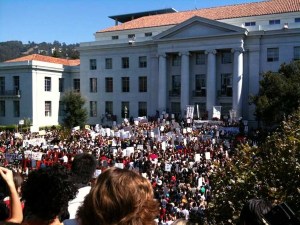 2 pm Pacific time: This was a big protest.
I’ve posted photos from Berkeley, Irvine, UCSB, Davis, and UCLA at the @studentactivism Twitter feed. (The photo at right is from Berkeley.)
2:10 pm: According to @AMYCHAMP on Twitter, UC Davis students briefly occupied the Davis administration building about half an hour ago before deciding “to keep it peaceful, and take it outside.”
2:20 pm: Reports coming in that UCLA students are holding a sit-in at the chancellor’s office, demanding a public forum on the budget crisis.
2:50 pm: The UC Berkeley rally went mobile a while ago, and eventually into a traffic-blocking sit-in/march through the streets of Berkeley. Waiting for word on further developments.
3:40 pm: The San Francisco Chronicle says the Berkeley rally drew five thousand participants.
5:40 pm: Local news says that several hundred students participated in the UC Santa Cruz walkout. Reports on Twitter suggest that there may have been a building takover there too.
5:50 pm: The UCLA Daily Bruin confirms that between 60 and 70 students are staging a sit-in at the campus’s Murphy Hall, demanding that the UCLA chancellor agree to hold a public forum.
6:30 pm: The UC Berkeley Daily Cal’s walkout blog says that Berkeley protesters shut down traffic near the campus for close to two hours this afternoon.
6:50 pm: It’s confirmed — UC Santa Cruz students are occupying the UCSC Graduate Student Commons, a student union building on campus … and the occupation has a blog.
7:30 pm: Odd that neither the Chronicle of Higher Education or Inside Higher Ed has updated their coverage of the walkout since this morning. I guess we’ll see what they have to say tomorrow.
Friday: I’ve compiled a campus-by-campus wrapup, posted here.
The post below is from Thursday morning, before the walkout began. For reports from the walkout itself, go here, and for a campus-by-campus wrapup of the day’s events, go here.
Students, faculty, and staff at all ten campuses of the University of California will be walking out today in protest of rising fees, pay cuts, enrollment restrictions, and the defunding of the UC system. This post provides an overview of what’s going on at each University of California campus today.
I’ll be updating as the day progresses, and I encourage visitors to add additional info in comments. Follow the @studentactivism Twitter feed and the #UCwalkout Twitter hashtag for real-time updates. (Update: Lots of tweets on the walkout aren’t using the hashtag, so search uc walkout for a fuller picture.)
The statewide walkout is scheduled for noon, with each campus holding a rally at that time. Other events will be taking place before and after. The University Professional and Technical Employees union has called a one-day strike in coordination with the walkout, and will be mounting picket lines on the various campuses over the course of the day.
Berkeley
A teach-in on the walkout was held yesterday evening, and half a dozen “teach-outs” on various topics are scheduled for this morning. A noon rally is planned for Upper Sproul Plaza, and there will be a General Assembly at Sproul Plaza at 6 pm.
More info:
- Your Guide to the Walkout Festivities, from the Daily Californian’s Daily Clog.
- The Facebook page for the Berkeley walkout.
- The website of the Berkeley Alliance Against the Cuts.
Davis
Participants in the UC Davis walkout are encouraged to join the campus picket lines at any time during the day. There will be a noon rally on the campus quad.
More info:
- A walkout factsheet from the UC Davis Graduate Student Association.
- The Facebook page for the Davis walkout.
Irvine
There will be an “interactive drama” in the Arts Plaza from 9 to 10 am, and teach-ins throughout the morning. The noon rally will take place at the flagpoles, and there will be another rally from 2 to 3 pm in the Social Science Plaza. From 5 to 7 pm there will be more teach-ins at Humanities Gateway 1010.
More info:
- A list of the day’s scheduled activities from a KUCI blog.
UCLA
Rally set-up at Bruin Plaza begins at 10:30, with a graduate student picnic at Meyerhoff Park at 11 am. The noon rally will begin at Bruin Plaza, and will march to Murphy Hall at 1 pm or a little later. From there, the marchers will head to Ronald Reagan Medical. There will be additional picketing and leafleting at UCLA Freud Theater from 6 to 8 pm.
More info:
- A list of events from the Saving UCLA blog. (login required)
Merced
There will be petitioning throughout campus, and tabling in front of the Koiligian Library from 10 am to 3 pm.
More info:
- The Facebook page for the Merced walkout and teach-in.
Riverside
There will be a teach-in at the corner of Canyon Crest and University Drive from 10 am to 3 pm. Events will include speakers, hip-hop theater, and rallies.
More info:
- A page on the UCR walkout from a student blog.
San Diego
There was a teach-in last night, and there will be another at the Pepper Canyon Building courtyard at 12:30 pm today.
More info:
- The Facebook page of the UCSD walkout.
- Saving UCSD website.
San Francisco
I haven’t found any online sources for information on the UCSF walkout yet.
Santa Barbara
There will be a variety of events going on all day, including tabling at the Davidson Library and an “open art studio” with lectures and hands-on workshops at Building 434. The rally at the Arbor (in front of the library’s main entrance) will begin with poems and songs at 11:30, and will continue with speakers from noon until 1 pm.
UCSB is also planning a teach-in on October 14 from 3 pm to midnight.
More info:
- Schedule of events from Saving UCSB
Santa Cruz
A friend writes that there will be a rally at noon, a general assembly at 3 pm, and picketing until 8 pm. Locations coming…
More info:
- News story on UCSC walkout plans.
Students, faculty and staff of the University of California, facing an unprecedented assault on their system’s funding, will be walking out of classes tomorrow, September 24. I’ll be posting more about the walkout soon, and updating during the day tomorrow, but here’s a quick intro:
Last fall’s economic collapse hit American higher education hard, and as the new academic year gets underway its effects are being felt all over the country, but the California budget crisis is in a class by itself.
California’s initiative system, and a state law that bars the legislature from raising taxes without a two-thirds vote, make it almost impossible to fund ordinary expenses in a recession. The state is in a financial free-fall, and political leaders are looking to higher education for revenue.
In the face of this assault, top administrators at the University of California are rolling over.
Last week, UC official released a proposal that would increase the cost of attendance by 15% for the winter term and another 15% in the spring — coming on top of a 9.3% increase approved in May, this would bring in-state fees to more than $11,000 a year.
As UC Berkeley’s student government president has said, “not even during the depression of the 1930’s did student fees rise as suddenly and as much as they are now proposed to rise.” And the attack on higher education isn’t limited to fee increases. California politicians and UC administrators are laying off faculty and staff and cutting employees’ pay while reducing enrollment and increasing class sizes.
Tomorrow’s walkout began as a faculty initiative, and more than a thousand UC professors have signed on, but the protest has been picking up steam among students and non-teaching staff as well. The statewide University of California Student Association has unanimously passed a resolution of support for the walkout, there are two student websites up spreading the word, and folks are sharing news via the #UCWalkout hashtag on Twitter as well.
More to come…

 studentactivism.net
Recent Comments