
You are currently browsing the category archive for the ‘Sexual Orientation’ category.
Note: I’m still digging on this story. Follow me on Twitter to keep up with new info as I get it.
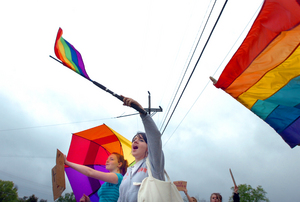 The tremendous Pam Spaulding writes at Pandagon about an administrator at a Kentucky high school who allegedly told teachers to prohibit gay and lesbian students from leaving class to use school bathrooms after two female students were caught kissing in the girls’ restroom.
What she doesn’t mention, though, is that fifteen students held a public protest against the ban in front of the school on Friday.
I’m repulsed by the administrator’s actions here, of course, if the story is true. But I also find it fascinating that high school administrators in Franklin County, Kentucky would assume that teachers would know who their gay and lesbian students were.
And I’m thrilled that these students — gay, straight, both, or neither — were willing to stand up publicly against such nonsense.
1:00 pm update: I’ve found an article on the incident from the Frankfort, Kentucky State Journal. In it, the principal of Franklin County High School says “we would never send out an e-mail that had anything to do with sexual orientations,” which is almost, but not quite, a denial that such an email actually was sent. Assistant principal Karen Buzard, who allegedly sent the email, was unavailable for comment.
The State Journal article also included the above photo from the protest, along with some new details — the protesting students painted “Gay Pride” and rainbows on their faces, and held signs that said “Honk if you’re gay” and “We have a right to pee.”
3:00 pm update: Several anonymous commenters at the State Journal website claim that Buzard’s email restricted the bathroom privileges of specific students, not all gays and lesbians. I have reached out to school officials for comment, but have not yet had a response.
It’s also worth mentioning that if school officials did restrict bathroom privileges of gays and lesbians as a group, what they did is likely legal, as Kentucky has no LGBT civil rights law.
May 4 update: I’ve just received an email from Harrie Buecker, superintendent of the Franklin County Public School system. She says the district is “continuing our investigation” of the email incident. More as I get it.
May 5 update: The principal of Franklin County High School has posted a statement on the school’s website saying that no email was ever sent “barring any specific group of students from using the restrooms.” According to the statement, teachers were told that “certain students should not be allowed to leave the classroom during class because they had been in violation of school rules,” but “all students have time between classes to use the facilities.”
July 2010 Update: A federal judge has ruled in EMU’s favor, upholding Julea Ward’s expulsion.
I posted a few weeks ago about Julea Ward, who was expelled from Eastern Michigan University’s counseling graduate program because she insisted that as a Christian she had a moral obligation to steer gay counseling clients to “cultivate sexual desires for persons of the opposite sex.”
When Ward discussed this issue with her professors, they made it clear to her that if she offered such a suggestion in a therapeutic relationship, she would violate the code of ethics of the American Counseling Association. And so, when Ward was assigned to a gay client in the course of her counseling training, she suggested that this client be given a referral to another counselor. (It was that request that set disciplinary proceedings in motion.)
Many of Ward’s defenders have, as she did, suggested that referral would have been an appropriate compromise between Ward’s beliefs and the ACA ethical rules. As someone said in a Reddit discussion of the case yesterday,
One could argue that if she is unable/unwilling to acknowledge homosexuality as an acceptable behavior, then she is ethically obligated to refer the patient to another counselor in order to keep from allowing her personal values from intruding her professional work.
In other words, while it would certainly be wrong for her to make judgements to her patient about their sexuality in a counselling session, perhaps it’s a valid compromise to find her patient a more qualified counselor.
I’ve come across this argument a lot recently, often in online discussions in which Ward’s critics cite my previous article on the subject, and so I’d like to respond to it directly.
The student government at the University of Florida is in a bind.
The university is saying that two student services programs — the Multicultural and Diversity Affairs program and the Center for Leadership and Service — are may be eliminated in the upcoming academic year. To save them, some students are proposing that students foot the bill with an increase to the campus Activity Fee.
MDA houses UF’s Institute of Black Culture and Lesbian, Gay, Bisexual, and Transgender (LGBT) Affairs, while CLS supports volunteering and student leadership development programs on campus.
University administrators are always eager to find ways to dump student affairs expenses out of their operating budget and into student fee-based funding mechanisms, and student governments across the country have learned to be wary of such proposals.
But the threat to shut down these programs may not be an empty one. The university is facing a possible a ten percent cut in its Student Affairs budget for the coming year, and a UF administrator says MDA and CLS, which cost a combined $508,000 annually, are the only budget lines in Student Affairs that aren’t mandated by state law.
Student governments have to tread carefully in these situations. It can be very difficult to separate fact from fiction in administrators’ claims. Even when the threat to a program is real, a short-term crisis often leads to a permanent shift in revenue streams.
We’re going to be seeing a lot more of these dilemmas in the months and years to come. How student governments respond to them will be a major test of their ability to advocate effectively for students’ interests.
The Peoria, Arizona Unified School District will let gay eighth grader Chris Quintanilla wear a “Rainbows Are Gay” wristband to school.
As we reported last month, Quintanilla’s principal instructed him to remove the wristband when he saw him wearing it in a school hallway.
The wristband ban was apparently part of a larger pattern of behavior on the principal’s part. According to Quintanilla’s mother Natali, when she expressed concern that her son was being harassed at school for being gay, the principal told her that he wouldn’t be a target “if he didn’t put it out there the way he does.”
But the ACLU is now claiming victory, saying that the district “has assured the American Civil Liberties Union that it will no longer prevent [Quintanilla] from wearing [the] wristband at school.”
The district, for its part, says the whole thing was just a big misunderstanding. Why it took them more than a month to clear it up remains unclear.
July 2010 Update: A federal judge has ruled in EMU’s favor, upholding Julea Ward’s expulsion.
The story of Julea Ward, a former counseling student who is suing Eastern Michigan University over her expulsion from their graduate program, is burning up the right-wing blogosphere.
Conservative commenters on the case generally argue that Ward, a Christian, was removed from the program because she refused to “advocate for homosexual behavior” — or, as National Review‘s David French puts it, “vocally support same-sex sexual conduct.”
But Ward’s attorneys have posted various documents relating to her dismissal up online, and those documents tell a different story.

 studentactivism.net
Recent Comments