
You are currently browsing the category archive for the ‘Governance’ category.
Evening update: Pitt’s chapter of the ACLU is co-sponsoring an Oakland Unites for First Amendment Rights rally on campus tomorrow at 5:30 pm. A four-point petition will be circulating at the rally — we’ll post the text as soon as we get it.
Last week’s G-20 meeting of the leaders of the world’s 20 largest economies drew massive protests in and around the University of Pittsburgh, and now police and campus administrators are facing heavy criticism for their handling of the incidents.
Over the course of the two-day meeting, police used sonic cannons, tear gas, pepper spray, bean-bag projectiles, smoke canisters, stun grenades, and rubber bullets on demonstrators, making hundreds of arrests. Innocent students, including some student journalists, were caught up in police sweeps on the Pitt campus.
Police arrested nearly two hundred people during the course of the G-20 demonstrations, including more than fifty students. The Allegheny County district attorney has already announced that charges against four students will be dropped, and more dismissals are expected.
Update: In a reversal of a policy announced yesterday, Pitt will allow students seeking dismissal of charges to bring attorneys to their meetings with campus police officials. The university has also confirmed that no campus judicial proceedings will be brought against students whose criminal charges are dismissed.
Dozens of videos from the protests have surfaced online, ranging from the hilarious (three burly cops in face masks attempt to pass as protesters, and failing spectacularly) to the chilling (students trapped on a stairway between two sets of cops, each trying to force them to go the other way).
Two student journalists for the Pitt News were arrested while covering the Friday night protests, and eight more were tear gassed, pepper sprayed, or maced. Stories have also emerged of students being locked out of their dorms, then arrested for failing to return to their rooms.
One student has posted a lengthy account online of how she was arrested for “failing to disperse” while helping students to disperse by holding open the locked doors of one dorm building. She describes students being arrested as they entered the dorms, and other reports suggest that students were arrested while waiting in line at local restaurants, or studying in the campus library.
Violations of students’ rights on campus were not limited to arrests. One video posted online shows police lobbing a tear gas canister onto the balcony of a dorm from which a group of students were quietly watching the protest in the street below. (The canister is thrown just after the two-minute mark in the video.)
The question of what limits should have been set on the actions of municipal police on the Pitt campus is being raised over and over again in the aftermath of the G-20, and evidence is emerging that it was a subject of dispute among police at the time. Police scanner recordings obtained by the Pitt News show that a high-ranking Pitt university police officer intervened personally on Friday night to prevent a non-university police “attack team” from storming the Towers, a campus dorm.
Adding to the confusion, and contributing to the police overreaction, is the fact that Pitt’s campus is an urban one, with no clear boundaries, and and the fact that thepolice were brought in for the G-20 protests from as far away as Tucson, Arizona. Many of the cops present were unfamiliar with the location.
Pitt’s university police have also been criticized, however. The university’s text message based Emergency Notification System was not used at all on Thursday, and only two messages were sent out on Friday — one encouraging them to “be careful” and “exercise good judgment,” and the other advising them to “remain near their residences.” As noted above, a number of students were ultimately arrested at or near their dorms that night.
Pressure on the police and the Pitt administration has been building since the meeting ended, with many claiming that, as one online petition puts it, “the right of citizens — students, professors, families, community members, and media — to assemble and gather peacefully in public was not only denied and violated but suppressed with unnecessary and excessive force.”
Note: Check out What Happened At Pitt?!?! for a huge collection of links and resources.
 As many as ten thousand students, faculty, and staff of the University of California participated in public protests against the defunding of the university yesterday, and untold thousands more walked out of classes, held teach-ins, and walked picket lines. Students at two campuses occupied university buildings, and observers of the Berkeley rally said it was that school’s biggest protest in a generation.
This was big.
And it was even more impressive because yesterday was the first day of classes for the year at every UC campus except for Berkeley and Merced. At UC’s other eight universities, organizers brought hundreds, even thousands, of people into the streets and quads despite the lack of time and facilities for organizing in advance.
Yesterday, then, was just the beginning. UCLA protesters won a commitment from their chancellor to hold a public forum on the budget crisis on October 6, and they’re already organizing to keep the pressure up over the next twelve days. UC Santa Barbara has scheduled a series of teach-ins for October 11. In the coming weeks and months, activists will be building on what was achieved yesterday, growing the movement that will restore the University of California’s health, strength, and accessibility.
Over the course of this afternoon, I’ll be posting detailed reports on yesterday’s events at each of UC’s ten campuses — Berkeley, Davis, Irvine, Los Angeles (UCLA), Merced, Riverside, San Diego (UCSD), San Francisco (UCSF), Santa Barbara (UCSB), and Santa Cruz (UCSB). Check back in to get the whole story!
Note: Josh from Santa Cruz (@alittlefishy on Twitter) has put together the best roundup I’ve seen of media coverage of the UC walkout. The reports below rely heavily on the sources he compiled.
Berkeley
Five thousand was the official police estimate of the size of the crowd, and UC sources called it the largest Berkeley rally in decades. After two hours of speeches and chants, the protest went mobile, streaming off the campus and shutting down traffic for several blocks. A mass meeting later drew hundreds of participants, who voted to meet again next Wednesday to plan strategy for a possible statewide conference October 24.
Davis
A crowd that the UC Davis student newspaper said numbered in the thousands rallied on the campus quad, then staged an impromptu march to — and into — the Mrak administration building. Hundreds of sign-toting protesters occupied the public areas of the building briefly before, as grad student @AMYCHAMP put it on Twitter, deciding “to keep it peaceful, and take it outside.”
Irvine
Morning and evening teach-ins bracketed the day at Irvine, where a crowd estimated at about five hundred attended the noon rally. One source said that 150 Irvine faculty walked out of their classes.
UCLA
The noon rally at Bruin Plaza drew about seven hundred participants, and like those at Berkeley and Davis, it eventually turned into a march. Police blocked protesters when they arrived at the front entrance of Murphy Hall, the site of UCLA’s administrative offices, but a group of about sixty students were able to find alternate routes inside and make their way to the doors to the chancellor’s offices, where they staged a sit-in.
UCLA’s chancellor was not in the building at the time, but a campus official met with sit-in leaders and agreed to their two demands — that he set up a meeting with representatives of the university’s undergrads, grad students, faculty and staff, and that he schedule a town-hall campus forum on the budget crisis. The sit-in ended without any arrests or university judicial action.
Merced
Merced is the newest UC campus — it’s just four years old — and one of the smallest. Their rally was the smallest as well, but the walkout had significant participation, and students and faculty conducted flyering and tabling during the day as well.
Riverside
Hundreds of students participated in the noon rally, with more attending teach-ins before and after.
San Diego
Teach-ins were held on Wednesday and Thursday, and a two-hour rally drew hundreds of participants. At the end of the rally, some protesters marched into classes to urge students and faculty to join the walkout.
A campus-wide planning meeting for future organizing is scheduled for Wednesday.
San Francisco
Hundreds attended a rally at the UCSF Medical Center, where State Senator Leland Yee addressed the crowd. Students at San Francisco State and the City College of San Francisco also held demonstrations in support of the UC walkout.
Santa Barbara
There was a full day of walkout events at UCSB, where more than 125 faculty members signed the walkout pledge. Four hundred university community members attended the noon rally.
There will be a budget teach-in at Santa Barbara on October 14 from 3 pm to midnight.
Santa Cruz
Two rallies were held — one at noon and the second at 3:30 pm. The first drew hundreds of participants, and the second led to a building takeover that (as of Tuesday morning, five days after the walkout) is still ongoing. More on that in a new post soon.
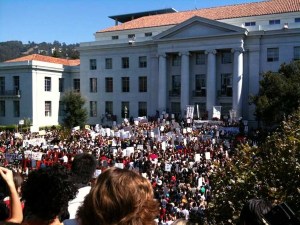 2 pm Pacific time: This was a big protest.
I’ve posted photos from Berkeley, Irvine, UCSB, Davis, and UCLA at the @studentactivism Twitter feed. (The photo at right is from Berkeley.)
2:10 pm: According to @AMYCHAMP on Twitter, UC Davis students briefly occupied the Davis administration building about half an hour ago before deciding “to keep it peaceful, and take it outside.”
2:20 pm: Reports coming in that UCLA students are holding a sit-in at the chancellor’s office, demanding a public forum on the budget crisis.
2:50 pm: The UC Berkeley rally went mobile a while ago, and eventually into a traffic-blocking sit-in/march through the streets of Berkeley. Waiting for word on further developments.
3:40 pm: The San Francisco Chronicle says the Berkeley rally drew five thousand participants.
5:40 pm: Local news says that several hundred students participated in the UC Santa Cruz walkout. Reports on Twitter suggest that there may have been a building takover there too.
5:50 pm: The UCLA Daily Bruin confirms that between 60 and 70 students are staging a sit-in at the campus’s Murphy Hall, demanding that the UCLA chancellor agree to hold a public forum.
6:30 pm: The UC Berkeley Daily Cal’s walkout blog says that Berkeley protesters shut down traffic near the campus for close to two hours this afternoon.
6:50 pm: It’s confirmed — UC Santa Cruz students are occupying the UCSC Graduate Student Commons, a student union building on campus … and the occupation has a blog.
7:30 pm: Odd that neither the Chronicle of Higher Education or Inside Higher Ed has updated their coverage of the walkout since this morning. I guess we’ll see what they have to say tomorrow.
Friday: I’ve compiled a campus-by-campus wrapup, posted here.
The post below is from Thursday morning, before the walkout began. For reports from the walkout itself, go here, and for a campus-by-campus wrapup of the day’s events, go here.
Students, faculty, and staff at all ten campuses of the University of California will be walking out today in protest of rising fees, pay cuts, enrollment restrictions, and the defunding of the UC system. This post provides an overview of what’s going on at each University of California campus today.
I’ll be updating as the day progresses, and I encourage visitors to add additional info in comments. Follow the @studentactivism Twitter feed and the #UCwalkout Twitter hashtag for real-time updates. (Update: Lots of tweets on the walkout aren’t using the hashtag, so search uc walkout for a fuller picture.)
The statewide walkout is scheduled for noon, with each campus holding a rally at that time. Other events will be taking place before and after. The University Professional and Technical Employees union has called a one-day strike in coordination with the walkout, and will be mounting picket lines on the various campuses over the course of the day.
Berkeley
A teach-in on the walkout was held yesterday evening, and half a dozen “teach-outs” on various topics are scheduled for this morning. A noon rally is planned for Upper Sproul Plaza, and there will be a General Assembly at Sproul Plaza at 6 pm.
More info:
- Your Guide to the Walkout Festivities, from the Daily Californian’s Daily Clog.
- The Facebook page for the Berkeley walkout.
- The website of the Berkeley Alliance Against the Cuts.
Davis
Participants in the UC Davis walkout are encouraged to join the campus picket lines at any time during the day. There will be a noon rally on the campus quad.
More info:
- A walkout factsheet from the UC Davis Graduate Student Association.
- The Facebook page for the Davis walkout.
Irvine
There will be an “interactive drama” in the Arts Plaza from 9 to 10 am, and teach-ins throughout the morning. The noon rally will take place at the flagpoles, and there will be another rally from 2 to 3 pm in the Social Science Plaza. From 5 to 7 pm there will be more teach-ins at Humanities Gateway 1010.
More info:
- A list of the day’s scheduled activities from a KUCI blog.
UCLA
Rally set-up at Bruin Plaza begins at 10:30, with a graduate student picnic at Meyerhoff Park at 11 am. The noon rally will begin at Bruin Plaza, and will march to Murphy Hall at 1 pm or a little later. From there, the marchers will head to Ronald Reagan Medical. There will be additional picketing and leafleting at UCLA Freud Theater from 6 to 8 pm.
More info:
- A list of events from the Saving UCLA blog. (login required)
Merced
There will be petitioning throughout campus, and tabling in front of the Koiligian Library from 10 am to 3 pm.
More info:
- The Facebook page for the Merced walkout and teach-in.
Riverside
There will be a teach-in at the corner of Canyon Crest and University Drive from 10 am to 3 pm. Events will include speakers, hip-hop theater, and rallies.
More info:
- A page on the UCR walkout from a student blog.
San Diego
There was a teach-in last night, and there will be another at the Pepper Canyon Building courtyard at 12:30 pm today.
More info:
- The Facebook page of the UCSD walkout.
- Saving UCSD website.
San Francisco
I haven’t found any online sources for information on the UCSF walkout yet.
Santa Barbara
There will be a variety of events going on all day, including tabling at the Davidson Library and an “open art studio” with lectures and hands-on workshops at Building 434. The rally at the Arbor (in front of the library’s main entrance) will begin with poems and songs at 11:30, and will continue with speakers from noon until 1 pm.
UCSB is also planning a teach-in on October 14 from 3 pm to midnight.
More info:
- Schedule of events from Saving UCSB
Santa Cruz
A friend writes that there will be a rally at noon, a general assembly at 3 pm, and picketing until 8 pm. Locations coming…
More info:
- News story on UCSC walkout plans.
Students, faculty and staff of the University of California, facing an unprecedented assault on their system’s funding, will be walking out of classes tomorrow, September 24. I’ll be posting more about the walkout soon, and updating during the day tomorrow, but here’s a quick intro:
Last fall’s economic collapse hit American higher education hard, and as the new academic year gets underway its effects are being felt all over the country, but the California budget crisis is in a class by itself.
California’s initiative system, and a state law that bars the legislature from raising taxes without a two-thirds vote, make it almost impossible to fund ordinary expenses in a recession. The state is in a financial free-fall, and political leaders are looking to higher education for revenue.
In the face of this assault, top administrators at the University of California are rolling over.
Last week, UC official released a proposal that would increase the cost of attendance by 15% for the winter term and another 15% in the spring — coming on top of a 9.3% increase approved in May, this would bring in-state fees to more than $11,000 a year.
As UC Berkeley’s student government president has said, “not even during the depression of the 1930’s did student fees rise as suddenly and as much as they are now proposed to rise.” And the attack on higher education isn’t limited to fee increases. California politicians and UC administrators are laying off faculty and staff and cutting employees’ pay while reducing enrollment and increasing class sizes.
Tomorrow’s walkout began as a faculty initiative, and more than a thousand UC professors have signed on, but the protest has been picking up steam among students and non-teaching staff as well. The statewide University of California Student Association has unanimously passed a resolution of support for the walkout, there are two student websites up spreading the word, and folks are sharing news via the #UCWalkout hashtag on Twitter as well.
More to come…

 studentactivism.net
Recent Comments