
You are currently browsing the category archive for the ‘History’ category.
In the spring of this year a wave of campus occupations swept Croatia, beginning with the takeover of the school of humanities and social sciences at the University of Zagreb on April 20. The protesters demanded free and universally available higher education, and by the end of their campaign all or part of twenty universities in eight Croatian cities had been occupied.
I had a chance to talk to some of the leaders of the Croatian occupations when I was in Zagreb earlier this month, and those conversations (and others I had there) were a real crash course in the student movements that have swept Europe this year. Much of what I learned is highly relevant to the American situation, particularly now that campus occupations are becoming a regular occurrence here.
The U of Zagreb occupation lasted for thirty-five days this spring. It took place not behind barricades but in a freely accessible building, with democratic governance meetings open to all, regular teach-ins and seminars — even a daily morning yoga session.
Today at a noon mass gathering, or plenum, Zagreb’s student activists voted to take up their occupation again. Occupations are also underway at the Universities of Pula and Rijeka, with a meeting scheduled for tomorrow at Split to consider similar action.
There hasn’t been much coverage of the current European wave of student protest in the United States, and what there has been has often been fragmented and decontextualized. I’m going to make an effort to overcome those problems in the coming days, using Croatia’s occupations — those of this spring and those going on now — as a case study and a starting point for broader discussion. Stay tuned!
 I’m still looking for more news on the windup and aftermath of the campus occupation that ended yesterday at the University of California at Santa Cruz, but in the meantime I want to clear something up.
In an article published yesterday in City on a Hill Press, a UCSC student newspaper, one of the students sitting in at the Graduate Commons building said that UCSC had just “broken a record for longest student occupation of a building to take place in America post-1960s.” A couple of days ago, an occupation spokesperson made a slightly less extravagant version of the claim, saying that the Commons sit-in was “one of the longest student occupations in many, many years.”
So is it true? Was the UCSC occupation the longest campus building takeover since the heyday of student activism in the sixties?
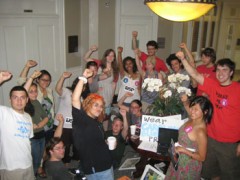
Well, no. Here are five that were longer, one of which — the UNC sweatshop sit-in pictured above — happened just a year and a half ago:
- At Harvard in 2001, a sit-in demanding that university employees be paid a living wage lasted for three weeks.
- Another living wage sit-in, this one at Washington University in 2005, lasted for eighteen days.
- In May of last year, students protesting the University of North Carolina’s ties to sweatshop garment makers occupied the lobby of their administration building for sixteen days.
- In 1989, students occupied the administration building at Wayne State University for either eleven or twelve days in response to racist incidents on campus.
- The Afrikan Student Union at Ohio State University occupied the offices of the campus president for eight days in 1998 in protest of proposed changes in the Office of Minority Affairs.
Claims that a certain protest was the biggest, or longest, or most dramatic, since the sixties are common, and almost always wrong. They’re common because we think of the sixties as being the last time there was a real student movement in the United States, and they’re wrong because their conception of the history of American student activism is wrong.
I knew about a couple of the campus protests listed above before I sat down to write this post, but most of them I uncovered by Googling. They don’t add up to anything like a comprehensive list of the last few decades’ multi-week campus sit-ins. They represent a small slice of a story that’s mostly gone untold in recent years — the story of American students’ persistent ongoing local campus organizing. I mention them not to mock the UCSC folks or belittle their protest, but because the more activists know about past struggles, the better equipped they’ll be to take on the future.
A new exhibit on the white anti-slavery activist John Brown opens today at the New-York Historical society, 150 years (minus a month and a day) after he tried to start a slave uprising at Harper’s Ferry, Virginia. Brown was executed in December 1859 for his role in that raid, but his actions — at Harper’s Ferry and before — helped to spark the Civil War.
I’ve got a photo on my bookshelf, in a carved wooden frame I bought at a rummage sale. The photo is actually a postcard, though it’s been trimmed down and you can’t really tell.
It’s this photo. John Brown, swearing an oath.
John Brown was an abolitionist, of course, and that’s part of why I like him. But I’ve never really been explicit about why I like him so much, why I’m drawn to him as opposed to any other white abolitionist. I think I just figured it out, though.
In 1856 John Brown went to Kansas, where pro-slavery and anti-slavery whites were fighting. He wanted to intervene on the side of righteousness, and he did. He went to Kansas and he killed a bunch of white people. He killed white people who were standing in the way of racial justice.
Three years later, with the Civil War looming, he acted again. This time he raided a federal arsenal to try to liberate weapons for a slave uprising. He was caught, and hanged.
The photo I have is of the John Brown of 1856. (By 1859 he had a huge flowing beard.) The Brown in my photo was the Brown who saw racism and went to Kansas.
Now, I’m not big on killing people. Not at all. Not even in my most ludicrous fantasies of radical action am I big on killing people. It’s never particularly been the killing people part that attracted me to Brown.
It’s more, I think, that he went into the white community first. It sounds weird, phrased like that, since his work with white people consisted of murdering them, but that’s what he did. He took his whiteness and he used it in the service of racial justice, used it to do what a black person couldn’t have done, used it in his own community.
When I look at that photo in that frame, I’m reminded that I’m white. I’m reminded that whiteness is an identity, one among many. I’m reminded that whiteness is specific, not generic. And I’m reminded that as a white man, I’ve got important work to do.
Gabriel Matthew Schivone, a reporter for the University of Arizona at Tucson’s Daily Wildcat, snagged an interview with Noam Chomsky recently, and Chomsky had some interesting things to say about student activism in the sixties and today.
The whole thing — including Schivone’s analysis of the role of protest on the campus — is worth reading, but here are a couple of choice Chomsky quotes:
When people talk about “the sixties,” what they are thinking of is about two years. You know, 1968, 1969, roughly. A little bit before, a little bit later. And it’s true that student activism today is not like those two years. But, on the whole, I think it’s grown since the 1960s. So, take the feminist and the environmental movements. I mean, they’re from the seventies. Take the International Solidarity Movement — that’s from the eighties. Take the Global Justice Movement, which just had another huge meeting in Brazil. That’s from this century. Plenty of students are involved in these things. In fact, the total level of student involvement in various things is probably as huge as it’s ever been, except for maybe the very peak in the 1960s. It’s not what I would like it to be, but it’s far more than it’s been.
Elite sectors and centers of power want students to be passive and apathetic. One of the reasons for the very sharp rise in tuition is to kind of capture students. You know, if you come out of college with a huge debt, you’re gonna have to work it off. I mean, you’re gonna have to become a corporate lawyer or go into business or something. And you won’t have time for engaged activism. The students of the sixties could take off a year or two and devote it to activism and think, ‘Okay, I’ll get back into my career later on.’ Now, that’s much harder today. And not by accident. These are disciplinary techniques.
Good stuff.
Tony Avella, a Democratic candidate for mayor of New York City, will hold an event at Hunter College this Friday to publicize his support for a return to free education at the City University of New York.
CUNY was tuition-free from its founding until 1975, when a fiscal crisis led the city to begin charging its students. (Not coincidentally, tuition was charged for the first time just six years after CUNY implemented an open-admissions enrollment policy.) Avella, who is currently running well behind Democratic front-runner Bill Thompson in primary polling, is the only candidate from either party to support a return to free tuition at CUNY.
Avella is himself a Hunter graduate, and the 11 AM event at 68th Street and Lexington Avenue will take place on CUNY’s first day of classes for the fall semester.
By the way, as Avella notes on his Twitter feed, the first of two primary election debates will be taking place on NY1 tonight at 7 PM.

 studentactivism.net
Recent Comments