
You are currently browsing the category archive for the ‘Students’ category.
I’ve addressed this before, in connection to the Wikileaks trending topics controversy (and previously in connection to #demo2010), but it’s always been tucked away as part of a longer post, so it’s been easy to miss. And it keeps coming up, so here goes:
Twitter has no policy against allowing usernames to trend on its Trending Topics list. Twitter usernames trend all the time.
Right now, as I write this, seven of Twitter’s global trending topics — dbsk, BEPE, Varanaski, alliwant, lemmeguess,Suyono, and Cassiopeia — are single words. Each of those seven words are also usernames. Some are long-established (@cassiopeia has tweeted more than 3400 times and has nearly 400 followers) and some are brand new (@lemmeguess has never tweeted and is following only four people), but all of them exist.
And if you think about it, this makes sense. If Twitter had a “no usernames as trending topics” policy, any of us could prevent any word from trending just by registering it as a username. The whole system would fall apart.
It’s true that really popular usernames tend not to trend, but that’s a function of Twitter’s trending topics algorithm rather than policy. As I’ve discussed in previous posts on the trending topics phenomenon, Twitter’s trend lists favor novel words and phrases, so even when chatter about Lady Gaga spikes, ladygaga (7,287,164 Twitter followers at last count) is unlikely to hit the trending topic lists. We’re always talking about @ladygaga.
Assange has been arrested in London in connection with sexual assault charges lodged against him in Sweden several months ago, and I’ve updated a post on the subject that I wrote last week with new information available this morning. I take no position on Assange’s guilt or innocence, by the way — I just think it’s important to set the record straight as to what happened, and what’s being alleged. There’s a lot of misinformation floating around, much of it problematic from the perspective of our understanding of sexual assault.
Among the issues I address in that post are these:
Myth 1: Assange has been charged with “sex by surprise.” (No. “Sex by surprise” isn’t a specific criminal violation in Sweden, but a slang term for rape. Assange has been charged with rape, sexual coercion, and sexual molestation.)
Myth 2: The charges against Assange carry only a 5000 Kroner fine as their maximum penalty. (No. He could be facing up to twelve years in prison.)
Myth 3: Prosecutors agree that the sex that took place was consensual. (No. Assange’s accusers and the prosecution claim that a sex act that began as consensual became non-consensual after Assange was told to stop and failed to.)
Anyway, you can go read the original post, if you’re interested. I’ll be updating there, rather than here, and closing this post to comments to avoid duplication of discussion.
December 8 Update | I’ve written a new post on the questions of guilt, innocence, and justice raised by this case.
A student was arrested — and reportedly assaulted by cops — as she and two friends attempted to block an entrance to the Rio Piedras campus of the University of Puerto Rico this morning. (Link | Google Translation)
UPR was closed for two months this spring by a massive student strike. At the time, students were able to negotiate a settlement on extremely favorable terms, but administrators have since reneged on one of their major promises — an abandonment of planned fee increases.
With plans in place for a tuition hike of $800 in the coming semester, students have approved a plan for a new strike to begin on December 14. As the activist blog Desdeadentro reports (Link | Google Translation), demonstrations are already underway. A one-day walkout, scheduled for today, has brought police to Rio Piedras in force. (Link | Google Translation)
The clash between protesters and police this morning occurred as students attempted to prevent police from dismantling a campus gate. In the previous strike, students chained several such gates shut to control entry to the campus, but this morning, after subduing the students, police private security removed the gate from its hinges and carted it away.
December 7 Update | As noted in comments, university administrators have brought private security onto campus, and things are tense indeed. Students have called a 48-hour strike, and the situation is being liveblogged here (Google Translation).
The DREAM Act is scheduled to come to a vote in the Senate this Wednesday, if all goes according to plan, and though the consensus is that defeat is far more likely than passage, it’s still too early to call it. Last week sponsor Dick Durbin released a new, scaled back version of the bill, and it’s possible that his changes will bring some new votes on board.
In my last vote count post, I said that there were forty-seven senators definitely in favor of the DREAM Act, and another thirty-seven definitely against it. One of those thirty-seven, Kay Bailey Hutchison, is still regarded as a possible “get” by some activists, but she reiterated her opposition to the bill over the weekend. She won’t be voting yes. On the other side of the column, Republican Richard Lugar’s staff is now saying that he has to review the most recent changes before committing to supporting the bill.
That leaves seventeen votes at least theoretically in play, and the DREAMers need to pick up fourteen of them to win.
Lets take a look at those seventeen…
I listed three senators as almost certainly against the bill in my last post, and one of those three — John McCain — has since come out formally against it. I’ll remove him from the next update. Neither Max Baucus nor George Voinovich has made any new statement.
Last time around I considered Kent Conrad (D), Byron Dorgan (D), Kay Hagan (D), Joe Manchin (D), Olympia Snowe (R), and John Tester (D) likely against. Dorgan (“still undecided”) and Manchin (“reviewing the legislation”) made non-committal statements in an article published Friday, while Tester’s spokesman told The Hill that he’s “inclined to oppose the bill” as he has in the past.
I described Sam Brownback (R), Susan Collins (R), Chris Coons (D), Mary Landrieu (D), and Lisa Murkowski (R) as unknowns. None have since made a public statement, but since there’s really no reason to doubt that Chris Coons will vote yes, I’ll bump him up.
Coons and fellow Dems Claire McCaskill and Jim Webb are now in my “likely yes” category. I’ll put Richard Lugar here too, until we hear more.
So that’s it. Of the sixteen left on the list, nine seem to be leaning, weakly or strongly, against the bill, which means that supporters need to hold all the neutrals and positives while flipping six of the negatives to turn the DREAM Act into law.
December 7, noon | A named White House source told reporters this morning that the WH believes they will need seven Republican votes to get the DREAM Act through the Senate. The good news? This suggests that they are confident that Democrats McCaskill, Webb, Coons, Landrieu, and Manchin, as well as three of Conrad, Dorgan, Hagan, Tester, and Baucus, are willing to vote yes. The bad news? I can only come up with six plausible Republican “gets” — Bennett, Lugar, Murkowski, Brownback, Snowe, and Collins.
12:10 | One note on the above — we shouldn’t assume that because the White House thinks they can count on the above Dems, that means they’ll all vote yes when the time comes. There are undoubtedly some senators who are willing to vote yes if needed, but would prefer not to if they don’t have to. Someone like Manchin, in other words, might well be willing to be the 60th yes vote, but not the 57th.
Feel free to follow Student Activism on Twitter or Facebook, if you like. You can also read this essay in German, if you like.
December 8 Update: Twitter released an official statement on the Wikileaks trending controversy this afternoon. I’ll have a full response soon, but for now I’ll just say that it doesn’t seem to me that it fits the data I’ve presented here.
December 11 Update: This has been an absurdly busy week in the world of things-this-blog-is-interested-in, but here it is at long last: How Twitter Kept Wikileaks from Trending, and Why.
Okay, this is a little ridiculous.
A week ago, I wrote a piece dismissing the idea that Twitter was actively working to keep Wikileaks out of its trending topics lists. This morning, I wrote a followup in which I continued to express skepticism that any monkey business was going on, but acknowledged that the data were really kind of weird.
Now I’ve gone back and compared long-term traffic patterns for “Sundays,” one of today’s big global trending topics, with those of “Wikileaks,” and I have to say I’m kind of flabbergasted. If the data I have are accurate, something very very strange is going on.
Here. Let me show you.

(click each chart to view full size)
This is the last 180 days of Twitter traffic data for “Sundays,” taken from the Trendistic website. We can see that the word peaks every weekend — unsurprisingly — and that it’s grown only slightly in volume since mid-July. With the exception of today’s large spike, the biggest weekend bump for Sundays was only about double the volume of the smallest.
Looking at trending topic data from Twend It, however, we see that Sundays has trended four times in the last two months — on September 26, October 18, November 21-22, and today. The first two of those “trend incidents” took place on completely ordinary days for Sundays (measured by total volume), and the third, which lasted much longer, took place on a weekend when traffic for the phrase spiked over a longer period of time, but no higher, than it had in the past.
Why is this significant? Because, as I wrote this morning, Twitter claims that a phrase’s novelty is a major predictor of whether it’ll trend or not. But “Sundays” is the opposite of novel — it’s a term that spikes once a week, every week, in pretty much the same way at pretty much the same time. By the criterion of novelty, Sundays should be at a huge disadvantage versus hundreds of other terms — including, yes, Wikileaks — in making the trending topics list.
Take a look at the Trendistic chart for Wikileaks over the same 180-day period and you’ll see what I’m talking about.
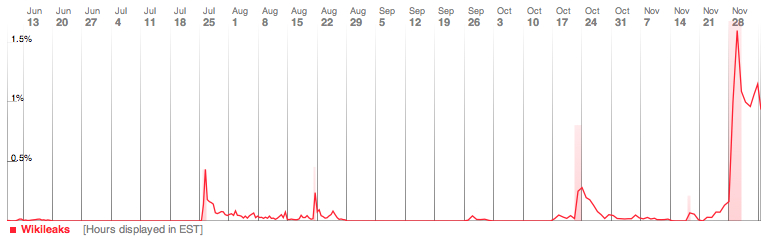
The first thing that jumps out, obviously, is that Wikileaks’ traffic pattern is far less regular than Sundays’. There are a few large-ish spikes, some extended periods of lower but still significant activity, and a bunch of long stretches when nothing’s going on at all.
If we look a little closer, we see that there’s very little happening here until the first spike, which comes on July 26. Activity then tails off gradually over the next month, with a second, smaller spike on August 21, and then almost nothing for two months. There’s a third spike — slightly smaller than the first, but much longer lasting — beginning on October 24. Traffic begins rising again in mid-November, spikes on November 29 at a volume four times that of the August peak, and has since settled in at a plateau about two-thirds the height of the November 29 spike ever since.
If you asked me, I’d say — just off the top of my head — that there are three or four obvious places on this chart where I’d have expected Wikileaks to trend, with the most recent being the most obvious. But if we look at Twend It, we see that it trended for thirty-eight hours over the course of three days at the time of the July spike, for less than two hours on August 21, and never again since.
Let me repeat that. Wikileaks trended on Twitter for three days following the first spike on the chart above, for two hours at the time of the smaller spike right next to it, and not at all for the third similar spike or the huge one that’s still going on now.
Weird, right?
But no. That’s not the weird part. This is the weird part.
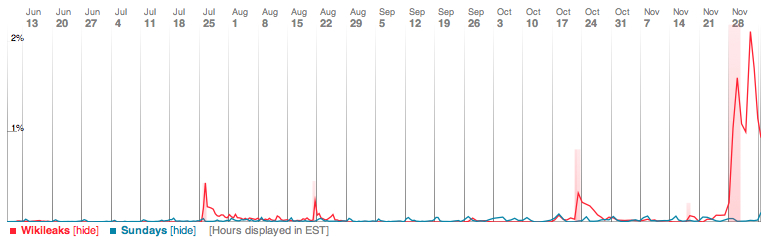
This chart tracks Sundays and Wikileaks over the last 180 days, with each term’s volume drawn to scale. The red spires? Wikileaks. The blue dust at the base of those spires? Sundays. The tiny blue uptick in the lower left hand corner of the chart has had Sundays trending for more than twelve hours today, while Wikileaks has been completely dark since August.
What the hell is going on here?
As I said in my last two posts, I don’t care that much about trending topics lists. I’m a big believer in online organizing, but I just don’t think getting your cause to trend is all that important in the grand scheme of things. But this, like I say, is ridiculous.
December 6, Morning | Be sure to read the full exchange between myself and Josh Elman of Twitter in comments — it’s illuminating in its own way. There’s a bunch of other important new info and analysis in the comments thread, too. I’ll be continuing to follow this story on Twitter over the course of the day, and I’m hoping to have a full new post up sometime this afternoon.
Also, you know, feel free to check out the rest of the site. Welcome!
December 6, Late Morning | Blogger Bubbloy has a post up that covers similar ground to this one in a complementary (and complimentary!) way. Be sure to check out the discussion of the “oil spill” trending topic in the second update.

 studentactivism.net
Recent Comments