
It’s 10:30 on Sunday night in New York, which means that it’s seven o’clock Monday morning in Tehran.

Monday, December 7. Student Day.

In August 1953 Iranian prime minister Mohammed Mossadegh was deposed in a CIA-backed coup. Four months later, US vice president Richard Nixon paid a diplomatic visit to the Shah of Iran, who had implemented Mossadegh’s removal from office. On 16 Azar by the Iranian calendar — December 6 — government troops opened fire on Tehran University students demonstrating against Nixon’s visit. Three were killed. Since then, 16 Azar has been commemorated as Student Day in Iran.

As I type this, the sun is rising on the morning of 16 Azar.

Media reports indicate that Iran’s government is doing everything it can to prevent protests from developing today. Campuses have been shuttered. Internet access has been cut. Student leaders have been arrested, as have the mothers of slain demonstrators. Press credentials for foreign media have been revoked.

The sun is rising.

9:30 am Tehran time | “Student movements are signs of realities greater than themselves.” – Mir Hossein Mousavi, statement commemorating Iran’s Student Day, December 7, 2009.

10:00 am Tehran time | Follow the hashtag #16Azar for news of the day, but remember to approach uncorroborated reports with skepticism.

3:30 pm Tehran time | An interesting insight from Iran News Now and the BBC: “We don’t hear ‘Where is my vote?’ anymore. The chants are mostly directed at the regime and its leaders in general.”

3:45 pm Tehran time | Media reports are still fragmentary, but video and photographs coming out of Iran show large-scale demonstrations on university campuses and beyond. Government forces are doing their best to clamp down, but it’s not yet clear how successful they’ve been.

Tuesday | Protests are continuing into a second day. Here’s a good news roundup from the New York Times.

Thousands of students and others rioted in Athens and throughout Greece today on the one-year anniversary of the police murder of 16 year old Alexandros Grigoropoulos.

The 2008 killing sparked weeks of rioting that caused millions of Euros in damage.

Police and demonstrators have provided very different accounts of the events of the day, but both sides appear to agree that as of Sunday evening, several hundred demonstrators are holed up in the University of Athens, which is under blockade.

In Greece, as in a number of other countries, police are forbidden by law to enter university grounds. There are reports from demonstrators that this ban has been violated in the vicinity of the campus gates, but a full-scale raid would likely provoke a major escalation in the crisis.

More news when I get it…

10:00 pm | Here’s a link to a post I put up last year on the roots of the Greek riots, and a set of links to the rest of my coverage of last year’s rioting: One, two, three, four. Also, the Twitter hashtag for the current disturbances is #griots.

7:30 am New York time | Greek police claim that 150 of the protesters are foreign anarchists who came to Greece for the riots, and the list of those arrested reportedly includes a handful of Italians, Spaniards, and Albanians. No reports of Americans yet. More marches and rioting are expected this afternoon.

10:30 am New York time | This Agence France-Presse article (in French) says that a group of hundreds of adolescents, some as young as twelve, threw stones at Athens police this afternoon. It also says that the occupation of the president’s office at the University of Athens has ended, and that the protesters arrested so far include several Italians and Albanians as well as Canadian, Turkish, Spanish and French citizens.

Twenty years ago today 14 women — 13 students and a staff member — were murdered on the campus of Montreal’s Ecole Polytechnique. Their killer, Marc Lepine, targeted female students in an engineering class and claimed to be “fighting feminism.”

Here’s an article that looks back at the shootings, their aftermath, and the larger struggle against misogynist violence. I’ll update this post with more links and info about memorials as the day goes on.

A reader reminds me that it would be appropriate to acknowledge the women who died by name. They were Geneviève Bergeron, Hélène Colgan, Nathalie Croteau, Barbara Daigneault, Anne-Marie Edward, Maud Haviernick, Maryse Laganière, Maryse Leclair, Anne-Marie Lemay, Sonia Pelletier, Michèle Richard, Annie St-Arneault, Annie Turcotte, and Barbara Klucznick-Widajewicz.

Updates…

A survivor of the massacre — then an engineering student, now a government official and a mother of four — comes to terms with her feminism.

The website of a group holding a campus candlelight vigil tonight.

An essay on the impact of the killings on Canadian society.

A collection of links from Spare Candy, one of my new favorite blogs.

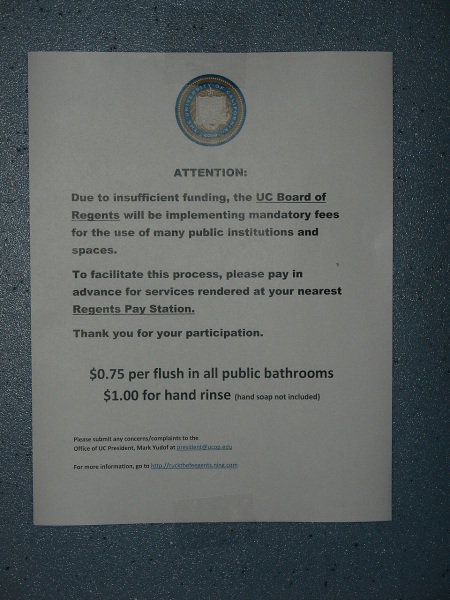
Notices were posted at UC San Diego last week about the latest fee imposed by the University of California Regents:

Thanks to my sources on the ground for the heads-up.

My Wednesday Campus Progress panel with Victor Sanchez, the president of the University of California Student Association, Bruce Cain, the director of the UC Washington Center, and Pedro de la Torre and Erica Williams of Campus Progress has been posted in full online.

Thanks so much to Campus Progress for hosting the event.

About This Blog

n7772graysmall
StudentActivism.net is the work of Angus Johnston, a historian and advocate of American student organizing.

To contact Angus, click here. For more about him, check out AngusJohnston.com.