
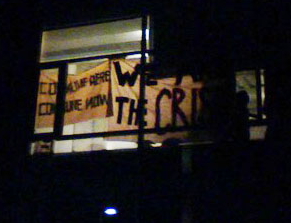
ucsc-occupation-humanities_10-15-09Two weeks after their occupation of a graduate student union building ended, UCSC student activists staged another campus takeover last night.

Details are still sketchy on the current occupation, but here’s what I have so far:

Sometime yesterday, apparently yesterday evening, students began an occupation at the University of California Santa Cruz.

According to this post at Santa Cruz Indymedia, the occupation is of UCSC’s “Humanities 2” building, which houses classrooms and offices, including the office of the Dean of Social Sciences. A comment there says that one student was maced and arrested early in the occupation, but that as of one o’clock this morning, other students remained barricaded inside, controlling the entire building.

This statement from UCSC activists, dated yesterday, indicates that more than one student was arrested and maced, and charges that students were not given proper warning before police moved in.

2:30 pm update | New details from Twitterer @creativecstasy, a UCSC student who was on the scene last night (and who took the photo posted above). She says the activists who conducted the takeover “knew what they were doing,” and that they “moved swiftly,” using “furniture/benches/trash [cans] to barricade doors.”

Once the occupiers were inside, supporters of the takeover massed for a dance party in front of the building, while the occupation’s manifesto was read aloud and projected with scrolling text on an outside wall.  The occupation was still going on when she left late last night, @creativecstasy says, and as far as she knows the students are still inside now.

4:00 pm update | UC Santa Cruz has released a statement on the events of last night. By that account, three students were pepper-sprayed while attempting to barricade the building with a table. One of the three was arrested, and the other two avoided capture.

The UCSC statement also says that students took over the building “for several hours last night,” but gives no details about when and how the occupation ended. A cryptic note posted moments ago on the Occupy CA website, however, seems to suggest that the students left the building voluntarily.

morning update | Two responses to the UCSC administration’s statement have been posted on the Occupy CA website.

Fears of  massive student protests coordinated with an upcoming general strike have led the University of Puerto Rico to shut all eleven of its campuses for an entire week.

The Puerto Rican government announced plans late last month to lay off sixteen thousand government workers in an attempt to close a $3 billion budget deficit. Since the announcement, students and labor have taken a number of protest actions, with student strikes shuttering several UPR campuses in recent weeks.

Fearing similar actions in the lead-up to an island-wide general strike slated for Thursday, and hoping to “calm things down and to allow the university community to think peacefully and constructively about the problems facing Puerto Rico,” the university’s president announced a weeklong system-wide “recess” beginning on Monday.

October 15 update, 11:15 am | A hundred thousand protesters are expected to participate in this morning’s largest rally in support of the Puerto Rican general strike.

11:25 am | Reports from Twitter, citing local news coverage, say that students from the University of Puerto Rico’s school of law have marched onto the Luis A. Ferré Expressway, a major highway into San Juan, shutting it down. Follow #ParoPR for Twitter coverage of the day’s events, most of it in Spanish.

October 16 update | Students occupied the Luis A. Ferré Expressway for eight hours yesterday, maintaining their position long after the primary protest march had ended. They were eventually convinced to disperse after a personal appeal from the elderly Puerto Rican nationalist Rafael Cancel Miranda. [Spanish language news report here, Google automatic translation here.]

Britain’s Conservative Party, also known as the Tories, seem likely to sweep into power in Britain next spring, and today a London newspaper is reporting that they may bring with them a doubling of tuition fees for British university students.

Undergraduate fees in Britain are currently capped at £3,225 a year, about $5,100, but the Tories’ chief higher education official was quoted this morning as saying that he’s open to raising that cap to as much as £7,000 — more than $11,000. Such an increase would dwarf even the massive hikes that are currently being proposed in the University of California system here in the United States.

The center-left Labour Party has led Britain’s government since 1997, but recent polling has shown a strong and relatively stable lead for the Conservatives. By law, new parliamentary elections must be held by June of next year.

This spring, the city Providence, Rhode Island announced plans to impose a $150 per semester tax on students attending the city’s colleges and universities, and now the city of Pittsburgh is moving in the same direction.

The Providence student tax is still working its way through the Rhode Island state legislature, along with a companion law that would allow the city to impose some direct taxes on private universities.

That companion bill reveals the motvation behind these new laws — to go after students if you can’t reach the universities themselves. Major private universities have enormous power, and they benefit from huge tax breaks. Taking them on directly is tricky, and carries potential bad consequences, so Providence and Pittsburgh are hoping students present a softer target.

October 14 update: See the comments to this post for a more detailed discussion of the pros and cons of the student tax.

Nearly three hundred Berkeley students kept the campus’s Anthropology library open from its scheduled closing time on Friday afternoon until 24 hours later, in protest of a new policy closing campus libraries on Saturdays.

Eighty students stayed overnight in the library, and they were joined by others in the morning. Some of the group studied, while others held teach-ins on the campus budget during the day on Saturday.

There are more than twenty libraries on the Berkeley campus, and administrators have eliminated weekend hours for at but two of them as a cost-saving measure.

October 13 update: Good on-the-scene report on the library takeover from Alternet. Here’s a taste:

What characterizes this movement (or maybe, what characterizes this as a movement), is the readiness of students, staff, and faculty to mobilize, as well as a diversity of tactics and strategies, coming from a myriad of organizations, bodies, coalitions, and mutually interested individuals who may be involved in none of those at all. This is the face of a new student movement, a movement invested in our spaces of learning, and one which demands to control the terms and conditions of our education.

About This Blog

n7772graysmall
StudentActivism.net is the work of Angus Johnston, a historian and advocate of American student organizing.

To contact Angus, click here. For more about him, check out AngusJohnston.com.