
Last fall the Supreme Court took up the question of whether a white applicant to the University of Texas had been unfairly treated when she was denied admission as part of a system that gave advantages to some applicants of color. After mulling the case throughout the term, the Court released an end-of-session ruling that kicked it back down to a lower court for reconsideration.

With that dispute still working its way through the system, SCOTUS will today hear arguments in a case that raises a separate issue in the use of race in college admissions.

In Fisher, argued last year, the question was whether the University of Texas could take race into consideration. In Schuette v. Coalition to Defend Affirmative Action, due up this afternoon, the question is whether public colleges in Michigan can be barred from doing so.

In 2003 the Supreme Court upheld the University of Michigan’s use of affirmative action in admissions, but in a referendum three years later the state’s voters rejected such policies by a 58-42 margin. Supporters of affirmative action say that the referendum unconstitutionally disadvantaged students of color by forcing them to use the state constitutional amendment process to win consideration in admissions, while other groups — donors, legacies, out-of-state applicants — could win changes to university policies through simpler means. (They also note that enrollment of black students has dropped significantly since the referendum: from 6.1% to 4.4% at the University of Michigan, for instance, and from 8.8% to 6.2% at Michigan State.)

Supporters of affirmative action face a steeper climb with the Court today than they did last year. Then, the question was whether states could use race in admissions. Now, the question is whether they may be compelled to.

Most observers expect the Court to reject the challenge to the Michigan referendum. With four Justices on record against the constitutionality of affirmative action generally, and a fifth — Justice Anthony Kennedy — clearly uncomfortable with such policies, it’s hard to imagine that a Court majority would impose an affirmative action plan on of a state in the face of a landslide popular vote to the contrary. (Some affirmative action opponents hold out hope for a flat ban from the Court, but if they didn’t take that opportunity with Fisher, it’s unlikely they’ll do so here.)

Surprises are always possible in the Court, however, and oral arguments are often illuminating. Justice Kennedy’s views on the scope of constitutionally permissible affirmative action remain something of a mystery, for instance, and it’s possible that today’s discussion will shed light not only on his thoughts on Schuette but also on his plans for Fisher II, once it wends its way back.

Oral arguments in Schuette v. Coalition to Defend Affirmative Action are scheduled for one o’clock this afternoon. Transcripts of the session will be released later today, and I’ll be back with a link and a review of the contents once I’ve had a chance to take a look at them.
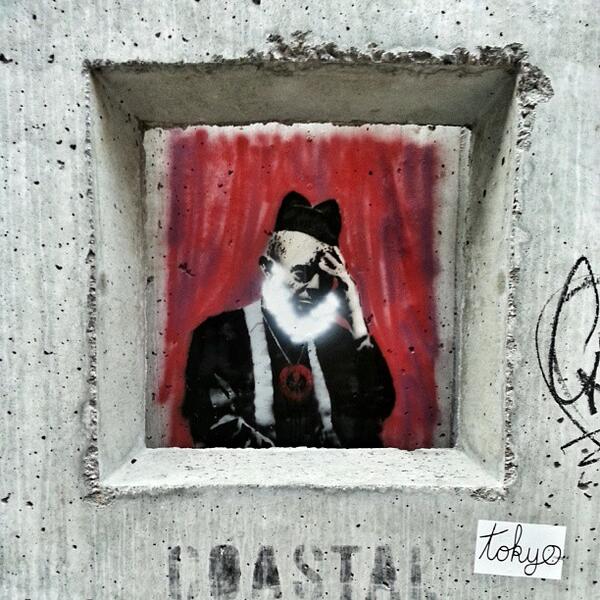
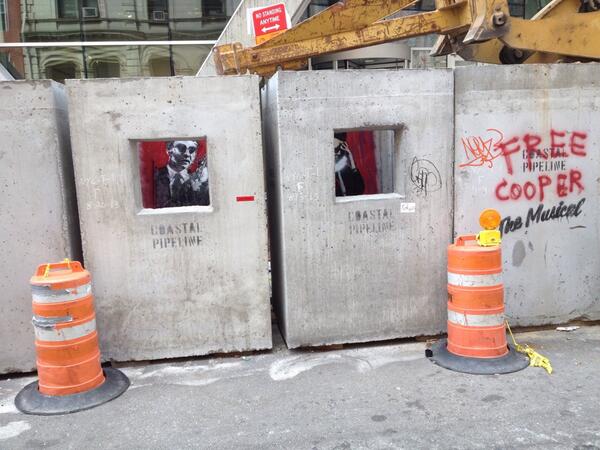
Within hours of its appearance on a downtown Manhattan sidewalk, the latest street art installation by rogue British artist Banksy was transformed by an anonymous, unauthorized collaborator into a visual statement of opposition to the administration of the city’s most famous — and beleaguered — art school.

BWdlHtzIMAA6oCrSometime last night or this morning, the priest in the painting was given a bushy white spray-paint beard which rendered him a dead ringer for Peter Cooper, the founder of the Cooper Union. At the same time, the cross that adorned his neck was replaced with a giant Flavor Flav style clock with a red face and hands set just prior to midnight, the symbol of the Free Cooper Union activist movement.

For more than a century Cooper Union, whose campus is just a stone’s throw away from the repurposed painting, has been free to all students accepted for admission. In the wake of a series of disastrous financial developments, however, the college’s administration has announced that they will begin charging admission next fall. The Free Cooper Union movement sprung up in the wake of the tuition announcement to fight to reverse that decision, and to bring other reforms to the university.

Banksy, the notorious and reclusive British graffiti artist, is currently in the middle of a monthlong “residency” in New York city. The new painting, entitled Concrete Confessional, depicts a weary priest.

Free Cooper Union has adopted Peter Cooper as a symbol of their struggle, deploying his likeness and statements in support of free higher education prominently in their campaign.

Image from @StreetArtNews on Twitter.

Update | Now wait just one goddamn minute.

New photos posted to Twitter appear to show a second painting next to Bansky’s original, in which someone who looks extraordinarily like Cooper Union President Jamshed Bharucha is making confession. Graffiti on the other side of the original piece reads “FREE COOPER.”

I haven’t been able to get down to the site to confirm that all of this is real, but if it is, what we have is a Banksy painting of a sad priest transformed into a triptych — Barucha praying for absolution to Peter Cooper, Cooper bowing his head in dismay, and then the movement’s slogan.

Holy crap.

BWeHNPfIEAAbBWcSecond Update | Yep. It’s real. It’s all real.

A photo from Banksy’s website shows that the original version of the piece didn’t include the painting of the Bharucha lookalike. And the photo at right, taken from a different angle than the previous ones, confirms that the Bharucha add-on isn’t just a photoshop job. (That photo also makes clear, as none of the others I’ve seen do, that the confessor the priest/Cooper figure are painted on the back wall of room-like enclosures, not on a slab inside a concrete frame.)

Someone, sometime last night, conceived and executed a revision of Banksy’s original piece that changed the priest into Peter Cooper and added a penitent Bharucha in exactly the place a confessor would be.

Wow.

Third Update | Commenter Bob Cooley believes that the Bharucha in prayer was painted over an image of an altarboy that Banksy put up last night, perhaps intended as today’s entry in the monthlong series. Images of the altarboy can be found here and elsewhere.

For whatever it may be worth, there’s no reference to the altarboy at the banksyny.com site, at least not yet. I have no information about whether that painting was by Banksy or was someone else’s addition. If I find out more, I’ll update again.

Oh, and one thing I missed earlier. The “FREE COOPER” graffiti on the right is actually “FREE COOPER: The Musical” graffiti, a play on the October 4 entry in Banksy’s monthlong series.

Fourth Update | Whatever the choirboy was, it wasn’t Banksy’s October 13 offering.

It appears, wacky as it may seem, that the choirboy was added to the piece by an unknown Banksy admirer and then painted over and replaced with the Bharucha image by the pro-Cooper Union folks.

In these days of skyrocketing tuition, administrators often justify rate hikes with promises to spare the neediest students from the pain of the increases. Pledges to set aside a portion of tuition revenue for financial aid are presented as a way of rationalizing college costs — charging the richest students more, the argument goes, will allow the institution to protect access for the poorest.

Tuition is far more visible than financial aid rates, however, and because of that there’s always a temptation to nibble away at grant disbursements when budgets need balancing. At the same time, pressure to lure wealthy students and to climb up in national rankings increasingly leads public colleges to divert the aid money they do provide to applicants farther up the income ladder.

The latest college to curtail financial aid in a big way is the University of Virginia, and students there are fighting back.

For about ten years, the AccessUVa program has provided full financial aid to eligible students — several hundred in each entering class — in the form of grants. Starting next spring, however, the first $3,500 to $7,000 of AccessUVa aid each student receives each year will be a loan.

The impact of the rollback extends beyond the financial, too. Just as a high base tuition price can scare away students eligible for aid — a phenomenon education researchers call “sticker shock” — the knowledge that they’ll have to apply for hefty loans can discourage students from applying at all. The problem is particularly acute at the UVa, which is seen by many students as “elitist, preppy … homogenous” and unwelcoming to poor students and students of color.

In the wake of August’s 15-2 Board of Visitors vote to restructure the program, a student group called Restore AccessUVa (@RestoreAccess on Twitter) has arisen to try to force a reversal of the decision. The group has deluged the Board with emails, held an on-campus rally, and collected thousands of signatures on a petition in support of the program’s original mission.

More as this story unfolds…

According to a statement posted on his website, Hugo Schwyzer has resigned his teaching position at Pasadena City College effective immediately.

Schwyzer had announced his intention to resign late this summer after his admission that he’d had sex with students in the recent past. He sought to delay the resignation’s effective date until he was able to secure a disability retirement settlement from the state, however, and PCC initiated termination proceedings.

In the wake of a September incident in which Schwyer seriously injured a woman in a DUI, the college stepped up its efforts to force him out, publicly requesting his immediate resignation. Subsequent to that Schwyzer indicated in online statements that the college could secure his silence regarding the names of the students he had slept with by agreeing to allow him to stay on until January, then took to Twitter and his blog to name one of those students, along with the woman he injured in the DUI and a woman he attempted to kill in the late 1990s. (The tweets and the blogpost were later removed.)

Today’s resignation, assuming it is genuine, brings Schwyzer’s career in higher education to an end. With any luck, it will also bring an end to this blog’s coverage of the story.

The text of the statement as published on Schwyzer’s website is as follows:

“Pasadena City College has accepted Dr Hugo Schwyzer’s resignation effective October 8, 2013. This brings to a conclusion all matters relating to Dr Schwyzer’s employment at PCC. This investigation being conducted under the supervision of outside counsel will not proceed any farther. Dr. Schwyzer expresses his appreciation and thanks to his students and colleagues at PCC.”

October 9 Update | Pasadena City College has confirmed Schwyzer’s removal in a notice posted on its website.

I’ve written before about “Pay It Forward,” a tuition restructuring proposal in the works in Oregon and under serious consideration elsewhere. Under the PIF plan, students would pay no tuition fees while attending Oregon’s public colleges, instead committing to pay a certain percentage of their income to the state for a certain number of years after graduation.

The most obvious benefit of PIF for students is the payment calculation method — with it, those who choose (or otherwise wind up in) low-paying jobs won’t have to pay as much as those who make more. What this means, though, is that PIF is pretty much just an income-based-repayment student loan system under another name.

Which is itself mostly fine, since income-based-repayment is a pretty good way to set up student loans, in principle. But there’s more than principle at stake here, and it’s in the implementation that the real problems arise.

The first problem is that PIF is being touted as an alternative to student loans, and even as an end to tuition, which it absolutely is not.

The second problem is that as with any major financial transaction, the fine print is what gets you. And the fine print on PIF contains plenty of cause for worry.

That’s the focus of an anti-PIF statement released yesterday by a coalition of education advocacy organizations, including the American Federation of Teachers, the American Association of University Professors, the Student Labor Action Project, and the National Education Association. In their statement, the groups raise a number of important concerns about PIF, including the following:

  • PIF as a model does nothing to remedy government disinvestment in colleges and universities, the core cause of the current crisis in public higher education.
  • By institutionalizing the idea of college education as something that “pays for itself” via student income deductions, PIF could actually exacerbate the crisis in public higher education funding.
  • Depending on their income and the repayment structure, PIF could end up costing some students far more than traditional tuition.
  • Because PIF is intended only as a replacement for tuition and fees, students enrolled in such a program would still have to cover the other costs of college, including room and board, textbooks, housing, and transportation. Such students could well wind up saddled with PIF obligations and student loans.
  • How PIF would integrate with current structures of student aid and student organization funding is by no means clear.

In addition to all these concerns, the statement raises alarms about what is for me the central paradox of PIF.

The premise of Pay It Forward is that the payments made by high-income students will subsidize those made by low earners. But because students will know this in advance, that structure will give students who anticipate high earnings a disincentive to participate. A PIF-only system will encourage such students to enroll at other institutions, while an optional PIF will lead many of them to opt out. Either way, the PIF-enrolled student body will likely skew poorer in lifetime earnings than that institution does now, and the more the students earnings drop, the higher their PIF contribution will have to be raised to keep the revenue stream afloat.

Under PIF, in other words, you could easily chase potentially high-earning students out of the system, forcing those with lower projected earnings — and those without the financial wherewithal to opt out — to bear an ever-increasing burden of higher education costs. At the same time, PIF would give colleges and states strong incentives to favor students with high earning potential in the admissions process.

If implemented with care, forethought, and robust public funding, PIF could be an interesting — though not particularly earth-shattering — development in the higher education funding debate. Without such safeguards, however, it looks like a wolf in sheep’s clothing.

About This Blog

n7772graysmall
StudentActivism.net is the work of Angus Johnston, a historian and advocate of American student organizing.

To contact Angus, click here. For more about him, check out AngusJohnston.com.
