A few quick thoughts on next week’s New Yorker cover, which I instantly loved but which some other folks really hate.

Ernie and Bert on the cover of next week's New YorkerThe “Ernie and Bert are gay” trope is old and tired, yes, and it wasn’t all that sharp even when it was new. If that was all this cover had been — a Muppet gay wedding — I’d whole-heartedly agree with the critics. But that’s not all it is.

I was initially puzzled by the outdated, rabbit-eared television the two are watching. At first I wondered if it was intended to place Ernie and Bert back in the sixties, when we first met them, but that didn’t  make much sense. Old-fashioned TVs “read” visually as TVs better than new ones, of course, and for a moment I thought that might be the explanation, though it wouldn’t explain the black-and-white image on the screen.

As I mulled, however, I realized that a black-and-white cathode ray set is exactly the television I’d expect these guys to have. They’re an old couple by now, set in their ways, hunkered down in the same spacious but shabby New York City apartment they’ve shared for the last forty-five years. The set in the picture isn’t an anachronism, they just never saw the need to upgrade to digital.

And yes, I used the word “couple” in the previous paragraph, and I used it advisedly. Because straight or gay or — canonically, and most satisfyingly — neither, a couple is who they are, and always have been. They bicker, they joke. They exasperate and console each other. They share a bedroom (though not a bed). They’re friends, but they’re more than friends. They’re partners.

And that’s what the cover portrays them as. It’s not a sexual depiction, or even a particularly romantic one. It’s a domestic depiction, one that draws on the easy intimacy that’s been built into their relationship since the beginning. It’s our old buddy Bert and our old pal Ernie, at the end of their day, watching the news together as they’ve been doing since before Gay Pride, before Stonewall [1], before Don’t Ask Don’t Tell and DOMA and Proposition 8.

Ernie and Bert are still Ernie and Bert, just as they’ve always been. But the world on their TV is changing, and they’re watching it change, and they’re happy.

[1] Not quite. See comments.

Yesterday’s 5-4 Supreme Court ruling invalidating the Defense of Marriage Act drew a lengthy, vituperative dissent from Justice Antonin Scalia. In that dissent, Scalia excoriated his colleagues for offering slipshod, even incoherent arguments, at one point  launching an extended assault on his conservative ally Samuel Alito over what he considered a mishandling of a jurisdictional issue.

All this is par for the course when Scalia finds himself in the minority, right down to the cuttingly sarcastic asides on seemingly abstruse constitutional issues. (“One could spend many fruitless afternoons ransacking our library for any other petitioner’s brief seeking an affirmance of the judgment against it” was one of my favorite sentences.)

But the dissent got really interesting in its final pages.

Scalia has long argued that any embrace of gay rights by the Supreme Court, however qualified, would put that body on an inexorable path to full support of same-sex marriage. That prediction, which many dismissed as ridiculous a decade ago, took a big step toward vindication yesterday, and Scalia was not happy.

Both the majority and the primary dissent in the DOMA case took pains to distance the Court from a full-equality position. Justice Kennedy wrote that his opinion “and its holding are confined to those … marriages” already “made lawful by the State,” while the dissenting Chief Justice declared that “the Court does not have before it, and the logic of its opinion does not decide, the distinct question whether the States … may continue to utilize the traditional definition of marriage.”

To Scalia, these disavowals were nothing short of absurd. Justice Kennedy’s opinion amounted, he wrote, to “a lecture on how superior the majority’s moral judgment in favor of same-sex marriage is to the Congress’s hateful moral judgment against it,” and predicting the Court’s “inevitable” application of that same lecture to state laws against same-sex marriage is “just a matter of listening and waiting for the other shoe.”

To illustrate this point, Scalia did something I’ve never seen before in a Supreme Court dissent — he drafted the language of a future majority opinion for the other side. Specifically, he extracted passages from Kennedy’s DOMA decision and, by altering a few words with strike-throughs and italics, turned them into passages from the full marriage equality ruling that he believes could come as soon as the court’s next term.

Here are those three passages as Scalia amended them:

DOMA’s This state law’s principal effect is to identify a subset of state-sanctioned marriages constitutionally protected sexual relationships, see Lawrence, and make them unequal. The principal purpose is to im- pose inequality, not for other reasons like govern- mental efficiency. Responsibilities, as well as rights, enhance the dignity and integrity of the person. And DOMA this state law contrives to deprive some couples married under the laws of their State enjoying constitutionally protected sexual relationships, but not other couples, of both rights and responsibilities.

[DOMA] This state law tells those couples, and all the world, that their otherwise valid marriages relationships are unworthy of federal state recognition. This places same-sex couples in an unstable position of being in a second-tier marriage relationship. The differentiation demeans the couple, whose moral and sexual choices the Constitution protects, see Lawrence, . . . .”

And it humiliates tens of thousands of children now being raised by same-sex couples. The law in question makes it even more difficult for the children to understand the integrity and closeness of their own family and its concord with other families in their community and in their daily lives.

Of the last passage, Scalia wrote that it did not “even require alteration, except as to the invented number.”

I’d quibble with some of Scalia’s phrasing — I think it’s likely that the Court would use the term “unions” rather than “relationships,” for instance — and I suspect that his assertion that the next decision might come as soon as 2014 was more a provocation than a prediction. But on the substance of his claim, I think he’s right on the money.

There’s nothing of any weight in yesterday’s majority opinion that distinguishes the federal ban on recognition of same-sex marriages from state bans, and the Court’s refusal to take its logic to its natural conclusion almost certainly reflects nothing more than a decision to wade slowly into the pool instead of jumping in at the deep end. There’s plenty of precedent for such a strategy, too — the Court did something similar the last time it took on the marriage equality issue, issuing a ruling invalidating state laws against interracial cohabitation in 1964, three years before Loving v. Virginia.

So Justice Scalia is correct. Barring a rightward shift in the Court’s composition, full marriage equality is coming to America, and soon.

And if the passages he cited do not appear in that forthcoming decision, it will only be because yesterday’s dissent embarrassed a future majority of the Court into leaving them out.

One thing about teaching community college history is that you wind up hearing quite a few conspiracy theories — some well-established, some mythical, some indeterminate.

When the subject of conspiracy comes up in my classes, one thing I sometimes say is that there are three basic ways to keep a  secret a secret. First, you can make sure that very few people know it. Second, you can let a lot of people know it, but make sure they’re committed to keeping quiet. And third, you can let a lot of people know it, but set things up so that they don’t consider the secret worth talking about.

The first of these three is the safest, of course. Someone who doesn’t know your secret can’t betray it. But it’s often hard to get a really good conspiracy going with a really small group of conspirators. This is a big reason that I’ve concluded that Lee Harvey Oswald probably acted alone — all the plausible alternative theories I’ve seen require conspiracies so broad as to be  unsustainable. Big secrets are hard to keep secret when lots of people know them.

Which brings us to the third, often neglected, way of maintaining a secret — don’t treat it as a big deal. The Tuskeegee syphilis experiments involved an ever-growing list of practitioners, bureaucrats, and observers, but it took forty years for the story to break. Why? Not because the folks involved pledged themselves to keeping the horrible truth from the public, but because most of them didn’t think the truth was horrible at all. The study wasn’t broadly acknowledged, but it wasn’t a scandal within the US Public Health Service. And because it wasn’t a scandal, most of the folks who knew didn’t treat their knowledge as a moral dilemma. The secret was kept secret because nobody treated it like a secret.

Now, clearly the nature of the NSA/Verizon and PRISM surveillance programs, leaked this week to huge public outcry, were in one sense treated as very big secrets. Even the fact of their existence was highly classified, with potentially serious legal consequences for anyone — even a member of Congress — who spilled the beans.

But at the same time, the existence of the programs appear to have been regarded by those who knew about it as less explosive than one might have assumed. The first leaks regarding the PRISM internet spying program came in the form of a PowerPoint presentation of the sort you might see at a middling corporate conference — the primary aesthetic impression left by the material is one of banal ordinariness. And as the New York Times reported this morning, “after days of speculation that the source behind [the leaks] must have been a high-level official at one of America’s spy agencies,” the whistleblower was revealed yesterday to be “a relatively low-level employee of a giant government contractor.”

The reporting on this story is still in its preliminary stages, of course, but in the early going one gets the distinct sense that these huge surveillance projects, so appalling to so many of us, were treated within intelligence circles less as dire forbidden knowledge to be protected at all costs than as ordinary government programs, hardly worth making a big deal over.

When we look back at the process by which the Watergate conspiracy became public, the whistleblowers who come to mind are highly-placed figures tortured by conflicting moral and institutional pressures: White House counsel John Dean, for instance, and Deep Throat himself, who was in 2005 revealed as Mark Felt, the former Associate Director of the FBI.

Bradley Manning and Edward Snowden have little in common with Dean and Felt. Any conspiracy that depended on the principled collusion of figures like these would be a poor conspiracy indeed. Instead, it begins to appear that our current national security establishment relies on Mannings and Snowdens not as active conspirators but as disinterested hired hands — not as Watergate burglars or grassy knoll sharpshooters but as Tuskegee physicians and pencil pushers.

If this is the case — if this information was as broadly held and as casually regarded as it’s begun to appear — then what’s been revealed so far may be just a taste of what’s to come.

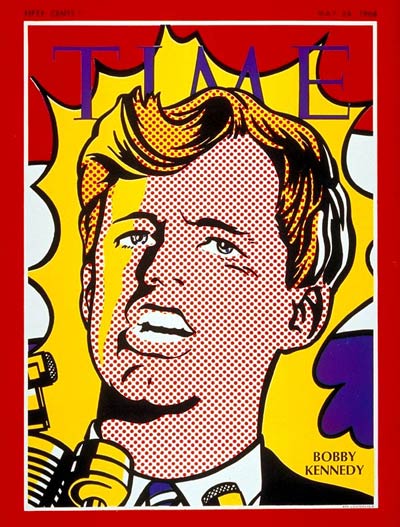
In the spring of 1968 Robert F. Kennedy was running an insurgent antiwar candidacy for the presidency of the United States. Late to declare and hobbled by an archaic nominating system (the Democratic Party primaries would be dramatically revamped and expanded for 1972), the slain president’s younger brother had nonetheless managed to garner huge attention, win a string of state contests, and — some argue — position himself for an outside chance of taking his party’s nomination.

Roy Lichtenstein Time cover, May 1968: Robert F. Kennedy.To capture the frenetic youthful energy of RFK’s campaign, Time magazine commissioned a cover image from celebrated pop artist Roy Lichtenstein. Already an art-world star by 1968, Lichtenstein’s signature technique adapted the colors, subjects, and technique of comic books and newspaper cartoons for his paintings. For his mid-May Kennedy cover, Lichtenstein portrayed the senator declaiming at a podium, framed by a red-white-and-blue background and haloed by a dynamic yellow sunburst.

It was a striking image, and soon a creepily prescient one. Three weeks after the issue appeared, Bobby Kennedy was dead — shot in the head just after giving a televised speech at just such a podium. (One famous photo taken after the shooting recapitulates the cover image in an unsettling way.)

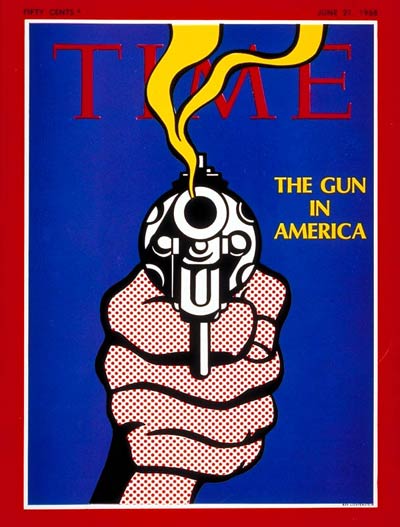
Shortly after the assassination Time ran another Lichtenstein cover, and the second image is a sibling of the first — same primary-color palette, same use of oversized Ben-Day dots to indicate skin tone, same black steel and yellow mist. In this case, however, the steel is not that of a bank of microphones, and the slash of yellow at the heart of the image is not a sunburst. The steel is a pistol pointed at the reader, and the yellow is smoke rising from its barrel.

Roy Lichtenstein Time cover, May 1968: Robert F. Kennedy.   1101680621_400

Time magazine had planned a cover story on gun violence in America prior to the RFK assassination, and commissioned the two Lichtenstein pieces on a single contract. According to the artist, he painted both at the same time and submitted them to the magazine simultaneously.

Though the covers were painted in tandem, they were not intended to be seen that way. Their thematic connection did not yet exist when they were requested, when they were completed, or when the first of the two was published. When the second appeared on newsstands the first was not at the front of anyone’s mind.

Today the gun cover is remembered occasionally, the Kennedy cover almost never. I’m a fairly close student of Robert Kennedy’s career, a scholar of the sixties, and a fan of Lichtenstein’s art, and I had never seen the two covers together — or known their story — until two weeks ago. (I stumbled across the RFK image while Googling the assassination after an episode of Mad Men, then searched “lichtenstein time magazine” in an effort to confirm it was the artist’s work. The gun cover popped up in that search.)

The diptych is not famous, but I think it deserves to be. Viewed together now, the two paintings sum up the delirious, discombobulated year in which they appeared — the year of the the Tet Offensive, Johnson’s withdrawal, the King assassination and the unrest that followed, the Paris uprising and the Prague spring, the Chicago convention police riots, the Wallace presidential campaign, the Mexico City Olympics, and Richard Nixon’s election — as few images do.

Last night brought shocking news for supporters of student involvement in university governance in the United States, as a Republican-controlled budget committee of the Wisconsin state legislature moved — with little debate, and after refusing a stand-alone vote  — to eliminate the primary funding stream of the nation’s oldest and most respected statewide student association.

The United Council of University of Wisconsin Students (UC) has been the democratic voice of students in the UW system since 1960, and it has earned a strong reputation for effective advocacy for students’ rights and interests.

Last night’s change to state law, if approved by the full legislature, would bar United Council from funding itself through campus student referenda, as it has done for decades. The move to defund United Council was made with no notice or warning, and comes at the end of a budget process in which United Council worked closely with Republican legislators to enact a two-year tuition freeze (a freeze which ironically was approved in the same omnibus budget proposal as the attack on UC itself).

Where did this assault on UC come from, and why is it happening now? One Wisconsin politics blog reports that Republican committee-member John Nygren said last night that the committee received a letter from the UW-Eau Claire student government calling for an end to the funding referenda. Wisconsin student activists I’ve spoken to since yesterday confirm that account.

As to why the student government at Eau Claire — which is, bizarrely, a United Council member campus — would want to cut off funding for their own statewide student organization, that’s an interesting question.

Campuses become members of United Council via referendum, as noted above. At the moment the students of a robust twenty out of the state’s twenty-six public colleges (nine of thirteen four-years, and eleven of thirteen two-years) have chosen to affiliate.

The Eau Claire student government has been unhappy with United Council for some time, and released a lengthy critical report on the organization last year. Dissatisfied with UC’s response, the student senate this spring voted to disaffiliate from the statewide organization. That vote appears to have had only symbolic effect, however, given that the referendum mechanism for UC membership is a matter of systemwide University of Wisconsin policy.

So why didn’t the Eau Claire student government run a UC referendum? Well, it turns out that they did just that, barely a year and a half ago. In the fall of 2011, with nearly two thousand voting, the Eau Claire student body endorsed UC — and a 50% increase in the per student membership fee — by a 65-35 margin, despite a campaign against UC by the statewide group’s critics. What’s more, the turnout for that referendum was more than double that of the student government election that brought UC’s current antagonists to power.

As a result of that 2011 precedent, when the Eau Claire senate took up the issue this spring, the UC opponents on the body declined to even propose a campus-wide vote. Instead they declared that they “did not see a referend[um] as a feasible means to accurately gauge student opinion,” given their expectation that UC and its supporters would be present on the campus organizing for its passage.

To recap: UW Eau Claire is a member of United Council. Its students voted overwhelmingly just nineteen months ago to maintain that membership, and to increase the dues they pay from $2 per semester to $3. The current student government opposes UC, but has no confidence in its ability to prevail in a campuswide vote on the question.

So instead they voted as a student senate to withdraw from UC in a manner apparently disallowed by university policy. And when that tack failed, they asked state legislators to eliminate referendum funding altogether.

Now, I don’t consider campus referenda sacrosanct, and I certainly think there’s something to be said for empowering student governments to control student activity fee money directly. I don’t have any objection in principle to a rule that would, for instance, grant a student government the authority to override a campus referendum under certain circumstances. And I certainly believe that state student associations have an obligation to maintain good relations with member student governments, too — it’s quite possible that some or all of the responsibility for the breakdown in the relationship between the Eau Claire student senate and statewide United Council leadership rests with UC.

But that’s not what’s happening here. What’s happening here is a state legislature and a student government seeking to destroy a democratically empowered and elected student association because they don’t like the outcomes of the democratic process that the university itself created.

If the students’ right to participate in university governance means anything, it must mean that students have the power to make decisions about who will represent them, and how. For the state government to dismantle a respected student advocacy organization with fifty years’ of history — and the freely chosen support of the vast majority of UW student bodies — under circumstances such as these is a travesty.

The Joint Finance Committee made a huge error last night. The Wisconsin state legislature and Governor Walker should rectify it.

Update | Governor Walker has signed the defunding provision into law.

About This Blog

n7772graysmall
StudentActivism.net is the work of Angus Johnston, a historian and advocate of American student organizing.

To contact Angus, click here. For more about him, check out AngusJohnston.com.