Just a few hours ago, a budget committee of the Wisconsin state legislature voted to hobble students’ ability to fund the nation’s oldest and most respected statewide student association, United Council. This could well be the biggest student movement story in the United States this year.

United Council, founded in 1960, was the first of the wave of state student associations established in the sixties and seventies, and has consistently been one of the most successful. UC has for half a century been a strong voice for students in Madison and across Wisconsin, and is a model and mentor to student organizers across the country.

Though United Council has at times been controversial in some quarters, it rests on a democratic base of student support. Campuses join UC by student referendum, and students on campuses that choose to join pay a membership fee of $3 a semester as part of their tuition bill. Individual students have the right to request a refund of the fee if they don’t wish to support United Council, and any time that a student government or group of students comes to oppose UC they can arrange to run a referendum to end their campus’s membership.

This is how United Council funding has operated for decades, and it’s a structure that is standard for student groups nationwide. From state student associations to PIRGs to the US Student Association, it’s a straightforward, democratic system that combines membership accountability with reliable, robust funding. Don’t like the group? Organize against them. Like them? Organize for them. Simple.

Which brings us to tonight.

This evening, the Joint Finance Committee of the Wisconsin state legislature took up an omnibus funding measure for the University of Wisconsin as part of the state budgeting process. Tonight, when that omnibus proposal reached the JFC, it included a provision eliminating the so-called “mandatory refundable fee” through which UC receives its funding. Instead, any campus funding for UC would be on an “opt-in” basis, meaning that individual students would have to affirmatively choose to pay UC dues rather than being given the option of opting out.

For United Council this would mean the virtual elimination of their student funding base. Organizing campus by campus is reasonable and democratic. Organizing student by student, three dollars at a time, is unworkable.

Democratic members of the Joint Finance Committee spoke out against the UC proposal, which was apparently sprung on them without warning, but the chair of the committee refused to allow a vote on a proposal to amend the omnibus measure to remove it. When the vote on the full omnibus — a proposal that provided not only for the UW budget, but also a politically popular tuition freeze — it was endorsed by a 14-t0-2 margin, with just two Democrats standing in opposition.

With the approval of the UW omnibus measure by the JFC, that proposal now becomes part of the state budget which goes to the Assembly and Senate for action. Both houses of the legislature are currently controlled by Republicans, and I am told that budgetary amendments on the floor of either house are uncommon. Final approval of the budget is expected sometime next month.

I’m still getting up to speed on exactly where this proposal came from and what the likely prognosis is now — as I said, the defunding plan took even careful observers of the Wisconsin legislature by surprise, and “careful observers of the Wisconsin state legislature” is not a group I usually count myself among. To my knowledge, there has been no media coverage of this development so far, beyond a few mentions on a Wisconsin politics blog earlier this evening.

I will know more, and report more, tomorrow. But for tonight, I’ll close with this:

The proposal adopted by the JFC tonight, if enacted as law, would essentially defund the nation’s oldest statewide student association, and one of its strongest. One SSA, the Arizona Students’ Association, has already been defunded this way this year. To lose United Council would be an immeasurable blow to the American student movement, and to students’ rights in Wisconsin.

United Council stands at the heart of American student organizing, and has for more than fifty years.

It is, to put it plainly, irreplaceable.

Morning Update | As United Council’s government affairs director Dylan Jambrek (a veteran Wisconsin student government leader himself) noted on Twitter late last night, not only did the JFC pass a two-year UW tuition freeze yesterday, Republican legislators thanked United Council for their work in helping to bring it about, even as they were plotting to defund the organization. “United Council has worked closely with GOP legislators this semester on the UW budget,” he writes, and “this was never discussed. This is simply a backstab.”

Second Update | More on the anti-democratic politics of the defunding vote .
In his post today on the Jason Richwine race-and-IQ controversy, Andrew Sullivan begins by acknowledging that Richwine’s recent study of ethnicity and immigration for the Heritage Foundation is worthless as a work of scholarship or public policy. He goes on to acknowledge that Richwine himself has a habit of consorting with white supremacists — his phrase, not mine.

So far so good.

But Sullivan goes on to argue that despite all that — despite the fact that Richwine is a hack, that he’s chummy with racists, and that his contemporary advocacy work is pernicious nonsense — Richwine himself deserves to be taken seriously as a scholar. Why? Because “the premise behind almost all the attacks – that there is no empirical evidence of IQ differences between broad racial categories – is not true.”

That’s not the premise behind the attacks. Here’s the premise behind the attacks:

First, as Sullivan notes, there’s the weaknesss of the claim that America’s “broad racial categories” can be used “as shorthand for a bewilderingly complex DNA salad.” Racial categories are culturally, not biologically, grounded — the geographical and ancestral dividing lines between what we think of as “races” have nothing to do with science and everything to do with our own ugly history of racial discrimination. As a result, any genetic research that doesn’t problematize such categories is going to run into major theoretical difficulties quickly.

Second, the concept of IQ is itself of dubious merit. As Sullivan himself declares, IQ is “an artificial construct” that “shouldn’t be conflated with some Platonic idea of ‘intelligence,'” assumed to hold “any moral weight or relevance to “immigration policy” or indeed “any public policy.”

That’s all important stuff. Race is a social construct with only an attenuated relationship to genetics, and IQ is a social fiction with only an attenuated relationship to intelligence. That would be enough to doom the race-and-IQ project, to my mind. But it’s only the beginning.

The third premise of the attacks on Richwine and his ilk is the objection that such research is unlikely to reveal anything about innate cognitive differences between human “racial” groups not merely because the theoretical underpinnings of such claims are so shoddy, but also because generations of such research have failed to produce any reliable positive results. Folks have been searching for evidence of heritable intellectual differences between ethnic populations for a very long time, and they’ve pretty much come up empty.

The fourth problem with this research is implied in the second, but extends beyond it: Even if such differences could somehow be proven — and again, there are powerful theoretical and evidentiary reasons why that is highly unlikely — the results would have no practical value, and tremendous potential for horrific misuse.

Let’s say it were discovered that one American racial group was, once all the effects of nutrition, healthcare, education, income, parenting, and every other environmental factor were controlled for, on average innately slightly less intelligent than another. Would that finding justify discriminating against the less intelligent group in employment, education, or any other realm of endeavor? No. Would it lend itself to any corrective public policies? Again no. It would be of no social value whatsoever.

Such a finding would, though — and this is the fifth problem with the project — assuming that the less intelligent group were a socially disfavored one (an unwarranted and yet essentially universal assumption), reinforce society’s ugliest racist attitudes and provide support (not justification, but support) to bigots and jerks. Although such research would not imply anything about any individual’s intellectual capacity, it would instantly be trumpeted as “proof” of all manner of false and discredited — and incredibly pernicious — beliefs.

Sullivan understands all this. He acknowledges most of it. And yet he insists that the work should be continued and embraced, though he provides no affirmative justification for that position.

Instead he offers nonsense like this:

We remain the same species, just as a poodle and a beagle are of the same species. But poodles, in general, are smarter than beagles, and beagles have a much better sense of smell. We bred those traits into them, of course, fast-forwarding evolution. But the idea that natural selection and environmental adaptation stopped among human beings the minute we emerged in the planet 200,000 years ago – and that there are no genetic markers for geographical origin or destination – is bizarre. It would be deeply strange if Homo sapiens were the only species on earth that did not adapt to different climates, diseases, landscapes, and experiences over hundreds of millennia. We see such adaptation happening very quickly in the animal kingdom. Our skin color alone – clearly a genetic adaptation to climate – is, well, right in front of one’s nose.

This paragraph is a miasma of shoddy argumentation. To wit…

  • Human races cannot be productively analogized to breeds of dogs, for reasons that should be patently obvious. And human races should not be analogized to breeds of dogs, because such false analogies lend themselves so readily to vapid racist ends. It’s a lousy analogy, and one with a repellent history.
  • Setting aside the faults in the race/breed analogy, if there were differences in cognitive or sensory capacity between human populations on the scale of those which exist between poodles and beagles, we’d know. We’d know because scientists have been assiduously searching for such differences for literally hundreds of years, hoping fervently to find them. They haven’t. Whether such differences, on such a scale, exist is a closed question, a question to which the answer is a clear “no.”
  • No scholar or pundit is arguing “that natural selection and environmental adaptation stopped among human beings the minute we emerged in the planet 200,000 years ago,” or that “there are no genetic markers for geographical origin or destination.” Nobody. And nobody is criticizing the many many mainstream scientists who are doing productive, uncontroversial work on questions such as these. Sullivan’s implications to the contrary are strawmen, pure and simple.

And this, at last, is the final argument against the kind of willfully obtuse and credulous engagement with tawdry racial theorists that Sullivan is calling for:

It makes people like Sullivan himself — smart people with interesting stuff to say on a variety of other topics — act really really stupid.

Yesterday the Census Bureau released a demographic report on the 2012 election that’s chock full of really interesting stuff.

The Bureau’s analysis of racial data has gotten the most attention, and not unreasonably. The report’s dramatic finding that black voter turnout levels rose above white levels for the first time in American history is just the beginning of that story. (I myself was even more intrigued to learn that black turnout rose almost as much between 2008 and 2012 as it did between 2004 and 2008. There’s a huge amount to unpack in just that one statistic.)

Beyond the racial demographics, however, there’s a lot more of interest lurking in the numbers — much of it unmentioned in the formal report and only discoverable in the accompanying tables. Here are some of the nuggets I found most compelling:

Perhaps the most dramatic age-related data had to do with educational attainment. Among all young citizens (defined as those under 25 years old), some 41% said they’d voted. (It’s important to note that this is an undercount, because not everyone was asked this question or answered it. Unlike with the racial date noted above, the Census did not use statistical analysis to correct for non-responses.) Among those without a high school diploma, that number dropped below 25%. High school graduates with no college weren’t much more likely, at 29%, but those who had attended college without getting a bachelor’s degree (or who were still enrolled as undergrads) voted at a rate of 50% and among those with a bachelor’s voting jumped to 63%.

When you compare these figures with those for the population as a whole, they become even more stark. Young people with a bachelor’s degree were 84% as likely to say they’d voted as all ages with bachelor’s, and those with some college were 78% as likely to say so as the full population in that educational cohort. But comparing high school grads across the age demographics, young people were only 55% as likely to have voted as all those with high school but no college.

When non-voters were asked why they didn’t vote, some reasons — they forgot, they weren’t interested, they were too busy, bad weather — turned up in essentially equal numbers among young non-voters and the non-voting electorate as a whole. One answer, “illness or disability,” was unsurprisingly far less common among the young. (Young non-voters gave that reason 3.1% of the time, compared to 14% for all non-voters and a full 42% among non-voters over 65.) Young people were also, perhaps more surprisingly, less likely to say they didn’t like the candidates (by a ratio of 9.9% to 12.7%) or that they weren’t interested (14.0% to 15.7%).

So why didn’t young people vote? Nearly 15% said they were out of town, double the percentage of older voters who said the same. And another 9.4% said they had difficulty registering, as compared to 5.5% of the total non-voting pool. Each of these difficulties reflects the barriers to registration posed by Voter ID laws, impediments to voting on campus, and similar suppression efforts that have in many states been targeted specifically at youth voters. Young non-voters were more likely to cite registration problems than any racial or ethnic group, region of the country, or income level. The only demographic group more likely to cite being away from their home polling site as the reason for missing out was those with income over $150,000 a year.

Add this all up, and you get a really clear picture. Young people who go to college vote. Young people who don’t go to college mostly don’t. And when young people who do go to college don’t vote, it’s often because someone put up barriers to them doing so.

So if you want to increase youth voter turnout, stopping Voter ID laws and encouraging on-campus voting is a really important first step. But it’s only the first step, and it’s only going to get you a small part of the way to parity.

If you want to increase youth voting more than at the margins, you need to reach young people who never make it to college. And that’s a group that’s not getting anywhere near the kind of attention it should.

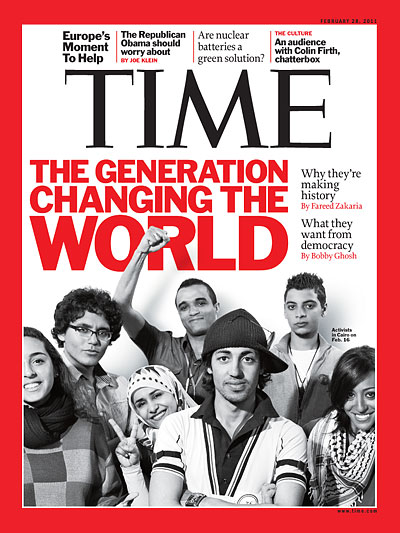
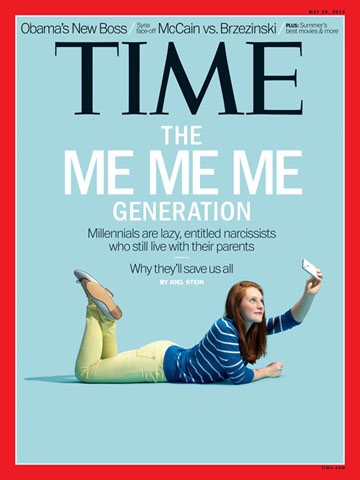
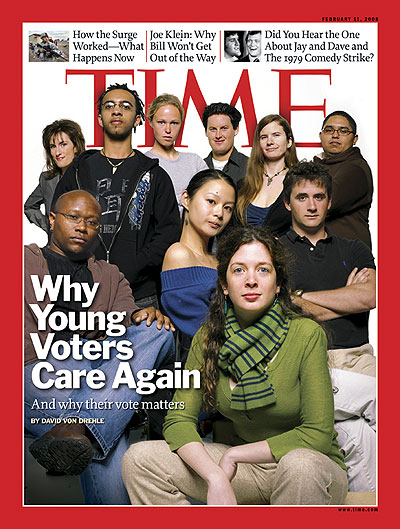
One magazine. Three covers. Five years apart.

Time-Magazine-Cover-Feb-2008 "Why Young Voters Care Again."Time Magazine Cover 2011: "The Generation Changing the World."Time Magazine Cover 2013: "The Me Me Me Generation."

Boy, the young generation sure went to hell in a hurry.

It was reported yesterday that Harvard historian Niall Ferguson, asked at a recent conference about the economic theories of John Maynard Keynes, claimed that Keynes’ theories were self-centered and short-sighted because he was gay:

“Ferguson asked the audience how many children Keynes had. He explained that Keynes had none because he was a homosexual and was married to a ballerina, with whom he likely talked of “poetry” rather than procreated.”

It has been amply noted that these comments were bigoted, sloppy, and fatuous, but it turns out that they’re based on a false biographical premise as well.

Keynes had many same-sex relationships, and in fact was apparently happily and exclusively gay until he was forty years old. But then he met Lydia Lopokova, and fell passionately in love. Multiple sources confirm that his marriage to Lydia was a sexually ardent one. Although I have only  found snippets of their love letters online, one scholar describes them as a “rich cache of intimate, unabashed, and sexually explicit” material “that was matched by the couple’s passionate, adventurous, and uninhibited love life.”

And contrary to Ferguson’s insinuation, Keynes’ childlessness had nothing to do with his homosexuality, or with his personal preferences. Though Keynes and Lydia tried to have children, his beloved wife miscarried in 1927, and was later discovered to be infertile.

Ferguson’s absurd and ugly comments on Keynes bring to mind Howard Kurtz’s chiding of gay NBA player Jason Collins a few days ago. For Kurtz, the incongruity of a gay man having been engaged to a woman was so extreme as to suggest deception. For Ferguson, the idea of a gay man having a satisfying sexual relationship with a woman is simply unimaginable. For each, their assumptions about sexual identity led them to ignore the obvious — Kurtz skipped over Collins’ discussion of his engagement in his coming out article, while Ferguson didn’t bother to investigate a marriage that has been chronicled in great detail many times.

Here is the truth that both Kurtz and Ferguson can’t fathom: human sexuality is complex and varied and diverse, and it exists within a challenging, confusing, and at times punishing social matrix. Some gay people are led by all this to deny their sexuality, while others find that it has the capacity to surprise them — and us.

Update | Ferguson has apologized for his “stupid” and “false” remarks on Keynes.

About This Blog

n7772graysmall
StudentActivism.net is the work of Angus Johnston, a historian and advocate of American student organizing.

To contact Angus, click here. For more about him, check out AngusJohnston.com.