
I’ve just returned home from a trip to downtown for tonight’s march in solidarity with the students of Montreal, and I want to say a couple of things.

For background, it was a march of about three hundred people, give or take. Ebullient, given today’s events to the north, but not raucous. We started at Union Square, meandered around for about an hour and a half, and ended where we began. Pretty standard stuff.

I arrived at Union Square about 8:30, and headed south looking for the march. Within a couple of blocks I caught it circling back toward me, and joined up. Folks were walking on the sidewalks and in the streets, without incident — on the side streets we were mostly facing traffic, and parting when lights turned green. On the avenues we generally hugged the parked cars, taking part of a lane when there was traffic, more when there wasn’t.

Cops occasionally herded us back onto the sidewalks, and we uniformly complied when they did. (I never saw a person refuse to leave the street all night long.) But then when the cops moved on, the people did too, and folks wound up in the streets again.

It was probably something like 8:45 when I saw a white-shirted cop, a supervisor, point at a small group of people in the street a ways ahead, pretty much on their own, and say, “let’s get those kids.” He and a couple of other cops broke into a trot, quietly closing the distance. I yelled to the group to watch out, as did several other people, but we were too far back for them to hear, and so a couple of them got grabbed. When a woman got upset with the cops for busting her friends, she was grabbed too.

I want to be clear: The people I saw arrested weren’t blocking traffic. They weren’t disrupting anything. They weren’t refusing to comply with police orders. They’d just wandered onto an uncrowded street like tens of thousands of New Yorkers do every day. (A little while later, a cop stopped a few of us from crossing an empty crosswalk on a red. He actually said “don’t you see the red light?,” a phrase which, since I’m from here, left me giggling in his face.)

Folks who go to Occupy marches know all about these kinds of arrests. They’re commonplace at this point. But folks who don’t do the Occupy thing — New Yorkers who would never think twice about jaywalking in front of a cop, who’d never even notice that they were doing so — are missing something weird and unsettling in the life of the city.

I said earlier that the mood of the march was ebullient, but after every arrest, every small, unnecessary act of police violence, things turned uglier and angrier. At one point, on St. Marks Place, cops were being rough with a guy on the ground, and a bunch of us were taping to make sure that there was a record. A cop with a steroid body suddenly flew out of the group around the guy and started grabbing people, shoving them, telling them to keep walking. (None of us were blocking the sidewalk or interfering with the cops in any way.) The cop kept on that way for half a block at least, just putting his hands on whichever protesters were in arms’ reach, including people who had no idea what he wanted from them. He was clearly wound up, and physically aggressive in a completely unprovoked way, but he wasn’t out of control — he was a guy who wanted to do some shoving, and he knew for sure that he could do it without consequences.

And something occurred to me as he was doing it. Here’s someone walking down a New York City street, just assaulting people. Just pushing and shoving and yelling. He knocked one guy’s phone out of his hands, and almost sent a woman sprawling. And this miscreant was surrounded by cops. And they did nothing. Didn’t intervene, didn’t stop him, didn’t try to calm him down. They just let their guy go ahead and blithely break the law right in front of them.

If you want to know why people get in cops’ faces on these marches, this is why. If you want to know why people get amped up, this is why. If you want to know why folks chant “fuck the police,” this is why.

Dharun Ravi was sentenced late this morning, to 30 days in jail, three years probation, community service, counseling, and a $10,000 fine.

Is this justice?

Many people are saying no. Compared to the ten years (or, depending on who you ask, several times that) which he could have received, it certainly seems light, and it’s left a lot of folks I respect quite angry. But I’m not sure I’m among them.

Let me start by saying that I consider what Ravi did a serious crime. He spied, he attempted to spy again, he tried to share private sexual acts with the internet. He did all this in such a way as to tip off his victim to the abuse, and he did it with a giddy indifference to the pain he was causing. In the wake of Clementi’s suicide he compounded his crimes by attempting to destroy evidence and asking others to do the same. And even after he was tried and convicted he displayed an ugly, dismissive refusal to come to terms with his acts.

In an impact statement read to the court this morning, “MB” — the young man who Ravi watched with Clementi — offered a powerful account of the “embarrassment, emptiness and fear” Ravi had put him through:

For the past year I was filled with anxiety and hurt as the trial approached. I felt like I was continuously walking in a mine field, waiting for the sudden explosion. I kept my secret from my family because I did not want them to go through the same emotional turmoil that I was experiencing. With each news article I read or saw on television, this feeling of uncertainty and unsteadiness only became worse.

From the beginning, MB said, he “just wanted [Ravi] to acknowledge that he had done wrong and take responsibility for his conduct, but instead Ravi and his lawyers compounded his trauma:

I do not believe that he has taken responsibility for his conduct, and to this day he seems to blame me for the actions he took. His attorney made it very clear at the trial as did Mr. Ravi in his gratuitous media appearances that I was to be his scapegoat. He wants everyone to believe that his conduct was prompted on each occasion by his concern that I may be a thief and his possessions were at risk as a result of my presence. He even went to go so far as to say that when he learned about Tyler’s death, he thought I might have been involved so videoing me might have been a good thing.

Ravi does not bear responsibility for Clementi’s suicide, but he does bear responsibility for his actions both before and after that night, and those actions have been appalling.

But is he getting off easy? I’m not sure.

As disgusting as what Ravi’s actions were, for him to even have been arrested for them is extremely unusual. Untold numbers of college students have treated gay roommates as badly or worse and never been made to pay for their crimes at all.

In contrast, Ravi has been forced to leave college. He has been entangled in the legal system for nearly two years. He’ll go to jail for 30 days, spend three years on probation, and pay ten thousand dollar fine on top of the presumptive hundreds of thousands his family have paid in legal bills. And unless he somehow manages to get it set aside, he’ll have a felony record for the rest of his life.

Compared to what he could have received, this may not seem like much. But I think it may be enough, and here’s why.

First, there’s the question of prison itself. While I’m not an abolitionist, I do believe that in most cases sentencing someone to prison does them — and society — more harm than good. I can’t imagine that Ravi would walk out of a year in state prison a better person or less likely to re-offend.

And then there’s the question of setting an example. As I said above, I don’t regard Ravi as a particular outlier. The kind of crime that he engaged in is prosecuted rarely not because it is rare, but because it’s not treated as a serious crime. Moderate, rather than draconian, punishment is the best way to change that perception.

Finally, there’s the issue of culpability. As the judge noted in his sentencing hearing, Ravi wasn’t convicted of causing Clementi’s death, and in fact the evidence for a link between Ravi’s acts and Clementi’s suicide is largely inferential. I’m not saying that Ravi didn’t contribute to Clementi’s decision, but I will say that we don’t know exactly how — or how much — he did.

Ravi did something horrible, and his life has been pretty much ruined. I think it’s enough.

To me, one of the most disturbing provisions of Bill 78, Quebec’s new law criminalizing participation in the province’s ongoing student strike, is one that has received virtually no attention in the media. Here’s an excerpt from the English-language version of Section 18:

“If the [Education] Minister notes that [a college or university] is unable to deliver instructional services as a result of a failure by a student association to comply with an obligation imposed by this Act, the Minister may … order the institution to cease collecting the assessment established by the student association or any successor student association and to cease providing premises, furniture, notice boards, and display stands to the student association or any successor student association free of charge.

“The cessation is effective for a period equal to one term per day or part of a day during which the institution was unable to provide instructional services as a result of the failure to comply.”

What does this mean? It means that if Quebec’s education minister concludes that a campus student association contributed to a disruption of classes, he or she will have the power to cut that student association’s funding, at a rate of one semester’s funding for every day (or part of a day) disrupted.

So let’s say that at four o’clock one afternoon the provincial government announces a new tuition hike, and the student association calls a rally that evening. Because Bill 78 requires organizers of any protest to provide police with eight hours notice, the rally — even if it’s peaceful and non-disruptive — represents “a failure by a student association to comply with an obligation imposed by” the law.

And let’s say that as the rally is breaking up, a group of students decide, on their own, to march off campus. They take over a street, causing a traffic jam. A professor gets caught in that traffic jam and can’t make it to class. That professor is thus rendered “unable to to deliver instructional services.”

According to the text of the law, that student association could have its student activity fee funds withheld for an entire semester. All funds, for all the association’s activities, gone.

And note how quickly the length of the suspensions mount. If, say, a student association officer calls for a blockade that drags on for two weeks, and the Education Minister finds the student association liable, that student association would see its funds withheld for seven years.

For the next seven years, that campus would — because of the actions of one officer — have no student association funding whatsoever. No money for officer stipends, or support staff, or printing. No office space, no speakers or concerts or other programming. And any clubs funded through the association would be similarly cut off — the women’s center, the cultural unions, the chess club. All gone.

And under the law the students of the campus would be prohibited from establishing another student association to replace the one they’ve lost. If a group of students, years later, after everyone involved in the original incident had long since graduated, wanted to set up a new student association, and the students of the campus voted overwhelmingly to fund the new group through their fees, they wouldn’t be allowed to.

Like so much in this law, it’s really quite astonishing.

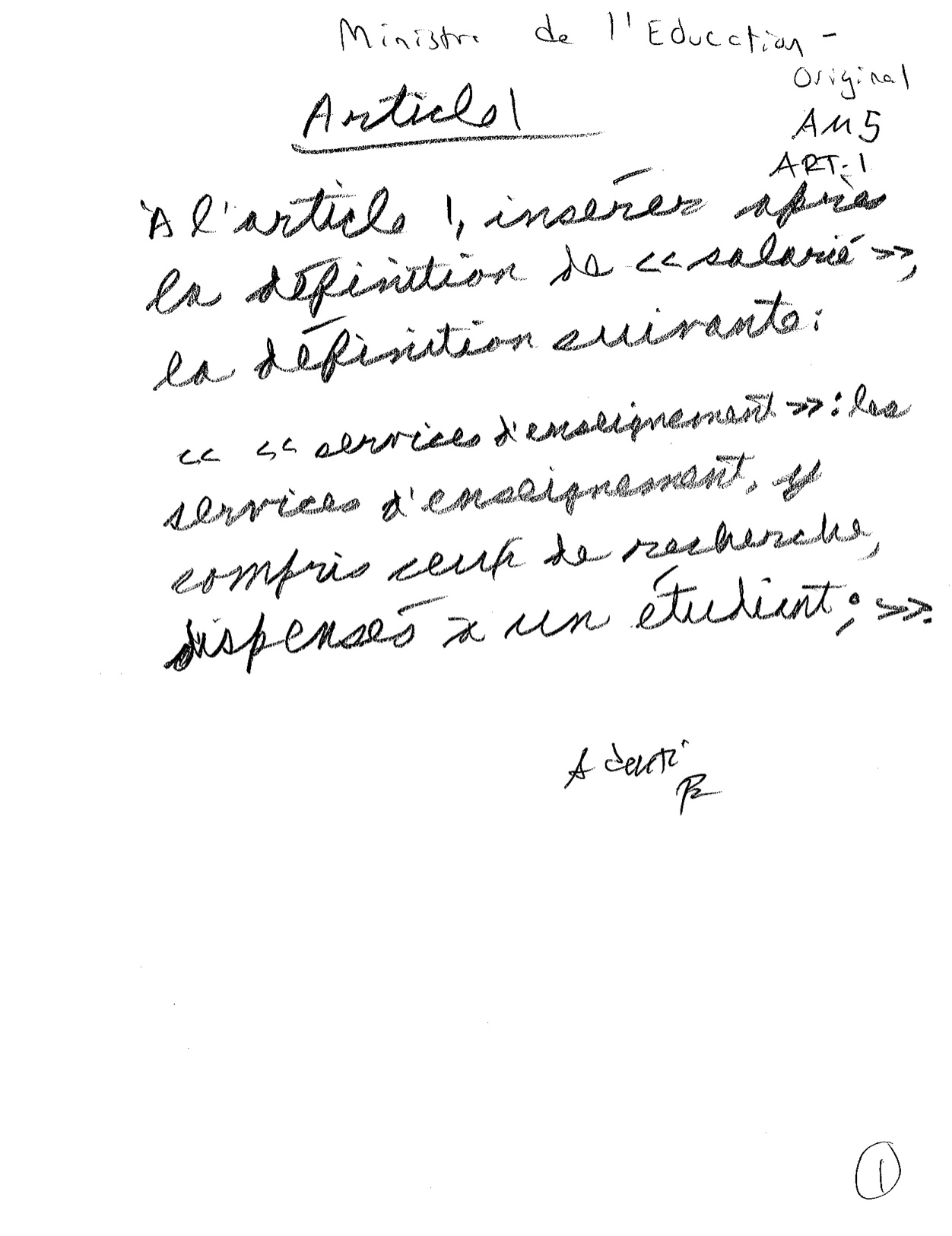
Call me naive, but I find it flabbergasting that major amendments to Bill 78, Québec’s new law criminalizing student strikes, were passed and inserted into the official record of the provincial legislature as hastily scrawled handwritten notes.

Bill 78 was drafted on Thursday, introduced on Thursday night, and debated for 21 straight hours before passage. The amendments in question were adopted on a single party-line vote, as was the bill itself. (The opposition offered a number of laudable amendments, in typewritten form, but all were rejected by the majority.)

What makes this haste extraordinary is the sweeping character of the bill, which regulates not only student strike actions but also any demonstration of any kind at which more than fifty people are in attendance. Several provisions of the bill are so vague that critics of the government have expressed doubt that they can be coherently interpreted — and when asked about these provisions, government officials waved them off with airy expressions of confidence in police and judges’ judgment.

This is big stuff, in other words. A major, controversial law in a delicate area. And it was written and passed on the fly.

You can’t look at these scribbled documents, festooned with false starts and marginal insertions — documents which, again, as of this morning make up a part of the official public text of a law which is even now in force in a province of eight million people — and have any confidence in the sobriety of the process that produced them. You can’t look at these amendments and believe that their authors took the fundamental questions of freedom of speech and assembly at stake with any kind of seriousness.

It’s an embarrassment.

“I read once, passingly, about a man named Shakespeare. I only read about him passingly, but I remember one thing he wrote that kind of moved me. He put it in the mouth of Hamlet, I think, it was, who said, ‘To be or not to be.’ He was in doubt about something — whether it was nobler in the mind of man to suffer the slings and arrows of outrageous fortune — moderation — or to take up arms against a sea of troubles and by opposing end them. And I go for that. If you take up arms, you’ll end it, but if you sit around and wait for the one who’s in power to make up his mind that he should end it, you’ll be waiting a long time.

“And in my opinion, the young generation of whites, blacks, browns, whatever else there is, you’re living at a time of extremism, a time of revolution, a time when there’s got to be a change. People in power have misused it, and now there has to be a change and a better world has to be built, and the only way it’s going to be built is with extreme methods. And I, for one, will join in with anyone — I don’t care what color you are — as long as you want to change this miserable condition that exists on this earth.”

—Malcolm X, speaking at Oxford University on December 3, 1964, eighty days before his death.

About This Blog

n7772graysmall
StudentActivism.net is the work of Angus Johnston, a historian and advocate of American student organizing.

To contact Angus, click here. For more about him, check out AngusJohnston.com.