
You are currently browsing Angus Johnston’s articles.
The DREAM Act is scheduled to come to a vote in the Senate this Wednesday, if all goes according to plan, and though the consensus is that defeat is far more likely than passage, it’s still too early to call it. Last week sponsor Dick Durbin released a new, scaled back version of the bill, and it’s possible that his changes will bring some new votes on board.
In my last vote count post, I said that there were forty-seven senators definitely in favor of the DREAM Act, and another thirty-seven definitely against it. One of those thirty-seven, Kay Bailey Hutchison, is still regarded as a possible “get” by some activists, but she reiterated her opposition to the bill over the weekend. She won’t be voting yes. On the other side of the column, Republican Richard Lugar’s staff is now saying that he has to review the most recent changes before committing to supporting the bill.
That leaves seventeen votes at least theoretically in play, and the DREAMers need to pick up fourteen of them to win.
Lets take a look at those seventeen…
I listed three senators as almost certainly against the bill in my last post, and one of those three — John McCain — has since come out formally against it. I’ll remove him from the next update. Neither Max Baucus nor George Voinovich has made any new statement.
Last time around I considered Kent Conrad (D), Byron Dorgan (D), Kay Hagan (D), Joe Manchin (D), Olympia Snowe (R), and John Tester (D) likely against. Dorgan (“still undecided”) and Manchin (“reviewing the legislation”) made non-committal statements in an article published Friday, while Tester’s spokesman told The Hill that he’s “inclined to oppose the bill” as he has in the past.
I described Sam Brownback (R), Susan Collins (R), Chris Coons (D), Mary Landrieu (D), and Lisa Murkowski (R) as unknowns. None have since made a public statement, but since there’s really no reason to doubt that Chris Coons will vote yes, I’ll bump him up.
Coons and fellow Dems Claire McCaskill and Jim Webb are now in my “likely yes” category. I’ll put Richard Lugar here too, until we hear more.
So that’s it. Of the sixteen left on the list, nine seem to be leaning, weakly or strongly, against the bill, which means that supporters need to hold all the neutrals and positives while flipping six of the negatives to turn the DREAM Act into law.
December 7, noon | A named White House source told reporters this morning that the WH believes they will need seven Republican votes to get the DREAM Act through the Senate. The good news? This suggests that they are confident that Democrats McCaskill, Webb, Coons, Landrieu, and Manchin, as well as three of Conrad, Dorgan, Hagan, Tester, and Baucus, are willing to vote yes. The bad news? I can only come up with six plausible Republican “gets” — Bennett, Lugar, Murkowski, Brownback, Snowe, and Collins.
12:10 | One note on the above — we shouldn’t assume that because the White House thinks they can count on the above Dems, that means they’ll all vote yes when the time comes. There are undoubtedly some senators who are willing to vote yes if needed, but would prefer not to if they don’t have to. Someone like Manchin, in other words, might well be willing to be the 60th yes vote, but not the 57th.
Feel free to follow Student Activism on Twitter or Facebook, if you like. You can also read this essay in German, if you like.
December 8 Update: Twitter released an official statement on the Wikileaks trending controversy this afternoon. I’ll have a full response soon, but for now I’ll just say that it doesn’t seem to me that it fits the data I’ve presented here.
December 11 Update: This has been an absurdly busy week in the world of things-this-blog-is-interested-in, but here it is at long last: How Twitter Kept Wikileaks from Trending, and Why.
Okay, this is a little ridiculous.
A week ago, I wrote a piece dismissing the idea that Twitter was actively working to keep Wikileaks out of its trending topics lists. This morning, I wrote a followup in which I continued to express skepticism that any monkey business was going on, but acknowledged that the data were really kind of weird.
Now I’ve gone back and compared long-term traffic patterns for “Sundays,” one of today’s big global trending topics, with those of “Wikileaks,” and I have to say I’m kind of flabbergasted. If the data I have are accurate, something very very strange is going on.
Here. Let me show you.

(click each chart to view full size)
This is the last 180 days of Twitter traffic data for “Sundays,” taken from the Trendistic website. We can see that the word peaks every weekend — unsurprisingly — and that it’s grown only slightly in volume since mid-July. With the exception of today’s large spike, the biggest weekend bump for Sundays was only about double the volume of the smallest.
Looking at trending topic data from Twend It, however, we see that Sundays has trended four times in the last two months — on September 26, October 18, November 21-22, and today. The first two of those “trend incidents” took place on completely ordinary days for Sundays (measured by total volume), and the third, which lasted much longer, took place on a weekend when traffic for the phrase spiked over a longer period of time, but no higher, than it had in the past.
Why is this significant? Because, as I wrote this morning, Twitter claims that a phrase’s novelty is a major predictor of whether it’ll trend or not. But “Sundays” is the opposite of novel — it’s a term that spikes once a week, every week, in pretty much the same way at pretty much the same time. By the criterion of novelty, Sundays should be at a huge disadvantage versus hundreds of other terms — including, yes, Wikileaks — in making the trending topics list.
Take a look at the Trendistic chart for Wikileaks over the same 180-day period and you’ll see what I’m talking about.
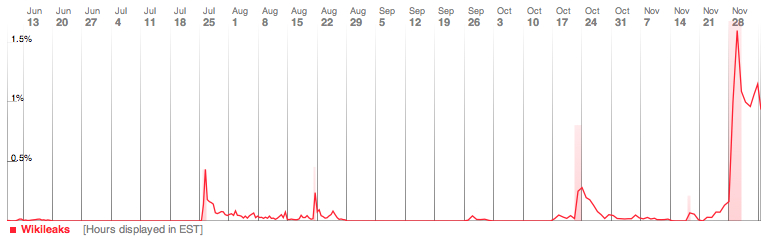
The first thing that jumps out, obviously, is that Wikileaks’ traffic pattern is far less regular than Sundays’. There are a few large-ish spikes, some extended periods of lower but still significant activity, and a bunch of long stretches when nothing’s going on at all.
If we look a little closer, we see that there’s very little happening here until the first spike, which comes on July 26. Activity then tails off gradually over the next month, with a second, smaller spike on August 21, and then almost nothing for two months. There’s a third spike — slightly smaller than the first, but much longer lasting — beginning on October 24. Traffic begins rising again in mid-November, spikes on November 29 at a volume four times that of the August peak, and has since settled in at a plateau about two-thirds the height of the November 29 spike ever since.
If you asked me, I’d say — just off the top of my head — that there are three or four obvious places on this chart where I’d have expected Wikileaks to trend, with the most recent being the most obvious. But if we look at Twend It, we see that it trended for thirty-eight hours over the course of three days at the time of the July spike, for less than two hours on August 21, and never again since.
Let me repeat that. Wikileaks trended on Twitter for three days following the first spike on the chart above, for two hours at the time of the smaller spike right next to it, and not at all for the third similar spike or the huge one that’s still going on now.
Weird, right?
But no. That’s not the weird part. This is the weird part.
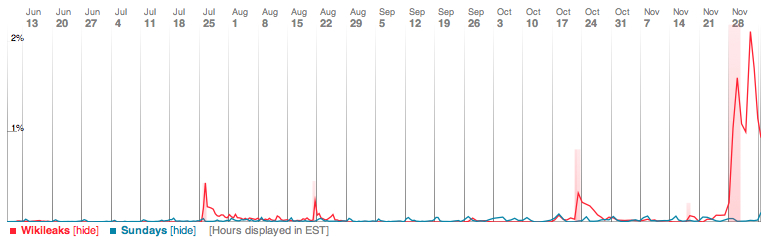
This chart tracks Sundays and Wikileaks over the last 180 days, with each term’s volume drawn to scale. The red spires? Wikileaks. The blue dust at the base of those spires? Sundays. The tiny blue uptick in the lower left hand corner of the chart has had Sundays trending for more than twelve hours today, while Wikileaks has been completely dark since August.
What the hell is going on here?
As I said in my last two posts, I don’t care that much about trending topics lists. I’m a big believer in online organizing, but I just don’t think getting your cause to trend is all that important in the grand scheme of things. But this, like I say, is ridiculous.
December 6, Morning | Be sure to read the full exchange between myself and Josh Elman of Twitter in comments — it’s illuminating in its own way. There’s a bunch of other important new info and analysis in the comments thread, too. I’ll be continuing to follow this story on Twitter over the course of the day, and I’m hoping to have a full new post up sometime this afternoon.
Also, you know, feel free to check out the rest of the site. Welcome!
December 6, Late Morning | Blogger Bubbloy has a post up that covers similar ground to this one in a complementary (and complimentary!) way. Be sure to check out the discussion of the “oil spill” trending topic in the second update.
Update | Click here for an update to this post. The more I dig, the more I think something weird is going on here.
A week ago I wrote a piece on why the hashtag #Wikileaks wasn’t appearing on Twitter’s trending topics lists, concluding that Wikileaks’ failure to trend was an artifact of an actually-quite-reasonable-really algorithm, and shouldn’t be taken as evidence of anything nefarious.
Okay. That was then. But in the intervening week, Wikileaks has seen a truly staggering amount of traffic on the site, and still hasn’t trended once.
How staggering? This staggering:
Back in the summer, the title of the movie Inception peaked at 0.4% of Twitter traffic, soon stabilizing at about half that. It trended for a month and a half. Wikileaks has broken 2.0% of total traffic twice in the last week, and hasn’t yet dipped below Inception’s all-time high.
Want more? Here’s more. Wikileaks had more traffic than “world aids,” the week’s longest-trending phrase, for all but three hours of the week. It out-trafficked Bieber and Obama by wide margins. It was more popular than Jesus by an order of magnitude. At its peak, it appeared more frequently on Twitter than the word “or.”
And here’s my favorite … on five separate occasions in the last week, including eight hours on Friday and two hours on Saturday, “wikileaks” was getting more traffic than “twitter.” On Twitter.
Okay. So does all this prove that Twitter is blocking Wikileaks from trending?
No.
Not exactly. Not quite.
For one thing, as I posted last week, Twitter’s trending topics don’t — and shouldn’t — just reflect raw traffic. As the company explained back in May, when they overhauled their algorithm, it’s designed to catch “topics that are immediately popular, rather than topics that have been popular for a while or on a daily basis.” Since Wikileaks has trended before, it’s now got a higher bar for trending again. (This explains why the alternate Wikileaks hashtag #cablegate trended for a total of 22 hours last week, despite having consistently lower traffic than Wikileaks itself. Because it was a new tag, it got the algorithm’s attention.)
For another thing, not all tweets are equal in Twitter’s eyes. As the site’s trending topics FAQ notes, they take a dim view of folks who try to game the TT list by flooding the service. “The most important thing,” they say, “is to make sure your Tweets are genuine thoughts or impressions and not attempts to insert yourself into a trend.”
This is likely a partial explanation for the incredible trending run that Inception had this summer. Inception wasn’t just a popular movie, it was a controversial and confusing one — one that got people discussing, not just tweeting. I haven’t gone back and checked, but I have a very strong suspicion that an unusually high proportion of Inception’s tweets during its reign were brand-new content — much higher than that of recent Wikileaks tweets.
It’s also possible, given Twitter’s warnings on its FAQ page against “repeatedly tweeting the same topic/hashtag without adding value to the conversation in an attempt to get the topic trending/trending higher,” that efforts to get Wikileaks to trend — or even discussions of why Wikileaks wasn’t trending — could have pushed the topic down on the TT lists. (Which means, for instance, that the folks who are tweeting about Wikileaks’ failure to trend under the #thingsimiss hashtag are likely hurting Wikileaks’ chances of trending.)
Finally, I have to at least acknowledge Twitter’s denial that they muck with the trending topics list for political purposes. A few days ago, a similar controversy arose in relation to the failure of #demo2010, the hashtag of Britain’s student protesters, to trend in that country. Asked for comment, a Twitter spokesperson told The Guardian that there was “absolutely no truth” to the charges. “We have not,” he said, “and will not, do anything to stand in the way of people using Twitter for the open exchange of information.”
So does that settle it? A week ago I thought so. But I have to admit that the sheer scale of the Wikileaks traffic since then gives me pause.
I still think the vast majority of TT conspiracy theories are bunk. Twitter wasn’t censoring #demo2010, I’m certain. There’s no evidence that it censored #cablegate. It’s not censoring #imwikileaks, as some have charged — that hashtag just hasn’t taken off in any serious way.
I’m also unconvinced that Wikileaks trending on Twitter would be all that big of a deal. Huge numbers of people are participating in Wikileaks discussions on the service — if the goal was to stifle conversation, it failed. Trending on Twitter is an easy measure of a subject’s influence, and in a weird way a sort of badge of honor, but it’s not obvious to me that it has a huge effect on a story like this.
To be honest, this is another reason that I tend to doubt that Wikileaks was censored — to do so would pose a huge risk to Twitter’s credibility with its audience, and for very little reward.
But if Wikileaks’ failure to trend is an artifact of Twitter’s algorithm — and that’s still my default guess — it’s a really screwed up algorithm. Because Wikileaks has been the biggest story by far on Twitter this week, by any measure. It’s a huge story. It’s an important story. It’s a breaking story. It’s an evolving story.
It’s the very definition of a trending topic.
So why isn’t it trending?
Update | As I noted at the top of this post, I’ve done a visual comparison and anaylsis of traffic for “Wikileaks” and “Sundays.” You can find that post here, and I expect you’ll find it as startling as I do.
This site’s top ten most-read posts of the last week. Numbers one and ten are my favorites, and number two is going to be getting a major followup later today.
1. Remembering Rosa Parks … And Claudette Colvin
Things we know, and things we don’t know, about the civil rights movement.
2. Why Isn’t #Wikileaks Trending on Twitter, and Should We Care?
I take on the charges that Twitter is messing with its trending topics list.
3. Julian Assange: Condoms, Rape, and “Sex By Surprise”
Unpacking the various claims about what Assange has been accused of.
4. Universities Warn Students: Reading/Discussing Wikileaks Could Cost You a Future Government Job
Columbia and Boston University tell students not to tweet about the leaked cables.
5. DREAM Act Whip Count Update
How the DREAM looks in the Senate. (See also The Latest on the DREAM Act)
6. On the “Why Can’t Whites Have a White Student Union?” Question
An old post brought back to life by the post below.
7. Fake White Student Union Flyers at West Chester University
Anti-racist students choose a bad approach.
8. A Twisted “History of Political Correctness”
What right-wingers see when they look at the left. Seriously creepy.
9. The Latest on the British Student Movement
Things are getting interesting over there.
My favorite post title ever.
The Office of Career Services at Columbia University’s School of International and Political Affairs emailed students this week to say that a SIPA alum working at the State Department wanted them to know that posting or discussing Wikileaks documents on social media sites like Facebook and Twitter could jeopardize their chances of getting work with the federal government in the future.
Going further, an assistant dean at Boston University’s law school contacted students there to let them know that even reading Wikileaks cables could “be seen as a violation of Executive Order 13526,” and thus imperil federal employment. After warning them — in all caps — not to post links or comments on the documents online, she helpfully reminded them that “polygraphs are conducted for the highest levels of security clearance.”
Update | You’re gonna love this. Gary Sick, a senior faculty member at Columbia’s SIPA, has blogged about Wikileaks twice in the last week. Both blogposts discussed the contents of the leaked cables, and one even linked to the cablegate archive — the same archive that the university has warned students not to discuss. But wait, it gets better: SIPA’s own website currently includes a prominent link to Sick’s blog.
Second Update | Here’s a post from a student-run blog at SIPA eviscerating the school for warning students not to discuss Wikileaks. Key quote: “Seriously, SIPA? … You claim to provide committed students with the necessary skills and perspectives to become responsible leaders. Apparently that means curtailing their academic freedom and teaching them how to bury their heads in the sand.”
Third Update | A State Department spokesman tells the Huffington Post that the department has “given no advice to anyone beyond the State Department to my knowledge.” On the other hand, the Columbia SIPA email credited “a SIPA alumnus who is working at the State Department” for the advice.
December 7 Update | Columbia’s School of International and Political Studies has repudiated the advice in the email. Says Dean John Coatsworth: “SIPA’s position is that students have a right to discuss and debate any information in the public arena that they deem relevant to their studies or to their roles as global citizens, and to do so without fear of adverse consequences.” Even better, SIPA professor Gary Sick — whose blogposts on Wikileaks I noted above — says that any international relations SIPA student who hasn’t “gone looking for the [Wikileaks] documents that relate to their area of study” doesn’t “deserve to be a graduate student in international relations.”

 studentactivism.net
Recent Comments