
You are currently browsing the category archive for the ‘Campus Protests’ category.
Fears of massive student protests coordinated with an upcoming general strike have led the University of Puerto Rico to shut all eleven of its campuses for an entire week.
The Puerto Rican government announced plans late last month to lay off sixteen thousand government workers in an attempt to close a $3 billion budget deficit. Since the announcement, students and labor have taken a number of protest actions, with student strikes shuttering several UPR campuses in recent weeks.
Fearing similar actions in the lead-up to an island-wide general strike slated for Thursday, and hoping to “calm things down and to allow the university community to think peacefully and constructively about the problems facing Puerto Rico,” the university’s president announced a weeklong system-wide “recess” beginning on Monday.
October 15 update, 11:15 am | A hundred thousand protesters are expected to participate in this morning’s largest rally in support of the Puerto Rican general strike.
11:25 am | Reports from Twitter, citing local news coverage, say that students from the University of Puerto Rico’s school of law have marched onto the Luis A. Ferré Expressway, a major highway into San Juan, shutting it down. Follow #ParoPR for Twitter coverage of the day’s events, most of it in Spanish.
October 16 update | Students occupied the Luis A. Ferré Expressway for eight hours yesterday, maintaining their position long after the primary protest march had ended. They were eventually convinced to disperse after a personal appeal from the elderly Puerto Rican nationalist Rafael Cancel Miranda. [Spanish language news report here, Google automatic translation here.]
Nearly three hundred Berkeley students kept the campus’s Anthropology library open from its scheduled closing time on Friday afternoon until 24 hours later, in protest of a new policy closing campus libraries on Saturdays.
Eighty students stayed overnight in the library, and they were joined by others in the morning. Some of the group studied, while others held teach-ins on the campus budget during the day on Saturday.
There are more than twenty libraries on the Berkeley campus, and administrators have eliminated weekend hours for at but two of them as a cost-saving measure.
October 13 update: Good on-the-scene report on the library takeover from Alternet. Here’s a taste:
What characterizes this movement (or maybe, what characterizes this as a movement), is the readiness of students, staff, and faculty to mobilize, as well as a diversity of tactics and strategies, coming from a myriad of organizations, bodies, coalitions, and mutually interested individuals who may be involved in none of those at all. This is the face of a new student movement, a movement invested in our spaces of learning, and one which demands to control the terms and conditions of our education.
Here’s a story with a happy ending.
Two weeks ago, Jacob Miller, a graduate student at the University of Arizona, was arrested on campus. His crime? Chalking.
Miller, along with a number of other students, had been writing slogans and drawings on the university’s sidewalks in chalk to promote a rally protesting the commercialization of higher education. A university employee called the police, and Miller was arrested for criminal damage and disturbing an educational institution.
The two charges were each class one misdemeanors, and carried a combined maximum penalty of a year in prison and $5,000 in fines. Miller had been identified through video surveillance footage.
The arrest sparked a huge uproar on campus. The following weekend a group of students began buying sidewalk chalk in bulk and handing it out by the bucketful on campus. Early on Monday morning a Poli Sci major named Evan Lisull was was arrested for writing the slogans “Chalk is Speech” and “Freedom of Expression” on campus sidewalks.
Lisull’s arrest seemed likely to escalate the situation further, but instead it brought the university to its senses. On Monday afternoon UA president Robert Shelton instructed campus police to drop all charges against the two students, and declared that the university would no longer treat chalking as a criminal matter.
UA said at the time that it would in the future handle chalking complaints “as possible Code of Conduct violations through the Dean of Students Office,” but soon it was in full retreat, announcing this week that chalkers would not face disciplinary consequences of any kind.
Chalk one up for … well, you know.
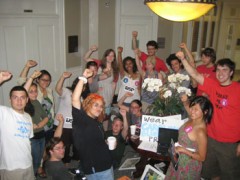 I’m still looking for more news on the windup and aftermath of the campus occupation that ended yesterday at the University of California at Santa Cruz, but in the meantime I want to clear something up.
In an article published yesterday in City on a Hill Press, a UCSC student newspaper, one of the students sitting in at the Graduate Commons building said that UCSC had just “broken a record for longest student occupation of a building to take place in America post-1960s.” A couple of days ago, an occupation spokesperson made a slightly less extravagant version of the claim, saying that the Commons sit-in was “one of the longest student occupations in many, many years.”
So is it true? Was the UCSC occupation the longest campus building takeover since the heyday of student activism in the sixties?
Well, no. Here are five that were longer, one of which — the UNC sweatshop sit-in pictured above — happened just a year and a half ago:
- At Harvard in 2001, a sit-in demanding that university employees be paid a living wage lasted for three weeks.
- Another living wage sit-in, this one at Washington University in 2005, lasted for eighteen days.
- In May of last year, students protesting the University of North Carolina’s ties to sweatshop garment makers occupied the lobby of their administration building for sixteen days.
- In 1989, students occupied the administration building at Wayne State University for either eleven or twelve days in response to racist incidents on campus.
- The Afrikan Student Union at Ohio State University occupied the offices of the campus president for eight days in 1998 in protest of proposed changes in the Office of Minority Affairs.
Claims that a certain protest was the biggest, or longest, or most dramatic, since the sixties are common, and almost always wrong. They’re common because we think of the sixties as being the last time there was a real student movement in the United States, and they’re wrong because their conception of the history of American student activism is wrong.
I knew about a couple of the campus protests listed above before I sat down to write this post, but most of them I uncovered by Googling. They don’t add up to anything like a comprehensive list of the last few decades’ multi-week campus sit-ins. They represent a small slice of a story that’s mostly gone untold in recent years — the story of American students’ persistent ongoing local campus organizing. I mention them not to mock the UCSC folks or belittle their protest, but because the more activists know about past struggles, the better equipped they’ll be to take on the future.
Right about the time that I was posting yesterday’s piece on the UC Santa Cruz commons building occupation, that sit-in was coming to a voluntary end.
So far there’s been no statement on the end of the occupation by the students who took over the building, and no reporting on the development from UC Santa Cruz’s student newspaper or Santa Cruz Indymedia, but an article in a local paper suggests that the decision to leave came at the request of the graduate student organization that owns the building.
Thanks to @dettman on Twitter for passing on the news late last night.
October 16 update | Another building occupation began last night at UCSC.

 studentactivism.net
Recent Comments