
You are currently browsing the category archive for the ‘Students’ category.
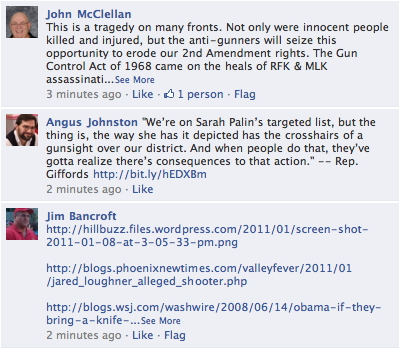
The comment thread from Sarah Palin’s Facebook post on yesterday’s Tucson shooting, as it looked this morning at 8:35 am:
Same thread, six minutes later:
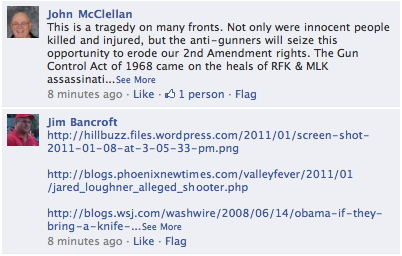
The comments from which the above Giffords quote was taken were made on MSNBC in March 2010, and can be found in full here.
Update | I should say a bit about why I posted that quote on Palin’s site, I guess. Commenters there have gone far beyond the (reasonable) claim that Palin’s rhetoric had no direct connection to yesterday’s tragedy — they’re claiming that Palin used no violent rhetoric at all, and that the current criticism of Palin’s speech is just after-the-fact piling on. I think that’s not just false, but demonstrably false, and it seemed to me that Gabrielle Giffords’ own words, spoken almost a year ago, were the best way of showing that.
The question of what role Palin’s words and images — and those of her friends and allies — played in yesterday’s events will be debated at length in the weeks to come, and may never be satisfactorily answered. But it is a fact that Gabrielle Giffords was the target of a sustained campaign of political violence and harassment in the last year. It is a fact that she drew explicit connections between that campaign and the rhetoric of Sarah Palin. And it is a fact that she called for such reckless, inciteful speech to stop.
It’s a fact that Representative Giffords criticized Sarah Palin’s “gunsight” graphic ten months ago. And it’s a fact that Sarah Palin left that graphic up online until yesterday afternoon, when Giffords lay in critical condition in a hospital — and a federal judge, a Congressional staffer, an idealistic nine-year-old, and three other Americans lay dead.
It’s a fact.
Second Update | It’s worth noting that Palin’s people are perfectly happy to allow extremist rhetoric from the right to stand in comments at her facebook site. Take this comment, posted hours before mine and still (as of 10:48 am) up, for example:
“This guy was a Hitler worshipper, a pure socialist. If you want to blame anyone, try the left wing agenda. She was against the Obamacare and all the radical left. She was a moderate democrat. That is what made her a target of the left. I would not put it past Obama and his regime to have perpetrated this horrific action. Chicago politics at it finest.”
Let America be America again.
Let it be the dream it used to be.
Let it be the pioneer on the plain
Seeking a home where he himself is free.
(America never was America to me.)
“Are you afraid? Are you fearful today?”
“You know, I’m not. We’ve had hundreds and hundreds of protesters over the course of the last several months. Our office corner has really become an area where the Tea Party movement congregates. And the rhetoric is incredibly heated. Not just the calls, but the emails, the slurs. So things have really gotten spun up. But you gotta think about it. Our democracy is a light, a beacon really around the world, because we effect change at the ballot box, and not because of these outbursts — of violence in certain cases, and the yelling, and it’s just … you know, change is important, it’s a part of our process, but it’s really important that we focus on the fact that we have a democratic process.”
“I think it’s important for all leaders, not just leaders of the Republican Party or the Democratic Party … community leaders, figures in our community to say, ‘Look, we can’t stand for this.’ I mean, this is a situation where people really need to realize that the rhetoric, and firing people up, and even things … For example, we’re on Sarah Palin’s targeted list, but the thing is, the way she has it depicted has the crosshairs of a gunsight over our district. And when people do that, they’ve gotta realize there’s consequences to that action.”
“In the years that some of my colleagues have served, twenty, thirty years, they’ve never seen it like this. We have to work out our problems by negotiating, working together, hopefully Democrats and Republicans.”
–Rep. Gabrielle Giffords, March 25, 2010.
Update | Comments closed.
Naomi Wolf just went on BBC Radio to defend her recent article calling for mandatory disclosure of the identities of people who bring rape complaints. The interview provoked a firestorm of criticism on Twitter as it was happening — it was the latest in a series of public statements by Wolf that have shocked and disappointed her former feminist allies.
Much of what Wolf said today repeated things she’s said in the past, but some of it was new, and worth examining. A few random thoughts follow, and then some conclusions.
She said on several occasions that the policy she’d advocating is a “Western” one, and wouldn’t necessarily be applicable to countries in the developing world where the stigma of rape is greater. But certainly the stigma of rape varies greatly within Western societies as well as non-Western ones. Her suggestion that her proposal should be tailored to local conditions directly contradicts, it seems to me, her insistence that it should be adopted throughout the West.
Another oddity was her decision to double-down on her widely criticized comparison of the stigma attached to rape to that which attached to homosexuality and abortion in the past. It was only, she said, because people came out of the closet as gay or as women who had had abortions that those stigmas began to fade.
The obvious rejoinder to this is one that has already often been made — that those people came forward voluntarily, and that those who were forced to disclose against their will often suffered mightily for it. But there’s another, deeper way in which this argument fails:
The same process has occurred, and is occurring, with regard to rape.
To have been sexually assaulted is seen as far less shameful now than it was in the past, and a major reason for that is the willingness of women and men to come forward and describe their experiences. The cultural process that Wolf takes as her model in the case of abortion and homosexuality has an exact analogue in the case of sexual assault, and it argues for a policy that is the precise opposite of the one she’s put forward.
So why is she advocating this change, in such a huge break from standard feminist policy and her own past views? A telling moment came when she described reporting a rape to the police as “a public act which should have major consequences.” Such a decision has major consequences today, of course. It’s not an easy or inconsequential thing to do, by any means. But Wolf is arguing here that it should be harder.
This is, I think, a fundamental weirdness of her position. Over and over again, she’s confronted with contradictions in her stance, only to brush them off. She concedes that rapists target people who have been raped before, for instance, but rejects the idea that publishing the names of complainants could expose them to danger. She offers no hard evidence to support the idea that shielding complainants’ names provides comfort to rapists, while conflating the salutary effects of voluntary and mandatory disclosure. She veers wildly between arguing that mandatory disclosure is possible because our cultural attitudes toward rape have become more enlightened and arguing that it’s necessary because they’re so backward.
But at no point does she articulate any argument that connects up to the one she alluded to in the statement I quoted above — that rape reporting “should have major consequences.”
She can’t acknowledge this, of course, because to acknowledge it would be to acknowledge that her concern here is not for those who have been raped. But remember where this all came from — remember what incident drew her, at the age of 48, to adopt a position that she herself describes as a break from her past beliefs.
The spur to her new position was an accusation of rape that she believes to be false and frivolous.
I hate to say it, but once you understand that, everything else starts to make sense.
Update | In her BBC interview today, Wolf acknowledged that her first published essay on the Assange sexual assault case was based on incomplete and inaccurate information. In that piece, “Julian Assange Captured By World’s Dating Police,” published at the Huffington Post on December 7, Wolf declared that Assange was “accused of having consensual sex with two women,” and proceeded to malign his accusers’ character and motivations in a variety of other ways.
That essay was published exactly thirty-one days ago. As Wolf notes, its falsity was exposed by a thorough report on the charges that appeared in The Guardian ten days later. And yet Wolf has neither pulled the essay nor posted any correction to it in the intervening three weeks.
As a sometime blogger at the Huffington Post, I know that it’s not only possible but quite easy to edit your submissions to that site after they appear. So why hasn’t Wolf done so in this instance?
Yesterday I put up a post about the challenges of teaching the history of race as a white professor in classrooms that are mostly populated by students of color. In it, I discussed the fact that white people — particularly white progressives — are given far more guidance and encouragement about how to listen when other people speak about race than about how to talk about race themselves, and noted that when a white professor is put in the position of teaching people of color about race, it can be uncomfortable, even scary.
I closed yesterday’s post with a promise that I’d talk more today about my own classroom experience, and I’d like to start by telling a story out of history.
George Wallace is best remembered today as a fierce segregationist. A four-time governor of Alabama and two-time presidential candidate, Wallace defined white opposition to racial integration for many Americans in the sixties. It was Wallace who, in his first gubernatorial inaugural address in 1963, coined the phrase “segregation today, segregation tomorrow, segregation forever.” It was Wallace who physically blocked the door of an auditorium at the University of Alabama later that year to prevent two black students from entering to register for classes.
But when Wallace first ran for governor in 1958, it was with a very different approach. Then, Wallace emphasized economic improvement — better roads, better schools — not white supremacy. He supported segregation, as every major white politician of his time and place did, but did not make it the centerpiece of his campaign. In 1958 Wallace received most of the few black votes cast for governor, while the Ku Klux Klan threw its support to his opponent, a virulent and vocal racist.
Wallace lost that election by a wide margin. When a supporter asked what he thought had turned the tide against him, he said simply, “I got out-niggered. And I’ll never be out-niggered again.”
This is an important story about race and politics in Jim Crow America. It’s a story about the ways in which racism served as a calculated tool for motivating white voters. It’s a story about the pressure that public figures felt to exaggerate and intensify their own attitudes. It’s a story about the ways in which black Southerners, stripped of their legal rights, became pawns in the white community’s political disputes — political disputes with profound and vicious consequences for blacks’ safety and well-being.
This is an important story. And it’s a story that can’t be told without uttering a racial slur.
I’ve thought a lot about this. I’ve thought about whether you could say that Wallace said “I’ll never be out-n-worded again,” or whether you could say “he said ‘I’ll never be out -blacked again’ — but he didn’t say ‘black.'” But you can’t. The word itself is central to the story. The word itself — the use of a racial epithet not as a noun, but as a verb — gets to the heart of how white supremacy operated in the segregated South. At that time in that place that word wasn’t just something you were, it was something that was done to you.
I don’t include this story in my standard lectures on American history. But every once in a while there comes a moment in the classroom when — in response to a question, or a comment, or the flow of a particular discussion — it comes up. At that moment, there’s something relevant, something important that I have to say about our American past and this story is the best way to say it. At that moment, doing the work I’ve been hired to do as fully and honestly as I know how involves telling that story.
So do I tell the story?
There are good reasons not to. I know the power of that word coming out of a white person’s mouth, and I know the power that a professor has in any classroom — a power that is heightened and magnified when the professor is white and the students are mostly not. I don’t want to lose any of my students, I don’t want them to mishear or to misunderstand — or to legitimately disagree with my choice — and not be able to speak up and make the wrong that they see right.
But at the same time, the power of that word isn’t a unique power. The dilemma it poses isn’t a unique dilemma. The trauma that it causes isn’t a unique trauma.
I’m a historian. I’m a historian who believes that most Americans have no idea how vicious, how brutal, how pervasive the horror of American white supremacist violence was in the era of Jim Crow. And I’m a historian who believes that you can’t really understand American history without understanding that horror. So that means that I have to talk about a lot of stuff that’s really hard to talk about, and even harder to hear about.
I have to talk about what was done to Emmett Till’s body, and why. I have to talk about public lynchings in which black men were tortured in front of white parents and their smiling, laughing children. I have to talk about WEB DuBois’ discovery that the charred knuckles of a man who had recently been flayed and burned alive were on display in a storefront window in the city he lived in.
I can’t take any of that lightly. I can’t just talk about that stuff like I was talking about the Taft-Hartley Act.
And I can’t talk about that stuff without recognizing that I, like the perpetrators of those atrocities, am white, and that most of my students, like those targeted, are not.

 studentactivism.net
Recent Comments