
I was off the grid last weekend, so I didn’t have the chance to post that week’s Twitter highlights. Here’s the best of the week before last, starting with the evening of September 20th…

North Carolina CCs adopt a new policy on undocumented immigrant students — their 5th in 9 years:http://bit.ly/u7C0H

#MadMen just gave a shout-out to the Dublin House, one of my favorite old obscure NYC bars.

Binge drinking at college keeps growing. Is it time to rethink the 21-year-old drinking age? http://bit.ly/Q5tEO

Bahrain: Student activist expelled for leafleting about students’ rights and educational quality. http://bit.ly/10wrVD

Men march against sexual assault at Penn State:http://bit.ly/Yg9OW

On the Hofstra rape case and telling the truth about sexual assault: http://bit.ly/1vB5aV

If you find yourself saying something is “not about race,” guess what? It’s partly about race. That’s how race WORKS.

RT @NUS_President The Irish national student Union led by @petermannion continue to fight uni fees: http://www.usi.ie/

Brick City is riveting. RT @glamorousvandal: what the fuck are you watching if you ain’t watching #BRICKCITY

U of Kentucky students march against anti-student housing law: http://bit.ly/GCpzp

Interview w/Speaker of CA Assembly on state’s budget freefall & her own campus activist past: http://bit.ly/B8qFX, via @ucLActivist323

(1 of 2) Good piece via @NiemanLab: Twitter as tool of cultural diplomacy. But why assume intercultural dialogue is international? http://tr.im/zpjs

(2 of 2) Part of the beauty of Twitter is that it fosters “cultural diplomacy” among neighbors, not just among strangers.

I’m going to have to write about this piece. RT @HappyFeminist: Teaching Feminism When You’re Not a Feminist http://bit.ly/ZfAFk

This post from @theapants, “PC nitpicking on mixed race folks and the language of fractions,” is 100% awesome:http://bit.ly/108PUf

Via @queerunity, a link to Too Asexy for My Shorts, a worth-reading blog by an asexual (ace) woman.http://bit.ly/4oN4Km

My answer to the question “how do you teach feminism if you’re not a feminist?” http://bit.ly/4fOl4x

UC Davis students’ naked protest against tuition hikes & budget cuts in advance of 9/24 #UCWalkouthttp://bit.ly/3r5Gb7

RT @baratunde right now. @OurBrickCity is on Sundance Channel. srsly. watch this show. every night this week.#JustDoIt

UK educator compares classrooms to strip clubs, calls ogling female students a “perk” of teaching. http://bit.ly/qFAZu

RT @Monique_Teal #DREAMAct Day of Action is TODAY! Not too late to join an action near you: http://dreamactivist.org!

I’ve updated the Speaking Engagements page on the website for folks who may be interested in bringing me to campus:http://bit.ly/mrMcC

What’s going on with tomorrow’s #UCWalkout:http://bit.ly/c7Zam (please RT & post additional links)

RT @glsen: Amazing NY Times mag story about LGBT middle school students and the benefits of GSAs http://bit.ly/ygDel

UC wants to raise in-state fees 45% in a year, to $11,000+? #UCWalkouthttp://bit.ly/c7Zam

Plans for the UC walkout, campus by campus:http://bit.ly/ucwalkout (Please RT!) #UCwalkout

Kansas students fight gory antichoice propaganda w/fabulous sex-positive sex ed: http://bit.ly/zAXcO (via @ChoiceUSA)

Finding lots of great folks on Twitter via the #UCwalkoutstory–check out @NewFacMajority, the activist adjunct group.

Um, WOW. #UCwalkout, Berkeley: http://twitpic.com/iyy8d(via @jonchang)

New post — reports from the UC walkout.http://bit.ly/ucwalkout2#UCwalkout

Okay, I’ve written 56 tweets and 14 blog updates (and taught three classes) in the last 16 hours. Time for bed. Goodnight all. #UCwalkout

RT @soulrebelJ: If anyone tries to convince you to commit violence based on your beliefs, they’re probably the police. Just say no.

Reports on yesterday’s #UCwalkout protests, rallies, and occupations: http://bit.ly/walkout3 (Please RT!)

RT @rootwork, @iwasaround @G20IMC: Police Attack Students at University of Pittsburgh (Video)http://bit.ly/2ZKx9x #g20
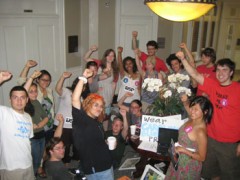
uncsitinI’m still looking for more news on the windup and aftermath of the campus occupation that ended yesterday at the University of California at Santa Cruz, but in the meantime I want to clear something up.

In an article published yesterday in City on a Hill Press, a UCSC student newspaper, one of the students sitting in at the Graduate Commons building said that UCSC had just “broken a record for longest student occupation of a building to take place in America post-1960s.”  A couple of days ago, an occupation spokesperson made a slightly less extravagant version of the claim, saying that the Commons sit-in was “one of the longest student occupations in many, many years.”

So is it true? Was the UCSC occupation the longest campus building takeover since the heyday of student activism in the sixties?

Well, no. Here are five that were longer, one of which — the UNC sweatshop sit-in pictured above — happened just a year and a half ago:

  1. At Harvard in 2001, a sit-in demanding that university employees be paid a living wage lasted for three weeks.
  2. Another living wage sit-in, this one at Washington University in 2005, lasted for eighteen days.
  3. In May of last year, students protesting the University of North Carolina’s ties to sweatshop garment makers occupied the lobby of their administration building for sixteen days.
  4. In 1989, students occupied the administration building at Wayne State University for either eleven or twelve days in response to racist incidents on campus.
  5. The Afrikan Student Union at Ohio State University occupied the offices of the campus president for eight days in 1998 in protest of proposed changes in the Office of Minority Affairs.

Claims that a certain protest was the biggest, or longest, or most dramatic, since the sixties are common, and almost always wrong. They’re common because we think of the sixties as being the last time there was a real student movement in the United States, and they’re wrong because their conception of the history of American student activism is wrong.

I knew about a couple of the campus protests listed above before I sat down to write this post, but most of them I uncovered by Googling. They don’t add up to anything like a comprehensive list of the last few decades’ multi-week campus sit-ins. They represent a small slice of a story that’s mostly gone untold in recent years — the story of American students’ persistent ongoing local campus organizing. I mention them not to mock the UCSC folks or belittle their protest, but because the more activists know about past struggles, the better equipped they’ll be to take on the future.

Right about the time that I was posting yesterday’s piece on the UC Santa Cruz commons building occupation, that sit-in was coming to a voluntary end.

So far there’s been no statement on the end of the occupation by the students who took over the building, and no reporting on the development from UC Santa Cruz’s student newspaper or Santa Cruz Indymedia, but an article in a local paper suggests that the decision to leave came at the request of the graduate student organization that owns the building.

Thanks to @dettman on Twitter for passing on the news late last night.

October 16 update | Another building occupation began last night at UCSC.

I’m in the middle of an incredibly busy stretch, but I don’t want to let the one-week anniversary of UCSC’s current situation go by without marking the occasion.

Last Thursday, on the first day of classes for most of the University of California, UCSC’s students joined those at the system’s other nine campuses in staging a walkout and rally in protest of moves to defund the University and raise new barriers to financial accessibility. Unlike the activists at the other nine campuses, the UCSC crowd took over a building and held it … and that occupation is still going on today.

There’s a lot to be said about the UCSC action, which is in some ways modeled on a pattern set at colleges in New York City and Britain last year, but my own thoughts will have to wait. In the meantime, here are some links:

  • The occupation’s website, and that site’s news page.
  • A statement from the occupiers about why they chose the building they’re occupying.
  • The Santa Cruz Indymedia site.
  • Two flyers from the occupation.
  • An interview with one of the occupiers.

October 16 update | The occupation discussed in this post ended two weeks ago, but another takeover began last night at UCSC.

Evening update: Pitt’s chapter of the ACLU is co-sponsoring an Oakland Unites for First Amendment Rights rally on campus tomorrow at 5:30 pm. A four-point petition will be circulating at the rally — we’ll post the text as soon as we get it.

Last week’s G-20 meeting of the leaders of the world’s 20 largest economies drew massive protests in and around the University of Pittsburgh, and now police and campus administrators are facing heavy criticism for their handling of the incidents.

Over the course of the two-day meeting, police used sonic cannons, tear gas, pepper spray, bean-bag projectiles, smoke canisters, stun grenades, and rubber bullets on demonstrators, making hundreds of arrests. Innocent students, including some student journalists, were caught up in police sweeps on the Pitt campus.

Police arrested nearly two hundred people during the course of the G-20 demonstrations, including more than fifty students. The Allegheny County district attorney has already announced that charges against four students will be dropped, and more dismissals are expected.

Update: In a reversal of a policy announced yesterday, Pitt will allow students seeking dismissal of charges to bring attorneys to their meetings with campus police officials. The university has also confirmed that no campus judicial proceedings will be brought against students whose criminal charges are dismissed.

Dozens of videos from the protests have surfaced online, ranging from the hilarious (three burly cops in face masks attempt to pass as protesters, and failing spectacularly) to the chilling (students trapped on a stairway between two sets of cops, each trying to force them to go the other way).

Two student journalists for the Pitt News were arrested while covering the Friday night protests, and eight more were tear gassed, pepper sprayed, or maced. Stories have also emerged of students being locked out of their dorms, then arrested for failing to return to their rooms.

One student has posted a lengthy account online of how she was arrested for “failing to disperse” while helping students to disperse by holding open the locked doors of one dorm building. She describes students being arrested as they entered the dorms, and other reports suggest that students were arrested while waiting in line at local restaurants, or studying in the campus library.

Violations of students’ rights on campus were not limited to arrests. One video posted online shows police lobbing a tear gas canister onto the balcony of a dorm from which a group of students were quietly watching the protest in the street below. (The canister is thrown just after the two-minute mark in the video.)

The question of what limits should have been set on the actions of municipal police on the Pitt campus is being raised over and over again in the aftermath of the G-20, and evidence is emerging that it was a subject of dispute among police at the time. Police scanner recordings obtained by the Pitt News show that a high-ranking Pitt university police officer intervened personally on Friday night to prevent a non-university police “attack team” from storming the Towers, a campus dorm.

Adding to the confusion, and contributing to the police overreaction, is the fact that Pitt’s campus is an urban one, with no clear boundaries, and and the fact that thepolice were brought in for the G-20 protests from as far away as Tucson, Arizona. Many of the cops present were unfamiliar with the location.

Pitt’s university police have also been criticized, however. The university’s text message based Emergency Notification System was not used at all on Thursday, and only two messages were sent out on Friday — one encouraging them to “be careful” and “exercise good judgment,” and the other advising them to “remain near their residences.” As noted above, a number of students were ultimately arrested at or near their dorms that night.

Pressure on the police and the Pitt administration has been building since the meeting ended, with many claiming that, as one online petition puts it, “the right of citizens — students, professors, families, community members, and media — to assemble and gather peacefully in public was not only denied and violated but suppressed with unnecessary and excessive force.”

Note: Check out What Happened At Pitt?!?! for a huge collection of links and resources.

About This Blog

n7772graysmall
StudentActivism.net is the work of Angus Johnston, a historian and advocate of American student organizing.

To contact Angus, click here. For more about him, check out AngusJohnston.com.