Extraordinary. A victory on tuition at Cooper Union may be possible after all.

Today the Cooper Union board of trustees met for the first time after the college’s Working Group on tuition policy finished its deliberations. Though the trustees had previously approved a proposal to begin charging tuition for the first time in Cooper’s history, tonight they blinked.

In an announcement to the campus community released just moments ago, Richard Lincer, the chair of Cooper’s board of trustees, announced that the board needs more time to review the Working Group’s proposal to keep Cooper Union tuition free. In order “to give the proposals contained in the report the serious and rigorous review and analysis that they warrant,” Lincer said, the board will continue its study of the proposal over the course of the next month.

The board will meet again in mid-January, he said, “to discuss the findings and determine whether, in its assessment, the plan proposed by the Working Group in fact presents a sustainable alternative to tuition.”

This isn’t a win. Not yet. But it’s not a loss either. A win is still possible, and it looks a hell of a lot more possible than it did yesterday.

Meanwhile, the board also deferred action on its draconian new code of student conduct, saying that no decision will be made on that proposal until next semester.

According to today’s announcement, the Working Group report and a summary of today’s trustee meeting will be released on the Cooper Union website tomorrow. More soon.

Update | Newly installed Cooper Union alumni trustee Kevin Slavin posted a statement to Facebook a few hours ago in which he described the Working Group as “heroes.”

“Their hard work,” he continued, “has paid off with a viable plan. … It is painful, and it is risky. But so is tuition. … I was surprised (and pleased) to see and hear how much thought and consideration that went into it, and how much thought and consideration it generated.”

I’m going to have a followup post with more detail on Friday’s shooting death of Texas college student Cameron Redus soon, but before that I wanted to write briefly on a similar incident from last year in which another collegian was shot and killed by a campus police officer.

Fourteen months before Cameron Redus was shot down in his apartment parking lot, University of Southern Alabama first-year Gilbert Thomas Collar was killed by a campus police officer at his own college. Collar, who was naked in public at the time of the shooting, was reportedly acting erratically and aggressively, but he was unarmed. (A former high school wrestler, Collar was just five foot seven and 135 pounds.)

Collar’s mother, Bonnie Collar, said this about the shooting in an interview with CNN: “The first thing on my mind is, freshman kids do stupid things, and campus police should be equipped to handle activity like that without having to use lethal force.”

This is exactly right. Both Collar and Redus were unarmed when they were killed. There is no indication that either posed an imminent lethal threat to police or anyone else. Under those circumstances, the obligation of any police officer is to manage and contain the situation without an escalation of violence.

But as Bonnie Collar says, that obligation is particularly obvious when an officer is working on a college campus. Weird, inappropriate, even confusing behavior isn’t aberrant in the campus setting, and boundary-testing is an inherent part of the student experience.

A campus police officer who lacks the capacity to peacefully resolve a situation like the Collar and Redus incidents should not be carrying a gun. Period.

This story stinks.

At about 2 am on Friday Chris Carter, a campus police officer from the University of the Incarnate Word in San Antonio, noticed a student, Robert Cameron Redus, driving erratically near campus. Apparently Redus didn’t stop his car immediately when Carter turned on his lights, instead driving into the parking lot of his building.

There was a disagreement during the stop, and then apparently some sort of struggle. According to a witness, the officer told the student that he was going to shoot, and the Redus responded by asking sarcastically, “Oh, you’re gonna shoot me?”

The officer did, firing four to six times. Redus died at the scene.

There’s a lot still unknown about the incident. But based on the facts available now, it’s a very strange story.

First, there’s the fact that a campus safety officer at a private Catholic college was carrying a gun on routine duty. I’ll admit that I didn’t know that was a thing.

Second, there’s the location of the initial incident — more than half a mile from the college. Since when do campus police make traffic stops at off-campus locations?

Third, there’s the officer’s record — nine jobs at eight different police agencies in eight years.

And then, of course, there’s the incident itself. A student is driving erratically. He doesn’t stop when told to. The cop, who has a checkered record, confronts him, threatens to shoot him. The student gives him attitude. Seconds later, he’s dead.

Maybe there’s a good explanation for all of it. But right now?

This story stinks.

Update | I haven’t found more recent data yet, but as of 2005 only 27% of American private colleges and universities of the size of the University of the Incarnate Word had armed campus police.

Second Update | UIW’s official statement on the shooting refers to Cameron Redus as “the suspect” and praises the officer’s “extensive law-enforcement background.”

Morning Update | Cameron Redus’s family has hired a lawyer.

The praise Nelson Mandela has received since his passing yesterday has been extravagant, well-deserved, and nearly universal. From every corner of the globe, Mandela has been lauded as a world leader without parallel in our era.

Praise for Mandela has been effusive even from many who had little use for him during the apartheid era. Conservative politicians from parties that spurned his struggle for national liberation while it was ongoing have been elbowing each other out of the way to memorialize him now.

This phenomenon has been particularly pronounced — and particularly jarring — at the website of the American conservative magazine National Review. Their outpouring of affection has shocked and dismayed many of the site’s regular readers, who have flooded the posts’ comments sections with expressions of outrage, many of them appallingly ugly, and the naked racism on display there has attracted a lot of attention around the ‘net.

More interesting to me, though, has been the way the writers at NR have dealt with the chasm between their present and past views. The editors’ unsigned editorial chose to avoid the topic entirely, instead tempering their praise for Mandela with criticism of some of his views, while the authors of each of the site’s two signed pieces wrote that their error in judging Mandela had been one of believing he was more of a leftist than he turned out to be. I’m not in a position to judge either of these writers’ sincerity, but the site’s collective representation of its, and the conservative movement’s, history with apartheid is dishonest.

William F. Buckley was the founder of National Review, and America’s leading conservative intellectual for much of the second half of the 20th century. He was also an explicit supporter of white supremacy — throughout the 1950s and 1960s he scoffed at the idea that either black Africans or black Americans were capable of self-governance.

As the years passed Buckley’s public views on the civil rights movement in the United States became more moderated, but his antipathy to popular democracy in Africa remained a constant. Here he is in a 1986 op-ed, writing just four years before Mandela was released from prison — at a time when the South African government had already begun the secret negotiations that would lead to an orderly transition to majority rule in that country:

“Western democratic fundamentalism has made things especially hard in South Africa for one simple reason, and that is that Western opinion has consolidated around the position that unless every black in South Africa over the age of 18 is given the vote, there is still injustice in the land.

“The government will not … grant political equality to everyone in South Africa. Nor should it. It is preposterous at one and the same time to remark the widespread illiteracy in South Africa and to demand the universal franchise.

“Continue our moral pressure, by all means. But … pull back on the one-man, one vote business.”

The open racism on display here is startling, of course. But so is the blatant antipathy to democracy itself. An insistence on the rightness of popular self-determination is, in Buckley’s eyes, a form of “fundamentalism” — if the black majority in South Africa, after generations of white minority suppression, is not prepared to exercise the franchise in the way, and with the results, that Buckley prefers, then it is entirely right and popular for that white minority to deny them the vote indefinitely.

A lot has been said in the last 24 hours about the impulse to water down Mandela’s fierce commitments and challenging beliefs, to canonize a pastel caricature instead of grappling with the man he was and the true fight he fought. But we should be just as wary about revising the history of his antagonists, of pretending that the only racists in power who were fighting to keep him and his people imprisoned were those who ruled his nation.

Not thirty years ago one of America’s most prominent conservatives offered the opinion, unsolicited, that black South Africans would not, could not, and should not govern themselves.

That shouldn’t be forgotten.

Both the City University of New York and Cooper Union are currently considering sweeping changes to their codes of student conduct, changes which — if recently circulated drafts are implemented — would dramatically curtail students’ expressive rights at those institutions.

Actually, that’s not quite right. Yes, changes to student conduct rules are being contemplated at the two universities, and yes, the changes under consideration would curtail students’ freedom to speak, organize, and agitate, but it’s not CUNY and Cooper as institutions that are contemplating the changes. It’s their trustees.

1479586_10201575413040971_428725376_nThis distinction is relevant for two reasons. First, because many students and faculty at both Cooper and CUNY have spoken out against the proposals, and if shared governance were more robust at either institution the discussions would be proceeding in a very different way. And second because the idea of non-students establishing and enforcing conduct rules for students was once much more controversial than it is now.

There are still some campuses in the United States at which some student disciplinary charges are considered by student judiciaries of one kind or another, and some where students have a say in what the disciplinary rules of the campus will be, but such bodies are uncommon and usually quite circumscribed in their ability to act freely.

It wasn’t always that way.

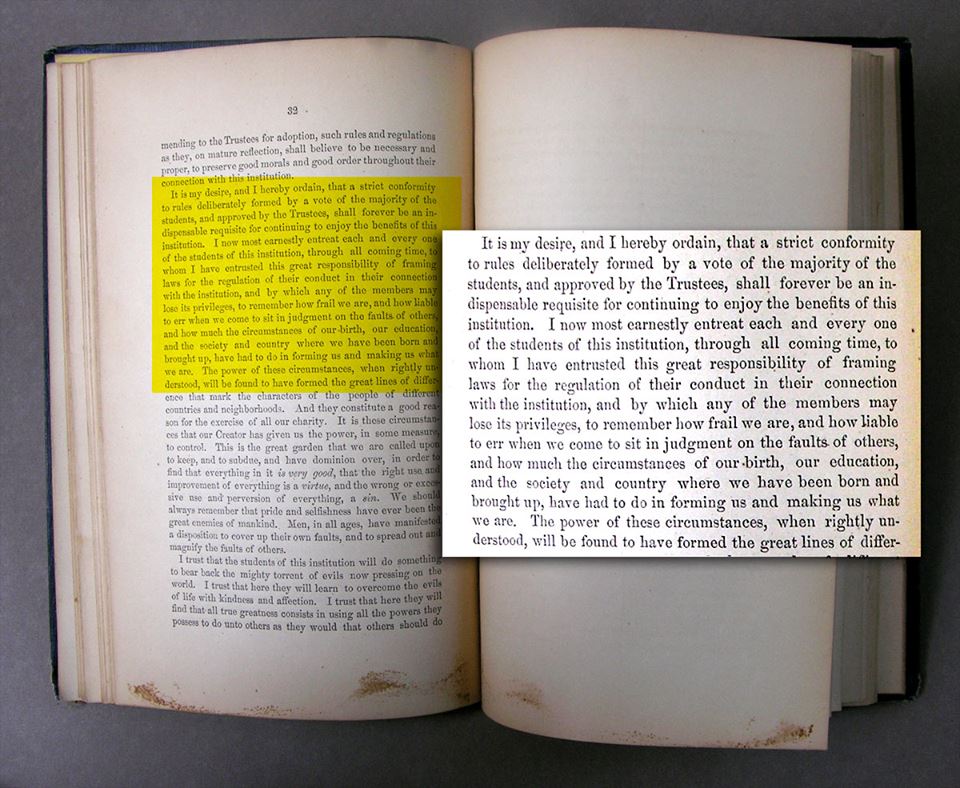
Take a look, for instance, at this quote from Peter Cooper, founder of Cooper Union, excerpted from a letter that he wrote to the college’s trustees in 1859:

“Desiring, as I do, that the students of this institution may become pre-eminent examples in the practice of all the virtues, I have determined to give them an opportunity to distinguish themselves for their good judgment by annually recommending to the Trustees for adoption, such rules and regulations as they, on mature reflection, shall believe to be necessary and proper, to preserve good morals and good order throughout their connection with this institution.

“It is my desire, and I hereby ordain, that a strict conformity to rules deliberately formed by a vote of the majority of the students, and approved by the Trustees, shall forever be an indispensable requisite for continuing to enjoy the benefits of this institution. I now most earnestly entreat each and every one of the students of this institution, through all coming time, to whom I have entrusted this great responsibility of framing laws for the regulation of their conduct in their connection with the institution, and by which any of the members may lose its privileges, to remember how frail we are, and how liable to err when we come to sit in judgment on the faults of others, and how much the circumstances of our birth, our education, and the society and country where we have been born and brought up, have had to do in forming us and making us what we are. The power of these circumstances, when rightly understood, will be found to have formed the great lines of difference that mark the characters of the people of different countries and neighborhoods. And they constitute a good reason for the exercise of all our charity. …

“I trust that the students of this institution will do something to bear back the mighty torrent of evils now pressing on the world. I trust that here they will learn to overcome the evils of life with kindness and affection. I trust that here they will find that all true greatness consists in using all the powers they possess to do unto others as they would that others should do unto them; and in this way to become really great by becoming the servant of all.”

Peter Cooper envisioned a college in which students would establish their own rules of conduct, a college in which the trustees would merely certify the students’ decisions. The students would review and update those regulations annually, and they would — Cooper hoped — do so in a spirit of generosity and forbearance.

It’s a long way from Peter Cooper’s vision to the university administration’s decision this summer to send armed guards to a peaceful campus demonstration.

______

The graphic that accompanies this post is an image of a printed version of the Peter Cooper passage quoted above. It was sent to me by Cooper alumna Carol Wolf, who took the photo.

About This Blog

n7772graysmall
StudentActivism.net is the work of Angus Johnston, a historian and advocate of American student organizing.

To contact Angus, click here. For more about him, check out AngusJohnston.com.
