
You are currently browsing Angus Johnston’s articles.
Posting will be light from now until Sunday, as I’m taking the opportunity presented by these next few slow news days to get some cool new site features up and running. But I’ll be here all weekend, and I’ve got some writing and links in the works, so don’t go far.
If there’s something going on that I should know about, either now or planned for next week, please feel free to leave a mention of it in comments to this post.
Last night students at UC Davis went back to Mrak Hall, where 52 people were arrested last Thursday, and launched the week’s eighth UC building occupation.
This takeover was shorter than several of its predecessors, but dramatic — it was the first in this wave of occupations to end with a written commitment by the administration to honor a set of protest demands.
The students began the occupation with a lengthy list of demands, but negotiated a suspension of the occupation on the basis of five: the university committed to conducting a review of one previous campus arrest, to urging the district attorney to “strongly consider … not filing charges” against the 52 Thursday arrestees, to dropping any disciplinary action against those students, to pursuing “further discussion” about co-op housing on campus based on “a mutual desire to promote sustainable, affordable cooperative living facilities,” and to holding “further discussions on all other demands with a representative group, as early as Monday, November 30.”
There’s nothing earth-shattering here, of course, but it’s still significant in at least three ways.
First, it gives students throughout the UC system a precedent for negotiated settlement of an occupation. There has been some resistance to that approach from both sides in the last week — from students who conducted “demandless” occupations, and from administrators who refused to enter into dialogue. Last night’s agreement affirms that negotiation is a live option in this series of actions.
Second, it provides a template for such negotiations. The Davis administration’s biggest concession was its agreement to forego disciplinary action against the Thursday demonstrators (and, implicitly, against last night’s demonstrators as well). That concession sets up amnesty as an achievable demand in future occupations.
Third, it opens up ongoing negotiations on local campus issues. A single university’s administrators have no direct power to roll back fees or reform the UC board of regents — such demands are aimed at off campus targets, and winning full victories on them is not a project for a single day. But local concessions can be won in a single action, and ongoing negotiations are a mechanism for refining and sharpening such demands to the point that more substantive victories become more likely.
In the NYU and New School occupations of 2008-09, those universities’ administrations shifted away from negotiation and toward punitive legal action as the students’ campaigns developed. The resolution of yesterday’s Mrak Hall occupation is the strongest evidence yet that the University of California is now moving in the opposite direction.
Update | Here is the UC Davis administration’s official statement on the occupation. Note that it describes the takeover as beginning with a study-in at eight o’clock yesterday morning, that it says that 150 demonstrators were present in Mrak at the end of the night, and that it strikes a conciliatory, respectful tone throughout. Note also that it binds the university to a new commitment beyond the five agreed to last night — the presence of Davis Chancellor Linda Katehi at a meeting with students next Monday.
Second Update | Commenter Cynthia D. notes that the Monday student meeting with the chancellor is actually a long-planned, regularly scheduled event. She also has a perspective on the administration’s behavior during the occupation that’s worth reading, so click through and read it.
Third Update | The Yolo County District Attorney announced on Friday that charges against 51 of the 52 Mrak Hall demonstrators have been dropped, with the only exception being the student charged with assault and resisting arrest. This is obviously a further victory for the second occupation.
Fourth Update | The third update above, based on a report from a local news station’s website, is inaccurate. Charges against the Mrak 51 have not been dropped, they’ve just been set aside, and they can be re-instated at any time in the next year.
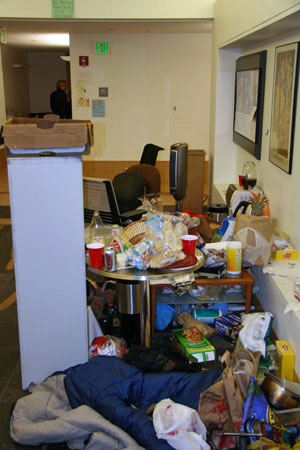 The occupiers of UCSC’s Kerr Hall were barely out of the building Sunday morning when the Santa Cruz administration launched a line of attack that’ll be familiar to observers of last year’s NYU and New School occupations: they said the students trashed the place.
On Sunday, a university spokesman claimed that the occupiers had done thousands of dollars in damage, and those costs, he said, would require the university to divert money “from budgets already strained by budget cuts.”
On Monday, administrators upped the ante. The students had done more than fifty thousand dollars of damage to the building, they said, not including labor costs for cleanup. They posted photos of the mess on the university’s website, and said that some items appeared to have been stolen.
On Tuesday activist Brian Malone posted an open letter in response to the administration’s claims. He said that most of the photos showed “little more than some leftover food and a bunch of paper products in need of recycling,” and that the rest — an overturned refrigerator, some teleconference equipment dumped on the floor, a broken table — would be easily easily fixed or replaced.
Now, I don’t doubt that UCSC is exaggerating its damage estimates. They have no reason to lowball their figures, and every reason to inflate them. As to whether the telecom equipment was “ripped out,” as UCSC claims, or “disconnected,” as Malone suggests, I can’t say either way. The occupiers apparently did use furniture and equipment as material for their barricades, so I expect there was some damage done there.
But I’m not interested in second-guessing strategies or tactics. That’s a big question, and it’s a question for another post. What I do want to offer is one small, simple piece of advice.
If you’re in a long-term occupation, clean up after yourself.
Malone says that tidying up the garbage the Kerr Hall occupiers left behind “would take a small crew no more than one or two hours.” But there were seventy students in that building for three days, and they knew that the cops could bust in at any time. There’s no reason why they couldn’t have been cleaning things up as they went.
A couple of weeks ago, I spoke to one of the students who occupied the school of the humanities and fine arts at the University of Zagreb for thirty-five days this spring. He said that the students in that occupation prided themselves on keeping the place sparkling — they swept and mopped every morning, broken equipment was repaired, replaced, or put in storage, and every occupier was expected to clean up his or her messes as he or she created them. Their occupation was based on the premise that this was the students’ university, he said, and they wanted to show the media and the community that they cared for that university enough to keep it clean, organized, and in working order.
Any time you’re occupying university space, you’re at risk of being evicted or arrested on a moment’s notice. If you’re dumped out and you’ve left the place a mess, you can expect that the administration will carefully photograph every tipped-over Solo cup and crumpled bread wrapper, and post the photos on the net. That’s their job, and that’s what they’re going to do. You can choose to give them that ammunition, or you can choose not to.
Choose not to.
Tomorrow is the one-week anniversary of the first University of California protests (and arrests) against the regents’ decision to impose huge new fees on the students of the system, and UC’s activists show no signs of letting up.
Today saw a rally and march on the main administration building at UC Irvine, and the first arrest of the week at that campus. It also saw a candlelight vigil — still ongoing — at UC Berkeley, in the wake of the news that the university will be investigating charges of excessive police force at protests there last week.
And at UC Davis, where 52 protesters were arrested in an occupation of administration building Mrak Hall last Thursday, students are hunkering down for the night at Mrak again. The Davis activists’ blog reports that between sixty and seventy students are in Mrak now, and they’ve “made a commitment to stay the night.” They’re dancing, they’ve ordered pizza, and they’re settling in to chat about demands.
8:10 pm | Liveblogging of the Mrak Hall occupation is here.
9:45 pm | A Twitterer on the scene says negotiations are happening at Mrak.
9:50 pm | The student newspaper’s Twitter feed says the occupiers have three demands: An apology for police violence on Thursday, action to save student co-ops, and amnesty for Thursday’s arrestees. They say they’re staying until at least two of the three demands are met. Another Twitterer says the cops are refusing to negotiate, but allowing occupiers to leave without arrest if they leave now.
10:20 pm | Via the student newspaper’s Twitter feed (@CaliforniaAggie), the administration is making a new offer: “Police will review alleged violence, even without formal complaint; students won’t be punished by school and admins will ask DA for leniency for those arrested Thurs.; and admins will meet with a representative group about student co-op closure. Protestors say this is not enough. They demand full amnesty for those arrested and a full apology for alleged police violence.”
11:15 pm | There has been a negotiated settlement of the occupation, and the students have left Mrak Hall. More in the morning.
Wednesday | Here’s my follow-up post on what the university agreed to last night, and why this occupation is a milestone in the UC student movement.
This post is a way for me to keep track of the arrests in the current wave of student protest at the University of California — for my own reference and for others’.
As of the morning of December 12, there have been 220 arrests in just 23 days. Students have occupied buildings at six California campuses in that time.
Wednesday, November 18
14 at UCLA: twelve students, two non-students, all arrested for refusing to leave the regents meeting.
52 at Davis: one for assault and resisting arrest, 51 for trespass. Fifty-one students, one professor.
2 at UCLA: UCLA website mentions just one, a student arrested for obstructing an officer.
Friday, November 20
44 at Berkeley: three arrested in the morning for burglary, 41 in the evening for trespassing.
Monday, November 24
1 at Irvine: a student arrested for attempted vandalism and resisting arrest. (As a commenter notes, the “attempted vandalism” charge was apparently based on the student banging on a closed door.)
Thursday, December 10
33 at SFSU: Police broke up an occupation on the San Francisco State University campus, arresting 23 inside and ten outside the building.
Friday, December 11
66 at Berkeley: UC police raided the peaceful open occupation of Berkeley’s Wheeler Hall shortly before five o’clock in the morning, arresting 66 people, more than 40 of them Berkeley students. The occupation had been going on for four days, and was scheduled to end voluntarily approximately 24 hours later.
8 more at Berkeley: Eight people, including two UC Berkeley students and two UC Davis students, were arrested near the university chancellor’s home on Friday night, accused of vandalizing the residence and attacking police.
Update: A commenter reminds me that there was an arrest at UC Santa Cruz more than a month before the earliest one listed here.

 studentactivism.net
Recent Comments