
You are currently browsing the category archive for the ‘Campus Protests’ category.
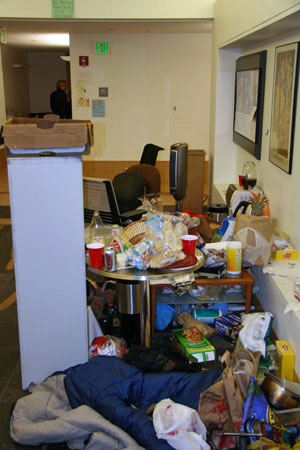 The occupiers of UCSC’s Kerr Hall were barely out of the building Sunday morning when the Santa Cruz administration launched a line of attack that’ll be familiar to observers of last year’s NYU and New School occupations: they said the students trashed the place.
On Sunday, a university spokesman claimed that the occupiers had done thousands of dollars in damage, and those costs, he said, would require the university to divert money “from budgets already strained by budget cuts.”
On Monday, administrators upped the ante. The students had done more than fifty thousand dollars of damage to the building, they said, not including labor costs for cleanup. They posted photos of the mess on the university’s website, and said that some items appeared to have been stolen.
On Tuesday activist Brian Malone posted an open letter in response to the administration’s claims. He said that most of the photos showed “little more than some leftover food and a bunch of paper products in need of recycling,” and that the rest — an overturned refrigerator, some teleconference equipment dumped on the floor, a broken table — would be easily easily fixed or replaced.
Now, I don’t doubt that UCSC is exaggerating its damage estimates. They have no reason to lowball their figures, and every reason to inflate them. As to whether the telecom equipment was “ripped out,” as UCSC claims, or “disconnected,” as Malone suggests, I can’t say either way. The occupiers apparently did use furniture and equipment as material for their barricades, so I expect there was some damage done there.
But I’m not interested in second-guessing strategies or tactics. That’s a big question, and it’s a question for another post. What I do want to offer is one small, simple piece of advice.
If you’re in a long-term occupation, clean up after yourself.
Malone says that tidying up the garbage the Kerr Hall occupiers left behind “would take a small crew no more than one or two hours.” But there were seventy students in that building for three days, and they knew that the cops could bust in at any time. There’s no reason why they couldn’t have been cleaning things up as they went.
A couple of weeks ago, I spoke to one of the students who occupied the school of the humanities and fine arts at the University of Zagreb for thirty-five days this spring. He said that the students in that occupation prided themselves on keeping the place sparkling — they swept and mopped every morning, broken equipment was repaired, replaced, or put in storage, and every occupier was expected to clean up his or her messes as he or she created them. Their occupation was based on the premise that this was the students’ university, he said, and they wanted to show the media and the community that they cared for that university enough to keep it clean, organized, and in working order.
Any time you’re occupying university space, you’re at risk of being evicted or arrested on a moment’s notice. If you’re dumped out and you’ve left the place a mess, you can expect that the administration will carefully photograph every tipped-over Solo cup and crumpled bread wrapper, and post the photos on the net. That’s their job, and that’s what they’re going to do. You can choose to give them that ammunition, or you can choose not to.
Choose not to.
Tomorrow is the one-week anniversary of the first University of California protests (and arrests) against the regents’ decision to impose huge new fees on the students of the system, and UC’s activists show no signs of letting up.
Today saw a rally and march on the main administration building at UC Irvine, and the first arrest of the week at that campus. It also saw a candlelight vigil — still ongoing — at UC Berkeley, in the wake of the news that the university will be investigating charges of excessive police force at protests there last week.
And at UC Davis, where 52 protesters were arrested in an occupation of administration building Mrak Hall last Thursday, students are hunkering down for the night at Mrak again. The Davis activists’ blog reports that between sixty and seventy students are in Mrak now, and they’ve “made a commitment to stay the night.” They’re dancing, they’ve ordered pizza, and they’re settling in to chat about demands.
8:10 pm | Liveblogging of the Mrak Hall occupation is here.
9:45 pm | A Twitterer on the scene says negotiations are happening at Mrak.
9:50 pm | The student newspaper’s Twitter feed says the occupiers have three demands: An apology for police violence on Thursday, action to save student co-ops, and amnesty for Thursday’s arrestees. They say they’re staying until at least two of the three demands are met. Another Twitterer says the cops are refusing to negotiate, but allowing occupiers to leave without arrest if they leave now.
10:20 pm | Via the student newspaper’s Twitter feed (@CaliforniaAggie), the administration is making a new offer: “Police will review alleged violence, even without formal complaint; students won’t be punished by school and admins will ask DA for leniency for those arrested Thurs.; and admins will meet with a representative group about student co-op closure. Protestors say this is not enough. They demand full amnesty for those arrested and a full apology for alleged police violence.”
11:15 pm | There has been a negotiated settlement of the occupation, and the students have left Mrak Hall. More in the morning.
Wednesday | Here’s my follow-up post on what the university agreed to last night, and why this occupation is a milestone in the UC student movement.
This post is a way for me to keep track of the arrests in the current wave of student protest at the University of California — for my own reference and for others’.
As of the morning of December 12, there have been 220 arrests in just 23 days. Students have occupied buildings at six California campuses in that time.
Wednesday, November 18
14 at UCLA: twelve students, two non-students, all arrested for refusing to leave the regents meeting.
52 at Davis: one for assault and resisting arrest, 51 for trespass. Fifty-one students, one professor.
2 at UCLA: UCLA website mentions just one, a student arrested for obstructing an officer.
Friday, November 20
44 at Berkeley: three arrested in the morning for burglary, 41 in the evening for trespassing.
Monday, November 24
1 at Irvine: a student arrested for attempted vandalism and resisting arrest. (As a commenter notes, the “attempted vandalism” charge was apparently based on the student banging on a closed door.)
Thursday, December 10
33 at SFSU: Police broke up an occupation on the San Francisco State University campus, arresting 23 inside and ten outside the building.
Friday, December 11
66 at Berkeley: UC police raided the peaceful open occupation of Berkeley’s Wheeler Hall shortly before five o’clock in the morning, arresting 66 people, more than 40 of them Berkeley students. The occupation had been going on for four days, and was scheduled to end voluntarily approximately 24 hours later.
8 more at Berkeley: Eight people, including two UC Berkeley students and two UC Davis students, were arrested near the university chancellor’s home on Friday night, accused of vandalizing the residence and attacking police.
Update: A commenter reminds me that there was an arrest at UC Santa Cruz more than a month before the earliest one listed here.
In the spring of this year a wave of campus occupations swept Croatia, beginning with the takeover of the school of humanities and social sciences at the University of Zagreb on April 20. The protesters demanded free and universally available higher education, and by the end of their campaign all or part of twenty universities in eight Croatian cities had been occupied.
I had a chance to talk to some of the leaders of the Croatian occupations when I was in Zagreb earlier this month, and those conversations (and others I had there) were a real crash course in the student movements that have swept Europe this year. Much of what I learned is highly relevant to the American situation, particularly now that campus occupations are becoming a regular occurrence here.
The U of Zagreb occupation lasted for thirty-five days this spring. It took place not behind barricades but in a freely accessible building, with democratic governance meetings open to all, regular teach-ins and seminars — even a daily morning yoga session.
Today at a noon mass gathering, or plenum, Zagreb’s student activists voted to take up their occupation again. Occupations are also underway at the Universities of Pula and Rijeka, with a meeting scheduled for tomorrow at Split to consider similar action.
There hasn’t been much coverage of the current European wave of student protest in the United States, and what there has been has often been fragmented and decontextualized. I’m going to make an effort to overcome those problems in the coming days, using Croatia’s occupations — those of this spring and those going on now — as a case study and a starting point for broader discussion. Stay tuned!
The web journal Inside Higher Ed is a go-to source for anyone interested in the American university. Founded in 2004 as a competitor to the well-regarded but stodgy Chronicle of Higher Education, IHE is an indespensible daily guide to the nation’s campuses.
So why isn’t it covering the biggest student story of the year?
We’re now five days into the wave of student protest that has engulfed California since the UC regents approved huge fee increases for their system’s students. Since then thousands have demonstrated on campuses across the state, often clashing with police. Six university buildings at five universities have been occupied. More than a hundred students have been arrested. And IHE has given the story a total of four words.
“As students protested outside, the University of California’s Board of Regents on Thursday reluctantly approved a 32 percent increase in ‘fees’ …” That’s how the IHE opened a one-paragraph piece on the fee increases in its “Quick Takes” section on Friday. That one clause, “as students protested outside,” was the only mention of student organizing in the piece, and the IHE has yet to return to the topic.
At the time the IHE put up that story, students had taken over four UC buildings in response to the fee hikes. Three of those occupations were still ongoing as of Friday morning, and the fourth had ended with mass arrests. Fourteen students had been arrested within the regents meeting itself, and several — despite UCLA’s initial denials — had been Tasered by campus police during the demonstrations that accompanied it. After the meeting, students blockaded the building in which it had been held, blocking the regents’ exit and at one point compelling them to abandon the van in which they were attempting to leave campus.
Since Friday morning, IHE has covered a lawsuit filed by a woman who was fired by the University of Nebraska when they learned she was a witch. It has published a lengthy piece on academic plagiarism. It has written about a physical fitness requirement for obese students at Lincoln University and an athletics director who quit after applying for reimbursement for expenses relating to an extramarital affair. It has run two stories on tax issues.
But on the largest student uprising in recent American history? Nothing so far.
Now, granted, it’s Sunday, and IHE generally doesn’t publish on the weekends. Only one of the stories I list above went up yesterday, and that one was a blog post. But as I say, this was a huge story by Friday morning, and it only got bigger as that day went on.
I’ll be eager to see what they have on it tomorrow.
Monday morning update | Well, it’s tomorrow, and IHE has a 108-word “Quick Takes” story up reporting on Friday’s events at three universities.
The piece makes no mention of the 52 arrests at UC Davis on Thursday, and declares that UCSC’s Kerr Hall “remains occupied,” even though that occupation ended on Sunday morning. Meanwhile, the journal finds room for 645 words on the end of football at Northeastern.

 studentactivism.net
Recent Comments