
Reports from the field are still scattered and incomplete, but it’s possible to start talking about how March 4 is shaping up.

Dozens of campuses are reporting rallies and actions, and dozens more have announced plans for forums, teach-ins, and other events. I’ve learned of a number of actions that weren’t on my national map as of last night, and there are surely more I haven’t heard about yet. This is big.

California is clearly leading the way, as it has since this movement began to bubble up last semester. The biggest, best-organized, and most dramatic actions reported so far are all happening in the Golden State.

In part that’s a reflection of the depth of the crisis facing California higher education right now, but it’s also a reflection of the head start that California’s campus organizers have compared to the rest of the country. Almost every campus reporting huge demonstrations today has seen multiple rallies and protests over the last few months. (The California schools that have not been active before today are generally reporting actions that resemble those taking place in the rest of the nation.)

This gap between the ten or fifteen most active California campuses and the hundred or so others taking part in today’s events suggests that for many activists today is a beginning rather than a culmination, and indeed students at more than a few campuses have portrayed today’s rallies as kickoff events for upcoming campaigns.

Students are looking to jump-start their local movements today, and with some traditionally quiet campuses reporting participation measuring in the hundreds of students, they may have done just that.

Last September’s co-ordinated protests at the ten campuses of the University of California system were followed by a statewide lull that lasted for several weeks — it was not until November that the state’s organizing began to pick up momentum. But I will be surprised if the aftermath of today’s protests follows a similar pattern.

Students from coast to coast are feeling their power today. They are envisioning themselves as part of a movement, many for the first time. The next few hours will no doubt be very interesting, but I expect that the days and weeks that follow will be too.

It’s almost noon in California, and closing in on mid-afternoon on the East Coast. I’ll be posting a review of the events of the first half of the day here … starting now.

University of California Santa Cruz | Students blocked both entrances to the campus to vehicular traffic early this morning, prompting the university to send out an alert urging staff and students to stay away. Administrators are passing along reports of intimidation and property damage by students, while students have claimed that two cars attempted to break through the throngs of protesters, injuring one.

Hunter College, New York City | Multiple accounts on Twitter suggest that hundreds of students have been rallying at Hunter College in Manhattan, and it’s been reported that one arrest has been made.

Sacramento, California | An estimated two thousand people are already gathered at the State Capitol building.

California, Statewide | Student demonstrators are entering classes to urge students to walk out at several campuses.

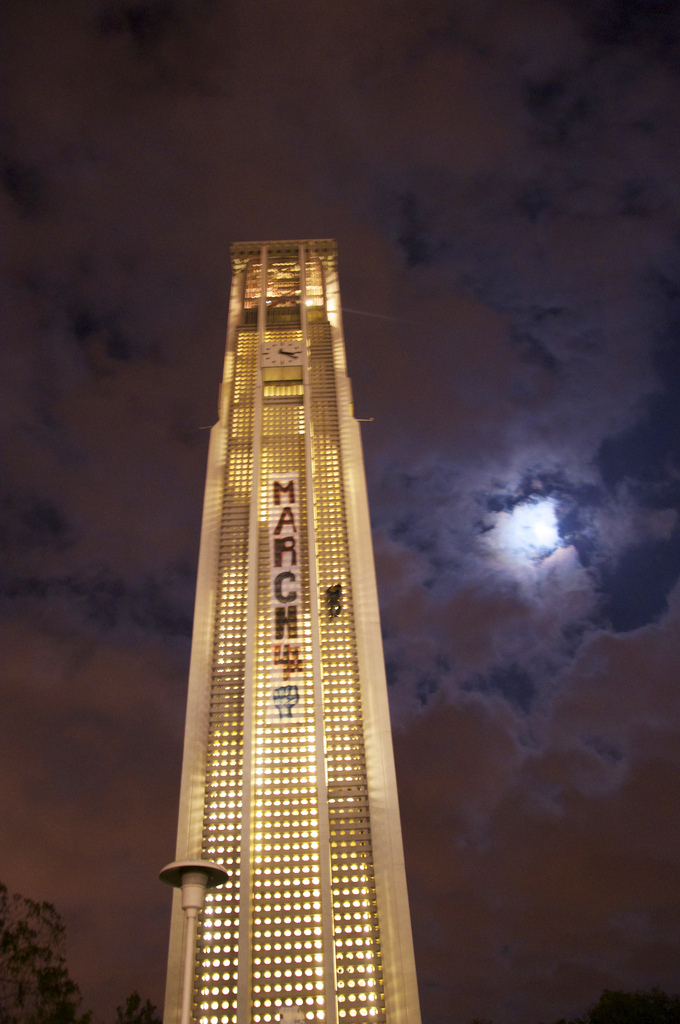
University of Maryland College Park | Students have hung a huge banner from a campus building reading “March Forth: Life Sucks, Let’s Change.”

I’m seeing reports on Twitter and elsewhere from dozens of different campuses across the country, but details are scarce for most of them — students are out marching, not home blogging, and the ones who are updating on Twitter are often posting short cryptic messages. I’m going to go gather some more info, and report back later.

That’s kind of what it sounds like.

A safety update posted at 7:00 am California time on the UCSC website says that “Due to potential safety concerns, people, including any employee scheduled for work, are advised not to come to the main campus. Check back for updated conditions.”

Earlier in the morning, student protesters closed both entrances to the UCSC campus to vehicular traffic. Occupy CA reported that as many as four people may have been hit by cars attempting to break through the human barriers at the campus entrances.

The UCSC website doesn’t mention that incident, but it does say that there was a report of a vehicle’s windshield being smashed in the vicinity. It does not present that account as confirmed, nor does it specify whether the vehicle was occupied at the time.

8:30 am California time | UC Santa Cruz sent out a “CruzAlert” message to all members of the campus community reading as follows: “Please avoid both campus entrances due to safety concerns. Check web or 459-INFO at noon for update.”

It sounds to me like they’re saying that anyone who is not already on campus should stay off campus until at least noon.

The Santa Cruz Sentinel has more on the morning’s events, though nothing (yet) on the advisory to remain off campus.

12:30 pm | UCSC is now advising “employees … not to come to the main campus for the duration of the day.” What’s odd, however, is what they’re not saying. They’re not saying classes are canceled, for instance.

It seems they’re trying to avoid saying that they’ve shut down the university for the day, but that’s pretty clearly what’s happened.

1:00 pm | The Santa Cruz Sentinel doesn’t share the university’s hesitance. Their headline? “Students Shut Down UCSC Campus.”

Trying to keep on top of the March 4 Day of Action? Here are a few resources that you’ll definitely find useful.

Student Sources

  • UC Regent Live(blog) will have a team of writers covering national events throughout the day.
  • The blog Occupy CA has been breaking stories about radical protest actions all year.
  • This site will of course be passing on everything we get.
  • Our national March 4 map includes links and contact information for many local actions.

Mainstream Media

  • CNN is covering the story here, and they’ve been updating their map of actions as events develop.
  • The Washington Post’s higher education section will be tracking the day’s news.
  • A Washington Post reporter has compiled a solid resource page.
  • Huffington Post’s new College site has been giving the buildup to March 4 a lot of attention. Expect more today.

Twitter

  • The standard hashtag for the day’s events is #March4.
  • We’ve created a Twitter list of folks who will be tweeting from today’s actions, and we’ll be adding feeds to it all day.
  • Where possible, we’re adding Twitter links to local actions on the national March 4 map.
  • And of course our own feed is @studentactivism.


About This Blog

n7772graysmall
StudentActivism.net is the work of Angus Johnston, a historian and advocate of American student organizing.

To contact Angus, click here. For more about him, check out AngusJohnston.com.