
You are currently browsing the category archive for the ‘Students’ category.
 I’m still looking for more news on the windup and aftermath of the campus occupation that ended yesterday at the University of California at Santa Cruz, but in the meantime I want to clear something up.
In an article published yesterday in City on a Hill Press, a UCSC student newspaper, one of the students sitting in at the Graduate Commons building said that UCSC had just “broken a record for longest student occupation of a building to take place in America post-1960s.” A couple of days ago, an occupation spokesperson made a slightly less extravagant version of the claim, saying that the Commons sit-in was “one of the longest student occupations in many, many years.”
So is it true? Was the UCSC occupation the longest campus building takeover since the heyday of student activism in the sixties?
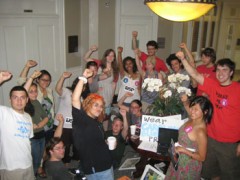
Well, no. Here are five that were longer, one of which — the UNC sweatshop sit-in pictured above — happened just a year and a half ago:
- At Harvard in 2001, a sit-in demanding that university employees be paid a living wage lasted for three weeks.
- Another living wage sit-in, this one at Washington University in 2005, lasted for eighteen days.
- In May of last year, students protesting the University of North Carolina’s ties to sweatshop garment makers occupied the lobby of their administration building for sixteen days.
- In 1989, students occupied the administration building at Wayne State University for either eleven or twelve days in response to racist incidents on campus.
- The Afrikan Student Union at Ohio State University occupied the offices of the campus president for eight days in 1998 in protest of proposed changes in the Office of Minority Affairs.
Claims that a certain protest was the biggest, or longest, or most dramatic, since the sixties are common, and almost always wrong. They’re common because we think of the sixties as being the last time there was a real student movement in the United States, and they’re wrong because their conception of the history of American student activism is wrong.
I knew about a couple of the campus protests listed above before I sat down to write this post, but most of them I uncovered by Googling. They don’t add up to anything like a comprehensive list of the last few decades’ multi-week campus sit-ins. They represent a small slice of a story that’s mostly gone untold in recent years — the story of American students’ persistent ongoing local campus organizing. I mention them not to mock the UCSC folks or belittle their protest, but because the more activists know about past struggles, the better equipped they’ll be to take on the future.
I’m in the middle of an incredibly busy stretch, but I don’t want to let the one-week anniversary of UCSC’s current situation go by without marking the occasion.
Last Thursday, on the first day of classes for most of the University of California, UCSC’s students joined those at the system’s other nine campuses in staging a walkout and rally in protest of moves to defund the University and raise new barriers to financial accessibility. Unlike the activists at the other nine campuses, the UCSC crowd took over a building and held it … and that occupation is still going on today.
There’s a lot to be said about the UCSC action, which is in some ways modeled on a pattern set at colleges in New York City and Britain last year, but my own thoughts will have to wait. In the meantime, here are some links:
- The occupation’s website, and that site’s news page.
- A statement from the occupiers about why they chose the building they’re occupying.
- The Santa Cruz Indymedia site.
- Two flyers from the occupation.
- An interview with one of the occupiers.
October 16 update | The occupation discussed in this post ended two weeks ago, but another takeover began last night at UCSC.
Students, faculty and staff of the University of California, facing an unprecedented assault on their system’s funding, will be walking out of classes tomorrow, September 24. I’ll be posting more about the walkout soon, and updating during the day tomorrow, but here’s a quick intro:
Last fall’s economic collapse hit American higher education hard, and as the new academic year gets underway its effects are being felt all over the country, but the California budget crisis is in a class by itself.
California’s initiative system, and a state law that bars the legislature from raising taxes without a two-thirds vote, make it almost impossible to fund ordinary expenses in a recession. The state is in a financial free-fall, and political leaders are looking to higher education for revenue.
In the face of this assault, top administrators at the University of California are rolling over.
Last week, UC official released a proposal that would increase the cost of attendance by 15% for the winter term and another 15% in the spring — coming on top of a 9.3% increase approved in May, this would bring in-state fees to more than $11,000 a year.
As UC Berkeley’s student government president has said, “not even during the depression of the 1930’s did student fees rise as suddenly and as much as they are now proposed to rise.” And the attack on higher education isn’t limited to fee increases. California politicians and UC administrators are laying off faculty and staff and cutting employees’ pay while reducing enrollment and increasing class sizes.
Tomorrow’s walkout began as a faculty initiative, and more than a thousand UC professors have signed on, but the protest has been picking up steam among students and non-teaching staff as well. The statewide University of California Student Association has unanimously passed a resolution of support for the walkout, there are two student websites up spreading the word, and folks are sharing news via the #UCWalkout hashtag on Twitter as well.
More to come…
I came across a blogpost this morning (via @HappyFeminist‘s Twitter feed) that asked what struck me as an interesting question, and I’d like to take a swing at answering it:
How do you teach feminism if you are not a feminist?
To answer this question, it seems to me, the first thing you need to do is to define your terms. If by “teaching feminism” you mean teaching about feminism as a movement, then you teach feminism the same way you teach Marxism, or existentialism, or surrealism — with as full and as sympathetic an understanding of the movement (and of its critics) as you can muster. If you’re going to talk about feminism in the classroom, you have an obligation to learn enough about it to talk about it intelligently, and that’s an obligation you have whether you’re a feminist or not.
In her post, Ashley says some teachers don’t teach feminism because they think they don’t know enough about it, or because they haven’t thought about teaching it, or because they don’t have time. She’s right, but those objections shift the topic a bit — from how you teach feminism to when.
So when should you teach feminism? When it’s part of the story you’re trying to tell, and when it’s part of the toolkit you’re trying to help your students assemble. More broadly, you teach about gender when it’s relevant … and when you’re talking about people, gender is almost always relevant.
You don’t need to “teach feminism” to talk about gender, of course, and you don’t need to teach from a feminist perspective to talk about gender. You do, though, need to have an understanding of how gender works. You need to have an analysis of gender, a perspective on gender. (More to the point, you need to have a considered perspective on gender, because by the time you can talk you have a perspective on gender, whether you realize it or not.) You need to know how you’re going to come at gender issues when they arise, you need to know why you’re taking the approach you’ve chosen, and you need to know how you’re going to work productively with students who are coming from a different perspective.
And of course that last paragraph applies as much to activists as it does to teachers.
(Last week, I started posting a weekend roundup of highlights from the @studentactivism Twitter feed. Here it is again.)
Links to this blog:
Students for a Democratic Society has relaunched its SDS News wiki. Great stuff: http://bit.ly/Y1zbm
Student protests in Allahahabad, India, entering their sixth day: http://bit.ly/pi4c9
Campus budgets are getting slashed coast to coast, and students are fighting back: http://bit.ly/1YxoTh
Chomsky on student activism in the 60s & today, & on high tuition’s role in suppressing protest: http://bit.ly/3BFxi
What John Brown taught me about privilege, whiteness, and anti-racism. http://bit.ly/AsIHi
#SAFRA means better student loans, financial aid, drug rules–but it still has to pass the Senate: http://bit.ly/1s7rIc
Students fight fees around the world! Reports from South Africa, Ireland, Cyprus, and Nepal: http://bit.ly/2v3i8c
Outside links:
RT @forstudentpower: Blagojevich gives a great example of why University Trustees should be popularly elected:http://bit.ly/zewZE
Student union suspended, leadership expelled, after anti-govt campus protest in Zambia: http://bit.ly/3duy7
Bizarre, unhinged National Review rant on student activism & campus culture: http://bit.ly/2FWikB
Harvard Med School has reversed new policy regulating students’ interaction with the media: http://bit.ly/t6st0
Canada: New province-wide student association looks to build student power in Saskatchewan. http://bit.ly/10VZFi
India: Campaign for students’ rights at Allahabad U goes national. http://bit.ly/19nHqX (Background here: bit.ly/pi4c9)
Race, frats, history, and the University of Alabama student government: http://bit.ly/3QLOe0
MUST READ — U of California students & profs will walk out Sept 24. Here’s why: http://bit.ly/LYrR7 (Via @kmmcbride)
Other stuff:
When MTV replays that Kanye moment, they should splice in a shot of Mike Myers looking uncomfortable. #vmas
This ACORN story is just so incredibly bizarre. Are we seeing the birth of Borat journalism?
I hate Illinois Nazis, but I always made an exception for Henry Gibson. RIP.
Whenever someone refers to something as “the last acceptable form of prejudice,” they’re full of crap. All kinds of prejudice still thrive.



Recent Comments